


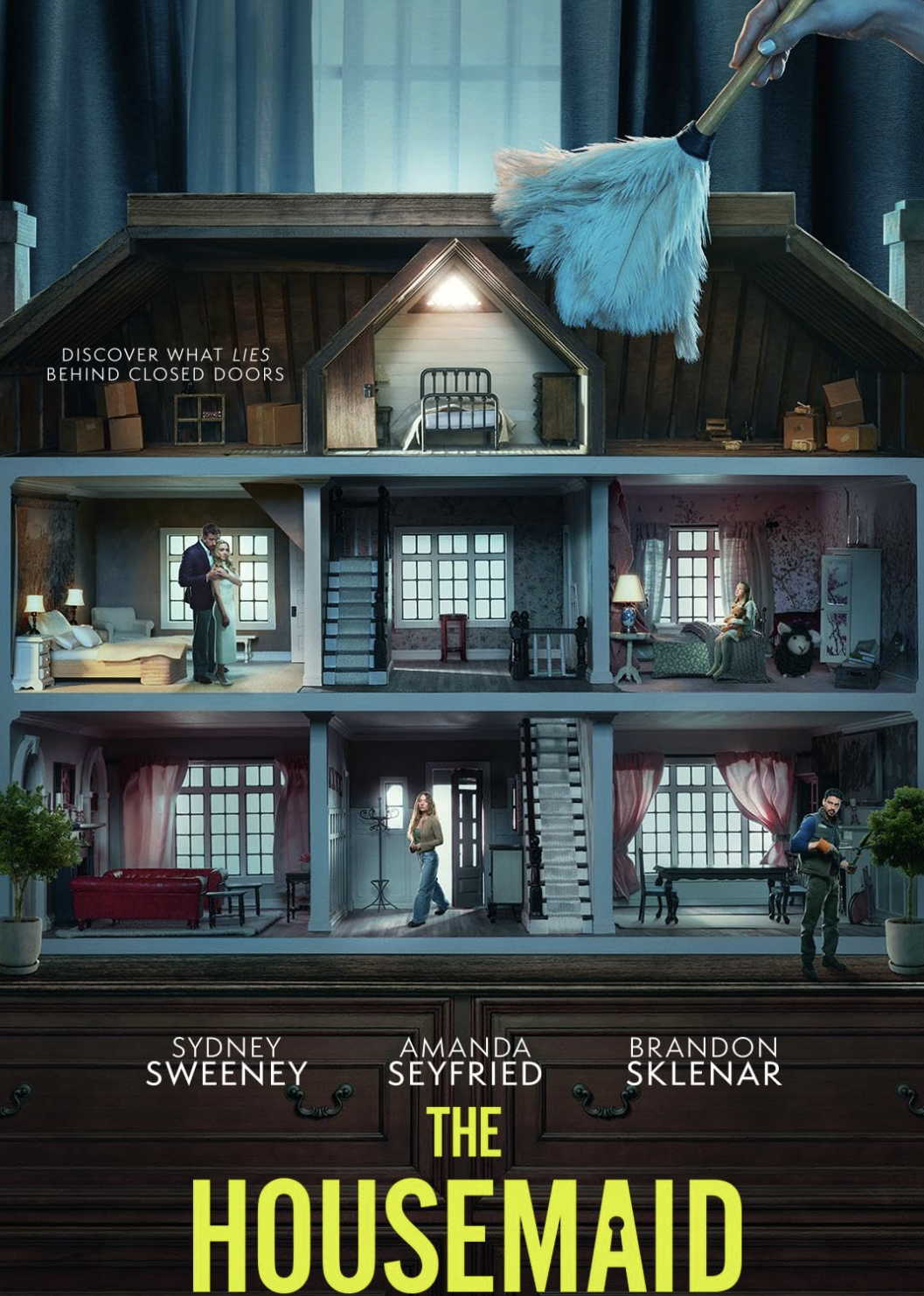
When it comes to portraying a “girlboss” from hell, Amanda Seyfried as Nina Winchester just might actually be giving Meryl Streep as Miranda Priestly some competition. At least, that’s how it seems at the outset of Rebecca Sonnenshine’s adaptation of The Housemaid, directed by Paul Feig and written in its book form by Freida McFadden. Indeed, the decidedly “The Devil Wears Prada energy” of certain parts of The Housemaid harken back to McFadden’s first self-published book, titled The Devil Wears Scrubs. Based on her time as a medical intern, it seemed that McFadden exposed herself rather early on to what is commonly known as a “toxic environment.” And the Winchester household is very much that, with Nina at the helm of its madness. That is, as far as Millie Calloway (Sydney Sweeney) can tell from her perspective. One that quickly favors the “man of the house,” Andrew Winchester (Brandon Sklenar, lately known for his performances in Drop and It Ends With Us—though being part of the latter was somewhat to his detriment).
In fact, the more that Millie observes the way Nina treats not only “the help” (that is to say, Millie herself), but also her husband, the more she can’t understand why he keeps staying with her. Granted, a plausible reason is for the sake of Cece (Indiana Elle), their only child. Well, Nina’s only child, really. Though that doesn’t come out until later, when Millie is made privy to their fertility struggles. This after Nina already told Cece that she was expecting while interviewing her. An interview that, although Millie technically “nailed,” she didn’t have high hopes for. Knowing full well that Nina would be the type of person to “fact check” her resume, with Millie’s voiceover informing that everything on it is “a total lie.” Much the same as “Peyton Flanders” a.k.a. Mrs. Mott (Rebecca De Mornay) lies in casual conversation throughout her interview with Claire Bartel (Anabella Sciorra) in 1992’s The Hand That Rocks the Cradle. Indeed, at first glance/for the first portion of The Housemaid, it feels as if this might all be just another rip-off of that (though, even if that had been the case, it would still be better than the actual atrocious remake that was released in October of 2025). But to be so quick to write the movie off this way would be misguided. Because, given its time to shine and meander, The Housemaid becomes a wild ride of twists and turns that many won’t see coming (at least those who haven’t read the book or still have deeply-ingrained faith in the patriarchy).
This includes even the first “small” twist within the first ten minutes of the movie, which reveals (again through Millie’s voiceover) that Millie desperately needs that job. For she’s been living out of her car and resorting to public bathrooms to manage her various “personal grooming” affairs (it’s very Madonna as Susan in Desperately Seeking Susan [there’s even a hand dryer scene in The Housemaid, too], except less glamorous). What’s more, because Millie is on parole (another “twist” of a detail to come), she’s required not only to have a steady job, but to have a place to live as well. Working for the Winchesters would kill two birds with one stone, which is exactly why Millie is bold enough to “shoot her shot” by lying so blatantly on her resume. So when Nina actually does call her with the job offer a few days later in one of Millie’s darkest hours (in the midst of being harassed by a couple of policemen telling her she can’t sleep in her car), she doesn’t think twice about why it might be highly suspicious that Nina either 1) didn’t do a background check on her or 2) didn’t care about her ostensibly sordid past. She just “goes for it.”
But, soon enough, it becomes quite apparent there’s a reason Nina hired her—probably because she’s fucking insane and every other professional nanny within a hundred-mile radius knows about it. Millie sees that immediately the very first morning she wakes up late, finds the door to her “maid’s quarters” (a confined attic with a triangle-shaped window that doesn’t open) slightly stuck before being able to open it (sending her into a brief panic) and then rushing downstairs to find that Nina is freaking the fuck out about the suddenly missing speech she wrote for a PTA meeting. (Allegedly) handwritten on paper and (allegedly) not saved on her computer, making its absence all the more dire…to her. “Luckily” for Millie, Andrew quickly swoops in to defuse the situation, as he will continue to do throughout the narrative.
This, of course, opens the floodgate for a lot of wide-eyed and open-mouthed looks from Millie directed at Andrew—as if to help put out the signal that she’s “down.” Much the same way that “Peyton” expresses she is to Michael (Matt McCoy), Claire’s husband. At times, it even seems as if Millie might be down for the “creepy” (read: smoldering) groundskeeper, Enzo (Michele Morrone, of 365 Days fame). This element/character offering yet another parallel to The Hand That Rocks the Cradle in that the Bartels, too, have a protective groundskeeper in the form of Solomon (Ernie Hudson), whose intellectual disability makes him an easy target for “Peyton” to get out of her way when the time comes.
Unsurprisingly, the time comes for Enzo as well, when Andrew angrily fires him after he startles Millie into dropping a fine china plate that’s highly valued by both Andrew and his uptight mother, Evelyn (Elizabeth Perkins). Of course, that’s not until about halfway through the movie, when Millie has managed to effectively oust Nina from the roost. Or so she believes that’s what has happened. But, as it turns out, there’s so much more at play—and so much more to Nina herself. In a way that very much distinguishes The Housemaid and makes it far from being just a knockoff of The Hand That Rocks the Cradle.
And while, to some, The Housemaid might come across as a glorified, more high-gloss “Lifetime movie,” its statement is worth reminding the masses of at a time like this. That statement being: it is easier for people, even women themselves, to believe that a woman is to blame…for just about everything. That she’s, as Lily Allen once sang on 2018’s “Come On Then,” “a bad mother” and a “bad wife.” That her supposed emotional instability means that she’s “the crazy one,” not the man. And in a country as gaslit as the United States on that front, it’s no wonder this movie has arrived to reflect that at a time when there is a woman-hating Orange Monster quote unquote running things.


[…] Genna Rivieccio Source link […]