


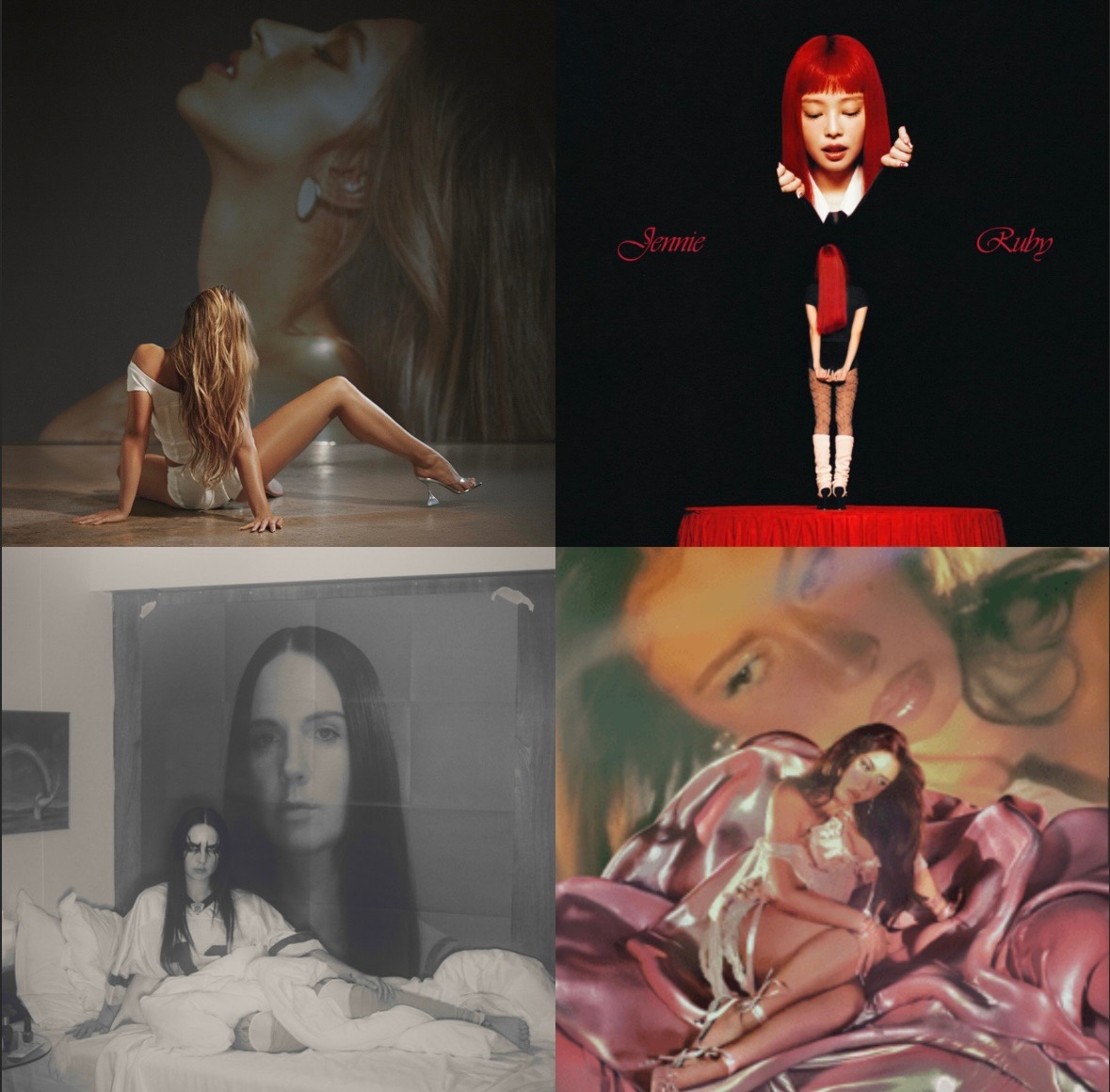
It’s nothing new in symbolism and psychology that women are expected to be either a Madonna or a whore. Nay, they can only be these two things. Hence, the Madonna-whore complex. Yet at the same time, a woman is expected to be everything all at once…while still conveying a largely two-dimensional persona. So the fact that 2025 saw four album covers that very explicitly referred to this trope hardly felt like a coincidence. In truth, it seemed to be more of a “collective consciousness” moment in the sense that all four of these musicians tapped into the way that women still feel hemmed in by the expectation to be “one thing” while containing so many multitudes. Or, who knows, maybe it was just a matter of photographers and art directors all ripping each other off in the same moment. Kind of like what happened with the “can’t be bothered to try” energy that happened in 2024 with album covers like Taylor Swift’s The Tortured Poets Department, Dua Lipa’s Radical Optimism and, of course, Charli XCX’s Brat (but that was a far more successful “lazy girl” album cover than those of the former two). Whatever the reason, there were four women in particular who seemed to have something to say about the notion of women 1) being pigeonholed as either a slut or a “good girl” and 2) being so much more than just one thing.
It all started in February, with the release of Tate McRae’s third album, So Close to What. The album artwork features the “foregrounded” McRae with her back turned to the camera as the “backgrounded” McRae’s head appears enlarged and in profile with her head tilted back (in many ways, it does feel like there’s some “Madonna True Blue” codedness here). So it is that it’s as if the McRae “on the ground”—who one might presume is the “real” McRae in this scenario—is watching herself (“Just Keep Watching,” as she says), the version that keeps getting more and more famous, as though disassociated from what’s happening. For, like everyone seeking fame, although she might have wanted it/worked her whole life toward it, now that it’s arrived, she’s left both wondering and wanting. Hence, the title of the album itself, of which McRae remarked that it was a reference to how achieving fame doesn’t necessarily make one feel close to anything. That once you reach the goal, it doesn’t exactly create the “completed” sentiment that one had hoped for. Nor does it do much to instill faith in humanity.
In any case, like Britney Spears, the pop icon McRae is constantly compared to (though perhaps unjustly so…to Spears, not McRae), Tate is someone who “activates” onstage in a way that she can’t when she’s “plain” Tate. The Tate presumably being alluded to on So Close to What’s foreground. To explain the way she goes from “shy, introverted” Tate to sexually-charged, ultra-bendable Tate when onstage, she opted to come up with a nickname for her alter ego: Tatiana. A name she also refers to on “Anything But Love,” when she goads, “And if you hate me, then why you keep on jackin’ off to Tatiana?” This song and lyric arose after the standard edition of So Close to What came out, with the deluxe, So Close to What???, being released later in the year (specifically, November 21st). A year that was as tumultuous on the professional front as it was on the personal, with everyone watching McRae and The Kid Laroi’s breakup unfold both in real time and in song form. Yet, unlike Spears and her very public early 2000s breakup with Justin Timberlake, McRae wasn’t going to tolerate a song like The Kid Laroi’s “A Cold Play”—this amounting to his version of Timberlake’s “Cry Me A River.” McRae, in contrast to Spears, was quick to respond with a song of her own called “Tit for Tat,” during which she ripped him a new asshole and made his single come across as being even shitter than it did before she taunted, “Let’s go song for song, let’s go back to back/Fix your fuckin’ self, kiss my ass for that/That’s the best you got, where’s the good one at?”
Such chutzpah and self-confidence is best explained by McRae herself, who told Rolling Stone for her January 2026 cover issue, “I started to black out onstage and become this person that I couldn’t explain, nor could my family or my friends, and I needed a reason for it. And I think [Tatiana] helps me grasp the strange theory of why I’m not nervous in front of fifteen thousand people, and why I can be nervous at a dinner party with four people.” In other words, McRae’s “I am two people” realization is in keeping with So Close to What’s album cover. And it also addresses the way in which women are actually conditioned to believe they have to be two people. Because channeling one’s “inner ho” is only “allowed” for the performance side of things—and often not even then, if the reaction to Spears’ skimpy onstage fashions were anything to go by. That’s what society has consistently brainwashed women to believe. So to be both things at once—“ho” and “nun”—is inconceivable. It’s always: pick a side and stay there.
JENNIE of Blackpink refused to do that in 2025, “having her cake and eating it too” by not only reuniting with Blackpink, but also releasing her solo debut, Ruby. A name that left some confused as they didn’t immediately understand the reason behind that particular title. But, for JENNIE, “Ruby-Jane” was, you guessed it, an alter ego she created as a pre-fame girl living in New Zealand. Per Billboard’s interview with JENNIE earlier in the year, Ruby-Jane “was inspired by the desire for a middle name like her new friends all had.” JENNIE then told the magazine, “I feel like I am great at creating different characters within myself. I like that about me… I intend to complete myself as Jennie Ruby-Jane, for that to be a whole person, in a way.”
That “whole person” seeming to want to merge on Ruby’s album cover. And, like McRae’s So Close to What, the “foregrounded” JENNIE is positioned in such a way so that she’s looking up at her larger-than-life “backgrounded” self. That self being the one to pull back the curtain as she observes her “tiny” self standing onstage looking, based on the body language that’s observable from the back, all shy and uncertain. As for the ruby-red curtain “tiny” JENNIE is standing on, it emphasizes that she also chose to call the album Ruby in honor of the color of stage curtains. For all the world’s a stage when you’re a girl with a “persona” to showcase. And, as JENNIE told Vogue, “[The name] reminded me of the theater curtain, ruby red, and I wanted to open the curtain myself and introduce my new music to the world for the first time.”
But, more to the point, she wanted to introduce the many different sides of herself to the world, with Ruby offering a veritable smorgasbord of “moods” and musical styles. Yet on each track, JENNIE’s energy is that of someone who knows herself well. And, in order to achieve that, she must acknowledge, as she did to Billboard, the “different characters within [herself].”
Something that Kali Uchis also did in 2025. For is there any type of woman that’s more of a “double” than a mother? Particularly a mother with artistic inclinations that she has no intention of “losing” just because she squeezed out a child? With, Sincerely, Uchis answered that question in spades. And the answer is to not only embrace this new side of herself—madre—but to intermix it with the side of herself that has always had the kind of self-assurance to know who she is and what she wants. An inner voice she listened to even when her own family did not believe in her musical ambitions, marking a period in Uchis’ youth when she was living out of her car after being kicked out of the house at seventeen. But now, Uchis is the parent. And it will be interesting to see how she supports her own child’s dreams compared to the lack of belief her parents had in her pursuits. Then again, it’s always easier to be and feel supported when you’re a nepo baby…
In any case, it wasn’t just her newfound role as a mother that influences the tone of Sincerely,. Because, with the unexpected death of her mother at the outset of 2025, the album seemed to take on new meaning via songs like “Heaven Is a Home…,” “Angels All Around Me…” and “Sunshine & Rain” (which features a bittersweet audio clip of Uchis’ mom saying, “Good morning sunshine”). Its lyrics became laden with “double meanings”—on the one hand, homage to her son, on the other, to her madre.
That the “doubling” image of Sincerely, features a “foregrounded” Uchis perched atop something that looks decidedly “labia-like” (in color tone alone) while looking decidedly bored is also telling of the kind of ennui that a woman can experience when she’s relegated to the often limiting role of “mother.” Subsequently expected to be only that and nothing else going forward. For to tap into any of her other “characters” would be deemed, by society, as “negligence” of her child. The “backgrounded” image of Uchis bears the same bored expression, with this “backgrounded” self seeming to watch over “foregrounded” Uchis like, well, a maternal presence.
As for MØ, she looks anything but maternal on the album cover for Plæygirl, one of the simultaneously most underrated and innovative albums of 2025. With Plæygirl, MØ rounds out the abovementioned musicians who favored a “double” image of herself for her record’s cover. Though she approaches it somewhat more uniquely than the others, with the “foregrounded” MØ shown in bed wearing what can best be described as diabolical KISS-like eye makeup. Meanwhile, the “backgrounded” MØ is shown in poster form looking all “clean-faced” and angelic. The point being, within every woman (every human), there is the potential for so-called good and bad, obedient and rebellious. As for MØ, she spent many years trying to be “obedient” in the sense that she was chasing after chart success once she got such a strong taste of it with her feature on Major Lazer’s 2015 single, “Lean On.” But with Plæygirl, MØ embraces all the multi-faceted parts of herself, whether vulnerable (on a song like “Without You”) or in total “cut a bitch” mode (on a song like, appropriately, “Knife,” during which she fittingly sings, “But you were playing double, now I see”).
And then, finally, it’s worth giving an honorable mention to this album cover category in 2025 to JADE with That’s Showbiz Baby, which features not two but five versions of JADE being everything to everyone and embodying the many personalities that make up a woman on any given second of the day. After all, as Meredith Brooks once said, “I’m a bitch, I’m a lover/I’m a child, I’m a mother/I’m a sinner, I’m a saint/I do not feel ashamed/I’m your hell, I’m your dream/I’m nothing in between/You know you wouldn’t want it any other way/Just when you think you got me figured out/The season’s already changing.” In other words, no woman can (or should) be pinned down to just one identity. Let alone only two. But the “double” image on these album covers at least helps subliminally disseminate the notion that a woman is—gasp!—more than one thing.


