


As if knowing, on some level, that she would need a form of “insurance” to make it so that the masses would remember “Taylor Swift” the Persona fondly as 2025 came to a close (you know, rather than remembering her solely for the cringeworthy The Life of a Showgirl), the timing of The End of an Era’s release in mid-December has set Swift up for “success.” That is to say, a kind of success that she’s been lacking of late: cool cachet. And also “relatability” cachet. That lack, on both fronts, began to ramp up, arguably, in August, when Swift announced her engagement to Travis Kelce with the shudder-inducing caption: “Your English teacher and your gym teacher are getting married” (followed by a dynamite emoji).
When The Life of a Showgirl came out on October 3rd, it didn’t take long for some of the social media commentary/backlash to mention that Swift was no one’s English teacher, reminding the internet hordes that she has no college education and should not be deemed some kind of “authoritative” source in the subject of English (no matter how much her biggest fans consider her work to be just that). And certainly not English literature, as “The Fate of Ophelia” reiterated. “Manufactured” backlash or not, the general “meh” feeling expressed toward The Life of a Showgirl was something that Swift wasn’t going to take lying down (though she’s made it clear she’ll take Kelce’s “Wood” lying down or otherwise).
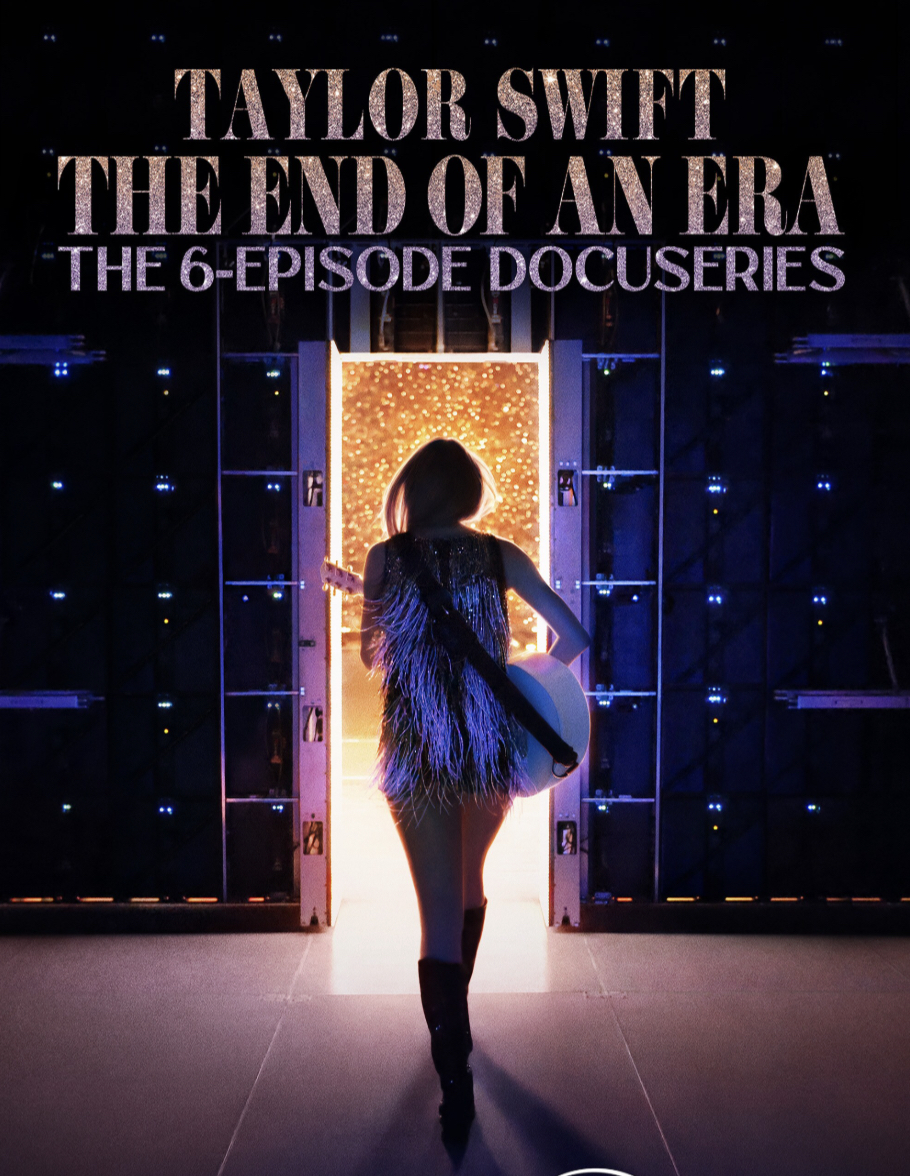
Thus, the well-timed release of The End of an Era (which is sure to mention via one of the captions during the final moments of the last episode that The Life of a Showgirl is “the biggest album of her career…to date” in one of those “the lady doth protest too much” kind of ways). As a six-episode docuseries, whether it admits or not, it’s intended to be the modern answer to Madonna’s seminal 1991 rockumentary, Truth or Dare. Though, of course, Swift would never credit Madonna for literally inventing this “genre.” Nor would she be inclined, based on all her self-congratulating throughout the series, to acknowledge that, without the Blond Ambition Tour (which is what Truth or Dare documents both onstage and behind the scenes), concerts would still be in the aesthetic and production value dark ages. And yet, to watch The End of an Era, one might be led to believe that Swift single-handedly invented the very concept of a “major tour.” Indeed, that meme of an elephant sucking on its own, er, trunk is the image that best summarizes this “tour diary.”
Though, of course, Swift does what she can to funnel her self-love into being projected by the many other people involved. In fact, most of the members of the tour group talk about The Eras Tour as a place where audience members can “escape” for three-plus hours, yet refuse to explicitly state what, exactly, is making most U.S. citizens feel like shit lately: a certain Orange Creature. Because Swift, true to form, never gets down and dirty when it comes to taking a definitive political stance in her work. Oh sure, she might once in a blue moon say something on social media, but beyond that, there is no sign of any politics in the “art” she puts forth. Begging the question of how her work can be considered art when it’s so apolitical. Though that certainly answers the question of how she’s made so much money (with another social media comment made during the rollout of The Life of a Showgirl being that Swift has done to music what Colleen Hoover has done to literature).
Meanwhile, Madonna, as she has done consistently throughout her career, stuck her neck out several times this year when speaking against the Orange Creature. First, when lamenting the “dismantling [of] all the Freedoms we have been fighting for and WON over the years” and adding, “Don’t give up the Fight!” Then, when the Orange Creature said “Long live the king” about himself, Madonna responded with, “Currently, we have a president who calls Himself. Our King. If this is a joke, I’m not laughing.” And once again on World AIDS Day when she acknowledged the horror of the U.S. government choosing not to honor this day (December 1st) as all previous administrations have since it was established in 1988. What’s more, throughout the Blond Ambition Tour, Madonna was met with everything from garden-variety criticism to the potential for being arrested as a result of the overt sexuality and political messaging of her show. The Eras Tour offers none of this, and that much is reflected in the milquetoast goings-on behind the scenes.
Even so, Swift does what she can to assure her viewers that her rapport with her dancers is just as memorable—if not better than—what Madonna had with the likes of Kevin Stea, Carlton Wilborn, Oliver Crumes (on a side note: Kam’s “narrative” mirrors Oliver’s in a certain sense, in that he’s M’s overt “favorite” of the group), Luis Camacho, Jose Gutierez, Gabriel Trupin and Salim “Slam” Gauwloos. All gay men, none of them white. This done at a time when the stigma against the gay community remained at an all-time high because of the panic surrounding the AIDS epidemic. Madonna, using her stature and standing in pop culture, decided not to give a fuck and presented these men to stages all over the world. Yet the audience is supposed to swoon over Swift having a gay Black dancer in episode two of The End of an Era. Kameron “Kam” Saunders, the dancer who gets a spotlight in this episode, is also meant to be a “profound” choice on Swift’s part because he doesn’t have a conventional (read: svelte) body type for a dancer. Never mind that MARINA was also showcasing dancers like this throughout her Love + Fear Tour, yet no one ever brings up what she’s done to help make strides on that front as well.
And then comes Swift saying, “I don’t want dancers that blend in. I don’t care about them pulling focus. I want them to pull focus. I want you to feel like you saw an entire crew of individual stars on the stage.” As if this hasn’t been Madonna’s thing from the outset of her career, intensifying especially with Blond Ambition, The Re-Invention Tour and The Confessions Tour. Yet in episode six, “Remember This Moment,” Saunders has the gall/lack of pop culture history knowledge to say, “[Taylor] has celebrated us in our moments in such big ways that the fan base knows us by name. That does not happen for dancers.” Uh yes, it fucking does…when you’re Madonna. And it has been happening ever since 1990, with dancers like Luca Tommassini, Daniel “Cloud” Campos, Leroy “Hypnosis” Barnes, Sofia Boutella, Tamara Levinson and Daniele Sibilli all standing out over the years beyond the Blond Ambition Tour.
As for Swift continuously pulling from the Madonna playbook, it’s the latter who says of hiring her dancers in 2005’s I’m Going to Tell You a Secret (which documented 2004’s The Re-Invention Tour), “I always, like, stuck out too much and couldn’t, sort of, blend in with everybody else. And that’s really what I look for, I look for people who have something special.” She also added, “I don’t think of them as dancers, I think of them as actors, performance artists, they have character and…they move me. And it’s got much more to do with who they are than the way they move their bodies.”
Moreover, despite both Swift and her dancers’ verbal insistence that they became “like family” as The Eras Tour went on, one doesn’t see that same sense of rapport that shines through between Madonna and her dancers during both of the documentaries she made. Each one radiating a sense of ribald, mischievous fun that simply doesn’t exist on a tour as vanilla as Swift’s. As for Swift documenting the intensity of the preparations she had to make in order to be ready for the tour—from her fitness regimen to memorizing the choreography to the set design logistics—this is all covered by Madonna with the simple voiceover during I’m Going to Tell You a Secret, “When you’re putting a show together, it’s like life during wartime. Everyone has to pay attention, no one can fuck up.” This said as various rehearsal scenes of varying intensity are shown. Yet Swift has to emphasize her rehearsal rigors with what can best be described as a “millennial sensibility” in that she really wants you to know how much work she’s put in and that she deserves a gold star for that alone. Whereas, to look at Madonna, with her baby boomer-meets-Italian heritage cast-iron balls, in either of these documentaries, the work is not to be discussed or ruminated upon, it’s just to be done.
Another parallel to the Madonna docs that Swift channels throughout The End of an Era is the “prayer circle” before each show. Here, too, Madonna or one of her dancer’s pre-show monologue proves to be far more entertaining than what Swift and co. might have to say. Which is a lot of “kumbaya” nothing. It certainly isn’t on the level of anything like what Madonna said in the circle before the AIDS benefit show dedicated to Keith Haring on June 25, 1990.
But then, Swift’s whole “message” isn’t aimed at the gays (contrary to what “You Need to Calm Down” would like to have people believe), but rather, the girls. As in, like, preteens. Maybe this is why Swift feels obliged to tell Florence Welch (one of many musicians to appear in The End of an Era as a result of also appearing onstage with her for a song), “There’s so much joy and like, and like, like, femininity that’s not, there’s no shame around it.” Oddly, Swift doesn’t seem to grasp that “femininity” as she seems to view it is, well, decidedly geared toward paving a tradwife path. Something that Madonna has long been the antithesis of (try as she did to dabble in the role while married to Guy Ritchie and playing the “English missus”).
What there is still shame around, even within the “bubble” of The Eras Tour, is a woman who “dares” to age in the spotlight. Something Swift addresses in the final episode when she has one of her many talking head moments, telling the camera, “I get very depressed about pop culture’s obsession with youth culture and…we designate extremely young people to be the ones who have to tell us where culture is going. And then, the idea that an artist had, in my case, the privilege of developing to the point where you’re in your thirties and you do know yourself a bit more and then you’re able to make the thing that they’ll know you for” (like “Vogue,” for instance, which Madonna released the same year she would turn thirty-two). But here, Swift is acting like she’s the first to really “take a stand” and say something about this when Madonna has been single-handedly crusading against the ageism toward women in the music industry since 1992, when she made her oh so prescient comment to Jonathan Ross,
“I think that not only do we suffer racism and sexism, but we also suffer from ageism. And that is that once you reach a certain age, you’re not allowed to be adventurous, you’re not allowed to be sexual, and, you know, I think that’s rather hideous. And a lot of people say, ‘Oh that’s so pathetic’ or ‘I hope she’s not still doing that in ten years.’ I mean, who cares? What if I am? I mean, what, is there a rule? What are you supposed to just die when you’re forty? And that’s basically what everyone wants people to do and I think it’s stupid. You’re just supposed to kind of put yourself out to pasture. Why? Life is long.”
Swift has undoubtedly gleaned this message from Madonna, whether directly or indirectly. And now she’s taking it up as her own. Which is perhaps why someone like Gracie Abrams, still in her twenties, seems to think that Swift is the true “blueprint.” Alas, Abrams doesn’t quite understand that The Eras Tour is not entirely “unprecedented.” Though she goes out of her way to offer the hyperbolic statement, “There’s just been nothing like this cultural phenomenon in a tour ever. It’s, like, changed people’s lives.” Be that as it may, to hear Abrams tell it, you’d think there’d never been a cultural phenomenon of a tour before, with The Beatles, David Bowie, The Rolling Stones, Bob Dylan, Michael Jackson, Celine Dion (you know, the icon that Swift treated like some kind of bellboy when she presented her with the award for Album of the Year at the 2024 Grammys), Cher and Britney Spears also creating “cultural phenomenon” scenarios with their tours and/or residencies. But, of course, that which is freshest in the minds of the collective consciousness is what “wins.” So is the tour that grosses the most cash, and there’s no denying that The Eras Tour has now taken on that title, raking in two billion dollars when all was said and done. So, fine, give the “prize” to Swift for “winning” on that front, but it doesn’t change the fact that none of it is interesting in that magnetic and “something to say” fashion that Madonna has showcased in each and every one of her twelve tours (yes, even The Virgin Tour).
With The End of an Era, Swift once more reveals that, like The Eras Tour itself, it’s all too “coiffed” and too polished under the guise of being “messy” and “authentic.” There is none of that edgy, gritty aura that Truth or Dare exudes. That chutzpah and repartee (this includes the comical dynamic between Madonna and her then boyfriend, Warren Beatty). So it is that, ultimately, it feels as if The End of an Era is the epitome of Swift wanting that abovementioned millennial-conditioned “gold star” for doing what someone like Madonna has always done (this includes nearly dying during the rehearsals for The Celebration Tour) without all this fanfare disguised as “modesty.” And she’s done it with a much better sense of irony and humor. To boot, in contrast to Madonna (even when she was touring with kids), Swift manages to make a “rock n’ roll lifestyle” look decidedly boring. Perhaps just another indication of the “Netflix-ification” of everything, as it were. All in a bid to ensure that nothing is offensive, affronting or generally “heart rate increasing.”


