


To many, Yorgos Lanthimos’ latest film, Bugonia (a remake of Jang Joon-hwan’s 2003 movie, Save the Green Planet!), will come across as being “preachy.” To be sure, there’s no denying that the core message of the film is frequently delivered with some heavy-handedness. The message being: humanity doesn’t deserve to endure based on its treatment of their own planet. This statement is “hinted at” from the outset, as scenes of bees pollinating various flowers are accompanied by a voiceover from Teddy Gatz (Jesse Plemons), the film’s “protagonist,” of sorts, explaining how valuable these insects and their pollination process is to humanity, how a third of food comes from this essential natural phenomenon. Lanthimos then cuts to two figures in beekeeping suits outside of a house, walking toward an apiary. On a related side note to the instantly-established bee motif, Bugonia is titled as such because that word refers to “a folk practice in the ancient Mediterranean region based on the belief that bees were spontaneously generated from a cow’s carcass.” A metaphor that will reveal itself to be quite applicable to the way in which Bugonia eventually describes the creation of humanity (not to mention how its destruction could generate something more valuable out of its own collective dead carcass).
As one of the beekeeper suit wearers, Teddy continues to explain to the man who is his cousin/lone henchman, Don a.k.a. Donny (Aidan Delbis), that the gradual dying out of various bee colonies has nothing to do with the numerous conspiracy theories surrounding colony collapse disorder (CCD), but because Earth is, in fact, inhabited by aliens who are “steering the ship” (yes, an on-the-nose metaphor for Teddy to use), later telling Donny, “That’s the way they planned it. To make us the same as the bees. A dead colony, atomized in a trillion directions with no way home again.”
Of course, from the get-go, the intent is to make Teddy seem as unhinged as possible. And it isn’t just his certainty that their mission is to capture an alien masquerading as the CEO of a pharmaceuticals company (though that’s a primary part of it). It’s that Teddy is exactly the type of guy one would find on the darkest corners of the internet, looking to confirm his “non-mainstream news” worldview by any means necessary. That his sole sounding board in life is his autistic cousin who’s willing to go along with whatever he says only adds to the sense that Teddy is deliberately sticking to his own echo chamber. Indeed, after Michelle Fuller (Emma Stone, Lanthimos’ ongoing muse) is successfully captured by Teddy and Donny (both wearing Jennifer Aniston masks, as if to add to the absurdity of it all), Michelle eventually tries to bring this up to Teddy as a means to “reason” with him. To make him question his certainty over his incontrovertible belief that she’s an alien, Michelle tells him, “I think you’re in a kind of echo chamber… You’re consuming content on the internet that is reinforcing this sort of warped, subjective idea of reality.” This being one of many instances of how an ongoing theme of Bugonia is that the white male is experiencing both a crisis and its own form of extinction as this particular “breed” of human struggles to understand its place in the world if it can’t be one of hegemony. But Teddy doesn’t see himself as part of “that narrative,” balking at Michelle when she keeps trying to placate his anger with such phrases as, “Can we have a dialogue please?” He spits back, “Don’t call it a ‘dialogue.’ This isn’t Death of a Salesman.”
Such repartee between these two is courtesy of screenwriter Will Tracy, known for his work on Succession (specifically, the episodes “Tern Haven,” “What It Takes” and “Tailgate Party,” as well as writing the script for 2022’s The Menu (he’s also less appreciated for the Kate Winslet-starring limited series, The Regime). Bugonia, however, is arguably Tracy’s most darkly comedic work to date…yet it seems to be Lanthimos who’s been lambasted the most with such critiques as, “…the disdain Lanthimos is expressing here is more for humanity itself than for any one subset of it; he’s less a misogynist than a misanthropist” (this from a Slate review by Dana Stevens). But if Lanthimos—not Tracy (in yet another example of how underestimated the screenwriter is in terms of being the backbone behind a film’s tone)—is to shoulder the “blame” for making Bugonia come across as misanthropic, he still can’t be faulted for fortifying what is ultimately the script’s (de facto, Tracy’s) perspective. After all, what on Earth is actually more simultaneously destructive and hateable than humans? (Apart from mosquitoes, of course.) So hateable, in fact, that many of them have had the good sense to become self-hating for their inherently grotesque, selfish nature. Then again, there’s also a great many who remain quite pleased with themselves (as most of the content on social media is sure to emphasize). And others still who aren’t “self-hating,” per se, but nonetheless feel the weight of their own insignificance. Like Teddy himself, whose response to Donny’s question, “What if someone finds out about what we’re doing?” is as follows: “They won’t. No one on Earth gives a single fuck about us” (this said as they’re buying the Jennifer Aniston masks they’ll use to abduct Michelle, a fitting image to go with this line considering that most humans only worship at the altar of celebrity, even if only in “TikTok influencer” form).
And even if someone does find out, the thoroughness of Teddy’s plan (going so far as to “chemically castrate” himself and Donny by injecting medroxyprogesterone acetate, “a progestin-type hormonal med,” into their bodies to evade being potentially seduced by Michelle) is such that it would probably be too late before anyone really caught on to the extent/madness of what they were doing. Though Michelle herself is convinced it will only be a matter of a day or two before local law enforcement and FBI officials are able to find her via a “statewide manhunt,” reminding Teddy and Donny, “I am crucial. Think of it like you’ve abducted the governor, but worse. That’s the level of bureaucratic urgency you’re contending with here. In all humility, I can say that.” Despite the exhaustiveness of her spiel, Teddy can only laugh at her attempt to both seem human and elicit a human response from him in return, telling her that, come hell or high water, on the night of the lunar eclipse, he wants her to get them an audience with her “royal superiors.” This so that Teddy can negotiate their withdrawal from Earth and the end of the “techno-enslavement” of humans.
At another point during this unique hostage situation, Teddy decides that Michelle has been acting insolent for long enough with him, consequently opting to conduct an excruciating, electroshock therapy-like test on her to determine more telling specifics of her “genus.” This done while, eerily enough, Green Day’s “Basket Case” gets played on the stereo (something that stands out far more than Chappell Roan’s “Good Luck, Babe!” being played as Michelle drives her Benz at the beginning of Bugonia). It’s Donny who pulls the plug as things start to get overly intense, with Teddy too distracted by Michelle’s threshold for pain to bother stopping him. This, to him, is the key determining factor that she has the “royal genetic code,” prompting him to now give her the so-called royal treatment…which essentially means unbinding her, allowing her to come upstairs and offering her some visibly gross spaghetti dish (the kind where the sauce isn’t even blended, but placed atop the “mound,” leaving the rest of the strands “white,” so to speak).
It’s during this little “civilized” sit-down meal that the two, once again, butt heads. Even as Teddy tries to find common ground with her by mentioning her own love of and fascination with bees. Unfortunately, her “dialogue” (as she likes to call it) veers in a direction that makes Teddy bristle, with Michelle speculating that colony collapse disorder—the topic at hand during the intro to Bugonia—isn’t a matter of anything her corporation, Auxolith, is guilty of doing, but rather, “Sometimes a species just winds down.” In disbelief at her refusal to admit her responsibility, Teddy repeats, “‘Winds down?’” Michelle further explains, with an air of mercilessness to her tone, “Maybe something clicks in their heads. And they just know, or they intuit. The futility of the entire enterprise.”
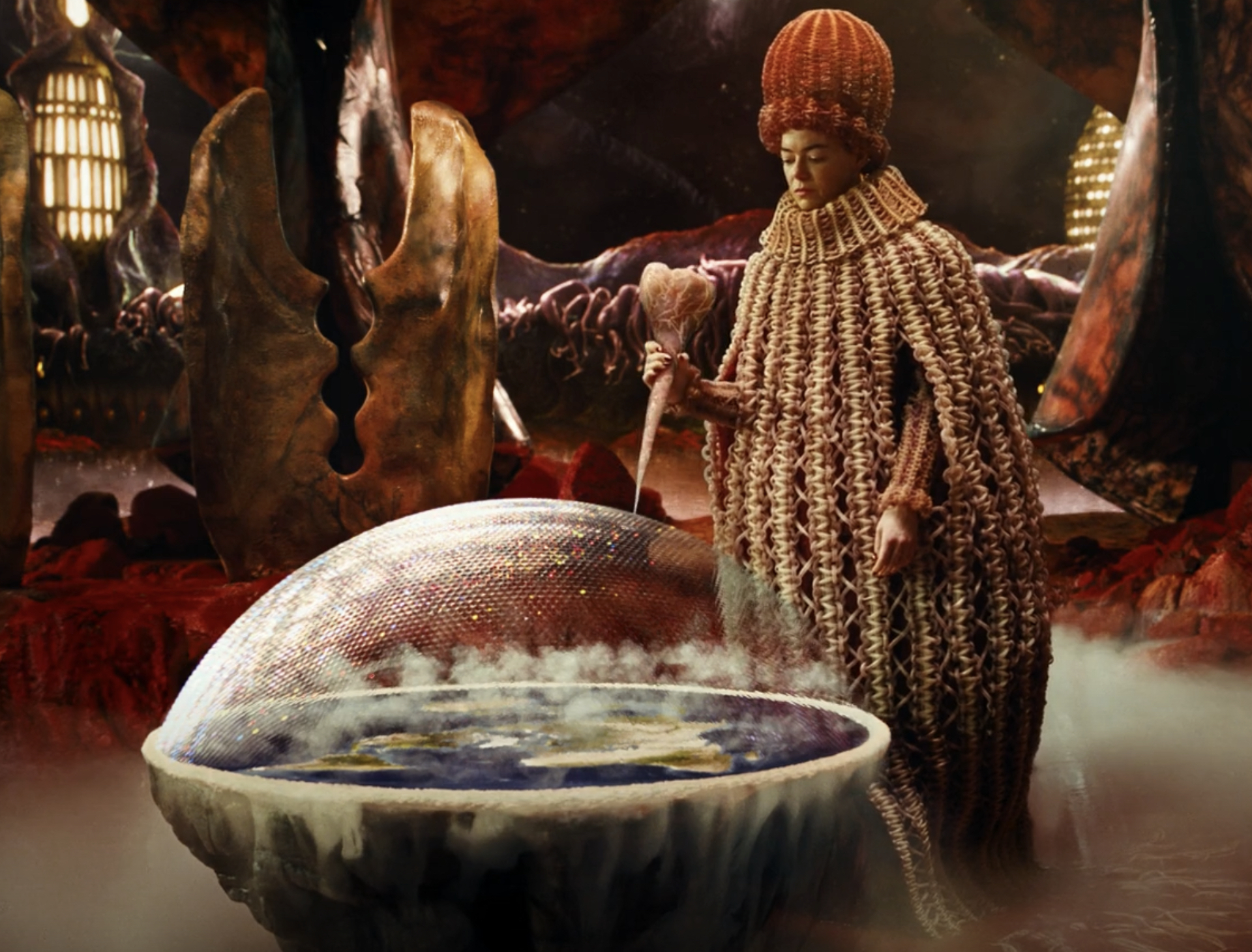
Naturally, the irony here is that humans themselves have willfully chose to ignore the futility of the entire enterprise as it stands. Refusing/unable to make the necessary changes that would render the “enterprise” at least slightly less futile. And yet, as Bugonia ultimately seeks to reinforce, “It is easier to imagine an end to the world than an end to capitalism” (as Mark Fisher said, by way of Fredric Jameson and Slavoj Žižek, in Capitalist Realism: Is There No Alternative?). This much confirmed by the grand finale of the movie, which shows Michelle, in her “alien form” (a guise that mostly involves looking like something knitted) hovering over what can be described as an effigy of Earth. Except it’s not a globe, but rather a flat representation on a platform, of sorts, enclosed by a translucent, barely visible half-sphere. One that Michelle literally bursts with the sharp point of a giant bone (that also looks sort of like a tooth). Because it is her and the royal council’s decision that humans have squandered too many of their chances for improvement and that, obviously, they’ll never change for the better. Or, as Michelle puts it to Teddy after admitting to being an Andromedan (in a move designed to be yet another instance of making the audience question, “Is she or isn’t she really though?”), “Even when presented with irrefutable evidence of their own self-destruction, the humans continued unabated.”
Whereas the dinosaurs, she informs him, were destroyed by mere accident. Calling them “magnificent creatures with a complex but stable ecosystem,” she debunks the asteroid myth by explaining, “We inadvertently spread a fatal virus to the planet. And the emperor was struck with guilt, watching all of Earth’s creatures perish. So he gave new life to this planet, life resembling us.” Thereby also debunking the “man was made in God’s image” myth, too. She then goes on to inform Teddy of how the worst of humanity’s ancestors survived to yield the type of humans that one sees on the planet today. The ones truly responsible for all of its woes. Thus, Michelle finally corrects Teddy’s original theory that the Andromedans have infiltrated the planet to destroy humanity by telling him that, in fact, they’re here to eliminate the “suicidal” (a.k.a. self-destructive) gene humans have within them and also “to save Earth from you and your kind.” Alas, that task is impossible even for a species as advanced as these aliens (in this respect, Bugonia also shares a similar thread with Pluribus in that the aliens of that series didn’t know what they were dealing with in trying to “improve” a human like Carol [Rhea Seehorn]).
And so, while it might be a valid critique that Bugonia is “thuddingly obvious”—as the abovementioned Slate review declares—in its execution (complete with showing an array of people lying dead next to a museum’s display of reconstructed dinosaur skeletons after Michelle ends humanity), it doesn’t make the film any less effective. Moreover, there’s no question that what humans seem to require right now is thudding obviousness in order to understand or even register a message of any variety. This, too, is part of Lanthimos’ and Tracy’s symmetry in commencing Bugonia with the line, “It all starts with something…magnificent. A flower. Just a flower” and then ending the film to the tune of Marlene Dietrich’s “Where Have All the Flowers Gone?” during which, in addition to singing the titular question, Dietrich also asks, “When will they ever learn, when will they ever learn?” The answer, based on all previous and current evidence, still appears to be: never. So yes, call Tracy and Lanthimos “misanthropic” for their unflinching perspective on humanity all you want. It’s still an accurate one.


[…] films to see, like After the Hunt, If I Had Legs I’d Kick You, Blue Moon, The Mastermind, Bugonia, Anniversary and Nouvelle Vague (meanwhile, everyone forgot that the Jennifer Lopez-starring remake […]
[…] films to see, like After the Hunt, If I Had Legs I’d Kick You, Blue Moon, The Mastermind, Bugonia, Anniversary and Nouvelle Vague (meanwhile, everyone forgot that the Jennifer Lopez-starring remake […]