


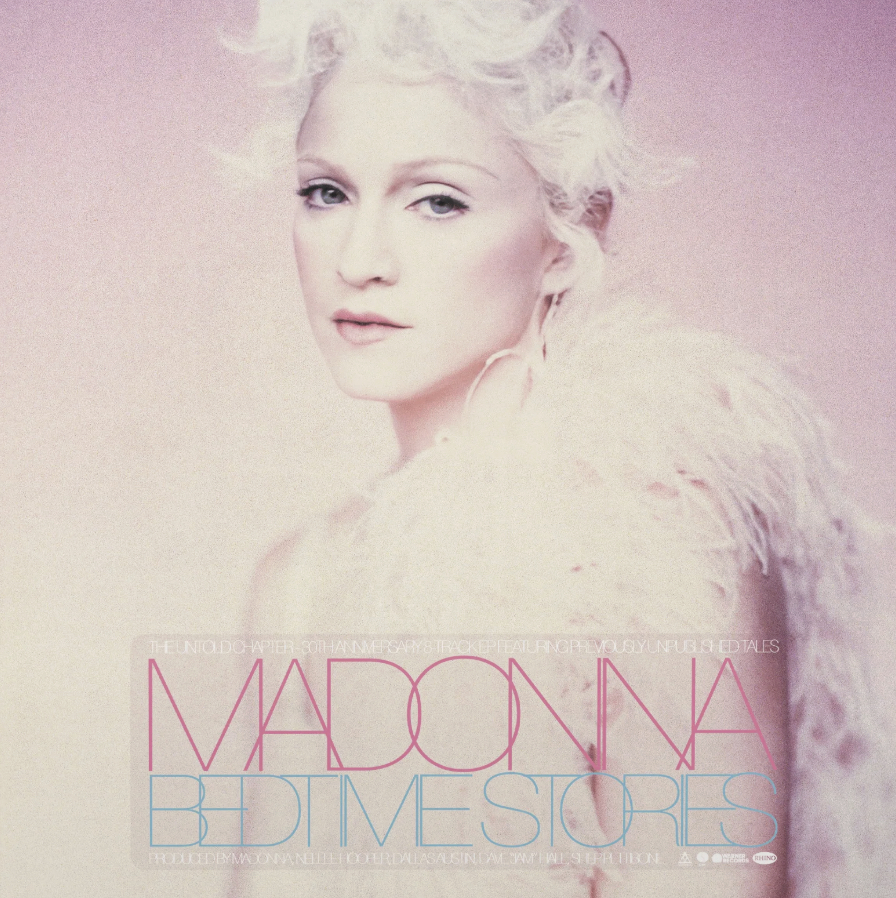
On October 25, 1994, almost exactly two years after Madonna released Erotica, and with it, a backlash against her like never before, she reemerged with a noticeably “softer” edge via Bedtime Stories. Some might have called the move “calculated” (for, long before that term was being hurled at Taylor Swift, it was being used on Madonna). Maybe so. Maybe it was all part of her master plan to both win back public favor and nail the “off-the-clock” audition she was doing for Evita, admitting that the video for “Take A Bow” was a full-on ploy to show director Alan Parker that she could be right for the part.
But maybe it was also just Madonna doing what she does best, which is moving on to “the next” sound. Granted, the R&B stylings of Erotica were already a precursor to the more full-fledged R&B tinge that would appear on Bedtime Stories, mostly thanks to the likes of Dallas Austin and Babyface. For Madonna has always been measured in selecting the producers she wants to collaborate with in order to achieve that elusive “perfect sound” for whatever project she’s working on in the moment. And she had already laid the groundwork for what fans might expect on her sixth record after releasing “I’ll Remember” in March of 1994, a lush, mid-tempo ballad made for the still little-appreciated film, With Honors (the closest Madonna has ever come to “working with” Joe Pesci), directed by one of Madonna’s “besties” of the era, Alek Keshishian (who also directed her 1991 rockumentary, Truth or Dare).
By September, she had then given fans another taste of her new musical era with “Secret,” which resulted in one of her most iconic videos of the 90s. In fact, every video made for Bedtime Stories is iconic, including “Take A Bow,” “Bedtime Story” and “Human Nature.” And, considering the album has but eleven tracks on it (going back to the “80s style” of scantness), offering up four singles was ample enough for Madonna. Even if track one on the album, “Survival,” also could have been a chart success as well. One is reminded of that much with Bedtime Stories: The Untold Chapter, on which a demo version, called the Quiet Storm Demo Remix, appears.
In this iteration, “Survival” has more than just a slight touch of TLC’s “Creep” to it (also released at the end of 1994), which is no surprise considering that Dallas Austin worked on that song as well. Infusing the track with the same reverb-sounding trumpet to lend an air of “extra spice” to the sound, it’s actually Nellee Hooper who co-produced with Madonna, but it’s obvious that her co-songwriter, Austin, had a say in the sound. One that reminds just how R&B-focused Madonna was at this time, claiming it was a bid to “get back to her roots” (something she often says when explaining her albums [e.g., Confessions on a Dance Floor]). One surmises she means the period when radio listeners assumed she was Black based on her first single, “Everybody.” And yes, as with “Everybody” and Madonna as a whole, for Bedtime Stories, she had the sense to not rely totally on R&B, but to suffuse the overall sound with dance elements—hence, the presence of Nellee Hooper.
And while this demo version of “Survival” is arguably more enjoyable (even if it occasionally sounds like a mash-up of “Creep” and “Survival”), Madonna did well to go with the version that currently stands on Bedtime Stories as a means to differentiate herself from TLC. Not to mention the other “legitimate” (read: actually Black) R&B artists she was competing against. A reality made telling by the fact that Bedtime Stories was boxed out of the number one spot on the Billboard 200 by Snoop Dogg’s (then Snoop Doggy Dogg) Murder Was the Case and Boyz II Men’s II. Even so, Bedtime Stories’ longevity on the charts made it outsell Erotica. Bringing to mind the additional line from this demo version of “Survival” that goes, “Don’t get caught up in the things I say/Just look at the big picture/My life’s a good mixture/Of up and down and all around.”
That much is also made clear on the Allstar New Single Mix of “Secret,” wherein Madonna explores the slight torture of her baby having a secret. Though the listener never does find out what it is, left to their own devices to speculate about what it might be. Indeed, in many ways, it’s comparable to Meat Loaf’s “I’d Do Anything for Love (But I Won’t Do That),” released the year before Bedtime Stories, in that he never expressly states what it is he won’t do. Call it the songwriting “tactic” of leaving certain things open-ended enough to be relatable to all walks of life. Elsewhere in this version, a voice in the background repeats, “Like that y’all,” in another instance that reminds how Madonna was always ahead of Mariah Carey (who released “It’s Like That” in 2005) in this musical regard, with Carey not embracing her bona fide Blackness until the late 90s, and still doing easy listening pop shit in 1994 (what’s more, three days after Bedtime Stories came out, Mariah released Merry Christmas—a Christmas album being something Madonna would never dream of making).
Though, to be fair, Madonna dabbles in a bit of that as well, this being manifest in the inclusion of a previously unreleased demo called “Right On Time,” which finds Madonna offering some marked lyrical cliches (e.g., “Birds are singing just because they’re next to you/Bells are ringing, maybe you’re my dream come true”), which is generally a rarity for her. And this is clearly part of the reason she opted to leave “Right On Time” off of the original album, unveiling it only now so as to give her fans a more complete glimpse into the thoroughness with which she worked on creating the sound of Bedtime Stories.
Another song that didn’t get left off the original album follows, namely “Don’t Stop,” billed here as the “Original Demo Edit.” And if it truly was, the final product is a much greater cut above this iteration, which has more noticeable elements of trying to be “funky.” Even so, “Don’t Stop” remains a bop even in this guise, and might also prompt Madonna’s avid listeners to again wonder why it wasn’t a potential contender for being released as a single (along with “Survival”). As for her urging to “keep movin’, keep groovin’,” it’s possible that “Right On Time” was also left off the tracklist because it would have been one too many uses of the word “groove.” A word that had a resurgence in the 90s thanks to not only Deee-Lite, but to the 70s becoming revitalized on the trends front (something Madonna could definitely appreciate as the 70s were her salad days).
The Short Mix of “Freedom” changes the tempo and tone of things (and does the “Original Demo Edit” of “Don’t Stop” one better on the “funky” quotient). Indeed, the song has a practically a capella vibe to it as Madonna lays out the argument, “No is just a word/That people say when they’re afraid.” Of course, in most contexts, that just comes across as rape-y more than anything else. Nonetheless, Madonna tries to mitigate that association by adding, “And if you say no to me/Then I will fight you till I’m free.” She then leans into the cheesy chorus (though still not as cheesy as some of her 80s fare, including “Love Makes the World Go Round”), “Freedom/Brotherhood/Justice/Just say yes/‘Cause no is just a word/That people say when they can’t cope/And if you say no to me/Then I will fight you till I’m free.” Perhaps realizing that George Michael might be miffed that she would release a song called “Freedom” so soon after his, Madonna didn’t include this on Bedtime Stories. Of course, the more likely reason is that, sonically and tonally, it just doesn’t gel as seamlessly with the other songs on the record.
Not like “Human Nature,” one of the standouts of Bedtime Stories that gets resuscitated here as “The Howie Tee New Edit.” And it’s one that finds Madonna incorporating an Ol’ Dirty Bastard-like voice (side note: Mariah wouldn’t have the cojones to feature the actual ODB on a track of hers [the “Fantasy” remix] until 1995) at the beginning that chimes in, “So give me room to breathe and get up off these—” Naturally, this male voice doesn’t seem to be saying this to Madonna, but more likely speaking from her perspective in the ultra-macho way that her own vocals can’t capture. But she does plenty fine on her own (as the album edit also conveys) as she goads, “And I’m not sorry/It’s human nature/And I’m not sorry/I’m not your bitch, don’t hang your shit on me.” In other words, Madonna was telling all of her detractors not to project their sexual hang-ups onto her and punish her for having the “audacity” to, that’s right, express herself and not repress herself.
The same philosophy stands on “Let Down Your Guard,” another song that Madonna fans are well-acquainted with as it was already released as a B-side to the “Secret” single in September of ‘94. And, of all the “rarities” paraded on this EP, “Let Down Your Guard” still shines brightest for being the most overt candidate for “Should Have Made It Onto the Actual Album.” Then again, perhaps Madonna felt there was something too similar to the Janet and Michael Jackson style to make this track more “official.” Whatever the reason, she’s bringing it to the fore again here, presented as the “Rough Single Mix.”
To conclude The Untold Chapter, Madonna offers “Love Won’t Wait,” a very 70s-esque number (indeed, it’s positively awash in “vintageness”) that gives her the chance to be thematically aligned with some of her previous “I Will Survive”-type tracks (e.g., “Think of Me” from her self-titled debut). And yes, the Gloria Gaynor-ness of it all is manifest in such lines as, “You think that I could never leave/You think I’m not that strong.” There’s even a dash of Joni Mitchell in the form of, “You won’t know what you had till it’s gone” (this lyric being yet another testament to how, by and large, most of the tracks Madonna excluded from Bedtime Stories were too filled with cliches). Other lyrical highlights extend to, “Love won’t wait/Forever and a day,” “So here I am with my heart on my sleeve/You said, ‘Baby, put your trust in me’/But I have come to the end of the line/And you have taken up all of my precious time” and “Everybody’s somebody’s fool.” (Incidentally, Madonna wrote a song in her pre-fame days called “Nobody’s Fool.)
The overwhelming success of “Love Won’t Wait” on iTunes in the UK is perhaps in part due to the British already being well-versed in the track thanks to former Take That member Gary Barlow recording it as a single and releasing it in 1997 for his solo debut, Open Road. In Barlow’s hands, however, the song has a much more overt “cornball-ness” to it, whereas when Madonna sings it, it has a greater aura of being a “self-empowerment” anthem. Which is just as good a note as any to leave her listeners with. In point of fact, compared to Veronica Electronica, another EP Madonna released this year to spotlight some “rarities” and remixes from Ray of Light, Bedtime Stories: The Untold Chapter leaves one feeling much more satisfied, having truly been transported back to this moment in time when Madonna was earnestly “rebranding” while still holding on to the many R&B influences of Erotica.
As for the album artwork chosen for this EP (shot by Paolo Roversi), it does seem to presage Madonna’s “Ethereal Girl” era for Ray of Light (additional images included with the physical EP also give listeners a chance to see previously “buried” photos from a 1994 shoot by Roversi, some of whose work did end up, at the very least, being used for the “Bedtime Story” single). In contrast, the image that does appear on Bedtime Stories, shot by Patrick Demarchelier, is among one of Madonna’s most polarizing (apart from Hard Candy—then again, it’s pretty much unanimously agreed that most fans don’t care for that cover). A polarization that was spotlighted when Paul Du Noyer of Q magazine commented that Madonna,
“…looks both older and younger than she does in the photos and the videos: a little more lined and possibly tired, but also less mature and grand. Her manner is quite teenaged, not femme fatale. She seems up for mischief, and yet quite conscious of her power. At the same time, her very frankness is almost innocent. These combinations are odd, and they give her the air of a prematurely wise child. Her current style is 1930s Hollywood meets early 1970s flash: Jean Harlow and Angie Bowie. She is not bewitching, but is certainly beautiful. She wears the nose stud that so troubled Norman Mailer in a recent interview. If you saw her in the street, you’d think: she looks like a girl who looks a bit like Madonna.”
In 1994, that was the entire point for the Queen of Pop, who so generously chose to remake herself into something the public at large (not just die-hard fans) could “tolerate”—better still, “digest”—again. And in this mission Bedtimes Stories very much succeeded. However, it’s with Bedtime Stories: The Untold Chapter that the album gets the much-needed revisit it deserves in order to emphasize just how bold and daring a rebrand this actually was for Madonna from a sonic standpoint. And, in this regard, the release of the EP is much more meaningful than both Veronica Electronica and the “Twenty Years Edition” of Confessions on a Dance Floor. With perhaps the only critique/missed opportunity being to finagle an early version or unreleased remix of “Bedtime Story” (though perhaps Björk, initially reluctant to help Hooper write that song, wouldn’t have approved).


