


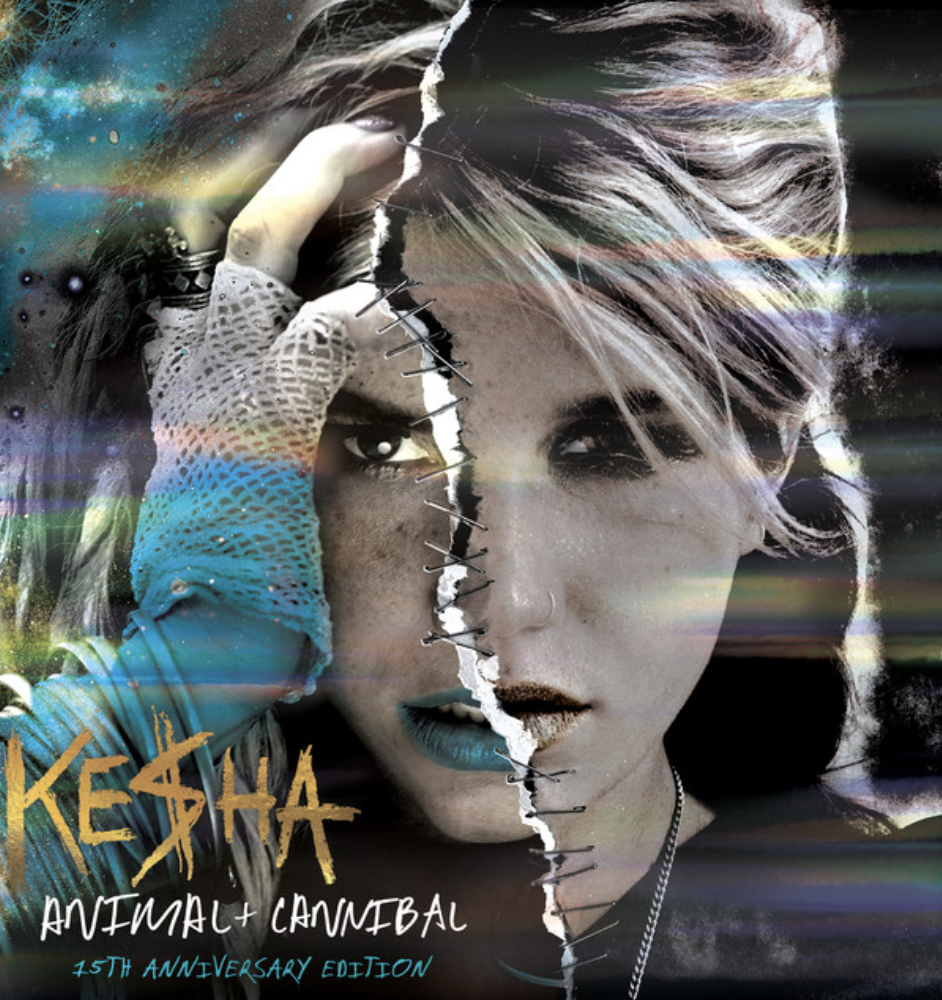
In 2010, a seminal voice of a generation emerged. No, it wasn’t motherfucking Lena Dunham, but Kesha Rose Sebert. Better known as her then stylized mononym Ke$ha (thus, bringing it back for the fifteenth anniversary reissue of Animal + Cannibal). Although listeners of Top 40 radio had already been unwittingly acquainted with her thanks to 2009’s “Right Round” (a Flo Rida song that Kesha wasn’t given a feature credit on, in yet another telling sign of Dr. Luke’s assholery, for it was he who tossed her into the studio to record it when Flo Rida mentioned wanting a female voice on the track), it wasn’t until Animal, her debut studio album, that audiences got the complete portrait of Ke$ha, a mangy twenty-two year old (going on twenty-three in March of that year) who had already delivered one of her thesis statements in the form of “Tik Tok,” released in August of 2009, about eight months after “Right Round” (which secured the coveted number one spot on the Billboard Hot 100).
But when Animal came out, it provided the total picture not only of Ke$ha, but a new decade of what can best be described as “low-budget excess” and “party it up nihilism.” This is why it now feels so appropriate and so telling that the record was released on January 1, 2010. As though to quite literally mark the beginning of a new era in music. For perhaps more than any other artist, Kesha’s sound from that time is the most representative of the decade. Along with being the primary emblem of what has been branded as “recession pop,” a term meant to categorize the EDM-infused, party-focused lyrics of most of the top hits from 2009-2012. Or, as Audrey Gibbs of USA Today summed it up, “The one thing all of the recession pop tracks have in common? They’re catchy, optimistic, party-focused and centered on living in the moment.” After all, if tomorrow can’t be counted on, the moment is all one has (as Charli XCX knows). This being part of why people, at that especially financially destitute moment, were turning to this kind of “frivolous,” ultra-upbeat music. Or, as Kesha weighed in when asked why her music is now constantly referenced as part of that period (not to be confused with her album of the same name),
“When I’m really sad, I listen to songs that really hit that dopamine receptor in my brain, my biggest thing that helps me, like more than anything is Italian disco… and it’s quite magical what it does to my brain chemistry and it’s really like alchemy for me, so I think there are certain chord progressions and BPMs… that elicit a feeling of euphoria or bliss or nostalgia… and I think that pop music just kind of makes you just feel stupid. And you’re like, ‘I’m gonna get a little stupid for like three minutes.’ At least I can say my first album was intended to just like really encapsulate this like not so serious moment in time of just like being a little rowdy shithead, so I’m happy to have lent that energy to people when they needed it.”
This was something she stated on an episode of Rolling Stone’s Music Now podcast, hosted by senior writer for the magazine Brian Hiatt. It was also during this podcast that Kesha reflected back on the recording of what remains one of her most signature songs, “Tik Tok.” A pop banger that she says has rendered her into the “dopamine doula to drunk people on the dance floor” (though Robyn might try to vie for that title as well). And as Hiatt asked her to look back upon the early phases of recording such indelible music for the album, Kesha likened making the songs to a “pilgrimage,” recalling how almost every day she would ride her bike from the top of a hill in Echo Park to the metro station Downtown, taking the metro rail to Long Beach and then riding her bike to David Gamson’s house to work on songs like “Stephen” and “Dinosaur.” Both of these tracks were already ones she had written in their earliest forms when she was sixteen. After moving to Los Angeles at eighteen, Kesha seemed to quickly align herself with a group of friends that had the same pursuits (getting fucked up and having a good time) and sentiments (feeling like an outsider who didn’t quite fit anywhere) as her.
Among some of the fondest memories she has from that time, as she tells it, were going to The Silver Platter in Koreatown to see drag shows or, that’s right, taking shots from the hood of her car (hence, “Shots on the Hood of My Car”—at last available on this version of the album, along with “Butterscotch”) while hanging out in the parking lot. In other words, what she loved best was the sense of having complete freedom and being totally fearless (even if a lot that fearlessness came from the fortification that alcohol provides). This despite the fact that she had signed a contract that would end up making her feel anything but free in the years to come. However, her naïveté in that moment is what gave her the chutzpah to deliver such bold lyrics as, “Don’t really care where you live at/Just turn around, boy, let me hit that/Don’t be a little bitch with your chit-chat/Just show me where your dick’s at” (this “Blah Blah Blah” verse repurposed from Guns n’ Roses’ 1987 song “It’s So Easy,” when Axl Rose says, “Turn around bitch, I got a use for you/Besides, you ain’t got nothin’ better to do/And I’m bored”).
And it was that level of bravado that prompted Kesha to tell Hiatt, “I love the girl that I was.” Indeed, in many ways Kesha shares a similar story, in terms of crafting her “persona” and music, to Lady Gaga (which is a bit uncanny considering how involved LG ended up being in Kesha v. Dr. Luke). At least in terms of how the music on Animal was made, with Kesha rehashing how she felt like a perpetual misfit as a teenager, and wanted others who felt the same to know that they weren’t alone. At the time, as she remembers, “I listened to Iggy Pop and I’d be like, ‘Fuck these losers at Brentwood High School! All these basic bitches, they don’t get me, I have purple hair.’ And so, like, I wanted to be that for pop music. Like, I wanted the girls that, like, didn’t feel like the picture-perfect ‘girlies’ that, like, have all the nice clothes from the nice stores [see: Andie Walsh in Pretty in Pink]. Like, I wanted them to have a girl where they could be, like, ‘That’s my bitch.’ And, like, I kind of took it as, like, my mission to, like, stand up for people like me, where you like just need somebody to make you feel like you’re not completely an outsider and alone and I’m quite proud of the girl, the Animal/Cannibal girl, like she’s a badass.”
And has only become even more of one, starting her own record label—Kesha Records, of course—and determining that no other artist (female or otherwise) should ever have to go through what she did. Not on her label, anyway. Even if Kesha can now look back on that era with more affection for it, coming to the conclusion, “There were really hard moments in this period of time. And then there were fucking the most fun, the most iconic, the most hilarious [moments]… I had a lot of fun and think that’s, like, part of the dichotomy…that’s why it makes me emotional talking about these songs is because there was so much magic and like naïve, youthful hope and opportunity and excitement and, like, holy shit, who gets to experience that in their life? I’m so lucky. And there were, like, sprinkled with really difficult both moments and situations that really I couldn’t talk about. And so it’s very polarizing emotionally to know how to look at a period of time when it’s two very drastically different emotions, but I think the thing about life is both things—all things—can be true.” So yes, she’s basically quoting Dexter Morgan (Michael C. Hall) during the finale of Dexter: Resurrection, further adding, “Both things [were] felt in that time and I felt both of those emotions, and I still can look back at this period of time and be, like, extremely grateful ‘cause it made me who I am.”
This includes her seemingly frequent exposure to gross men (not just “Dr. L”), also remembering an instance of being drunk in a “back house” near Jumbo’s Clown Room (which recently got a merchandise-oriented shoutout on I Love LA) “in the backyard, like, barefoot, singing ‘Dinosaur’ because me and my best friend were at a bar the night before and there was some old guy hitting on us and we were, like, LOL’ing and, like, screaming this in Jeff Bhasker’s backyard, that’s where the song came from and then I ended up going to Sweden [to record it] and spending time there and, like, eating amazing sushi.”
To further assist in triggering some of her memories—good and bad—from that time, Hiatt played a clip of her working on writing “Your Love Is My Drug” with her mom, Pebe Sebert, prompting her to tell him that the lyrics stemmed from her intense feelings for Harold (of “The Harold Song” fame), her first real boyfriend and “boyfriend love.” She also started tearing up over the clip because, “It makes me emotional ‘cause, like, I couldn’t listen to these songs for so long. I, like, just couldn’t do it. There was so much pain wrapped up in it… This whole period of my life just makes me really emotional.”
For many of Kesha’s fans, too, the songs are retroactively emotional. For it dredges up a quintessential example of “it was the best of times, it was the worst of times.” When Cannibal was released at the end of 2010, and billed as either an EP or an “expanded edition” of Animal (sort of like what Lady Gaga did with The Fame and The Fame Monster)—though Kesha told Hiatt she considers it her second album (and rightly so)—it was as though she was doubling down on being the “dopamine doula,” ushering an entire generation of financially fucked-over millennials to the dance floor so that they might, as Kesha said, escape from their worries and troubles, even if only for roughly three minutes at a time. As for the constant mention of the world ending—adding to that sheen of nihilism on both Animal and Cannibal—one might chalk it up to the influence of the Mayan calendar on the imminent year of 2012, which had many both “casually” and “jokingly” referring to an inevitable apocalypse (hence, the meme that often comes up saying something to the effect of, “We all died in 2012 and this is a simulation”). Hell, Kesha even appeared on Britney Spears’ 2011 remix of “Till the World Ends,” joining in to cheerfully and defiantly sing, “See the sunlight, we ain’t stoppin’/Keep on dancin’ ‘til the world ends/If you feel it, let it happen/Keep on dancin’ ‘til the world ends.”
In ways far more metaphorical than literal, Kesha has continued to do just that over the course of her nearly decade-long legal battle with the very person who helped bring her to the forefront with her debut. But now, for the first time, she can claim that debut with more autonomy, and view it with a fondness and appreciation that wasn’t possible before. The same goes for her “Animals,” who have long waited for the day when “Butterscotch” and “Shots on the Hood of My Car” would be released in an official capacity, making it feel possible to once again “party like it’s 2010” (not least of which is because the economy and job market is shit anew [ergo, Charli XCX’s contribution of Brat to the recession pop genre]…perhaps irrevocably so).


