


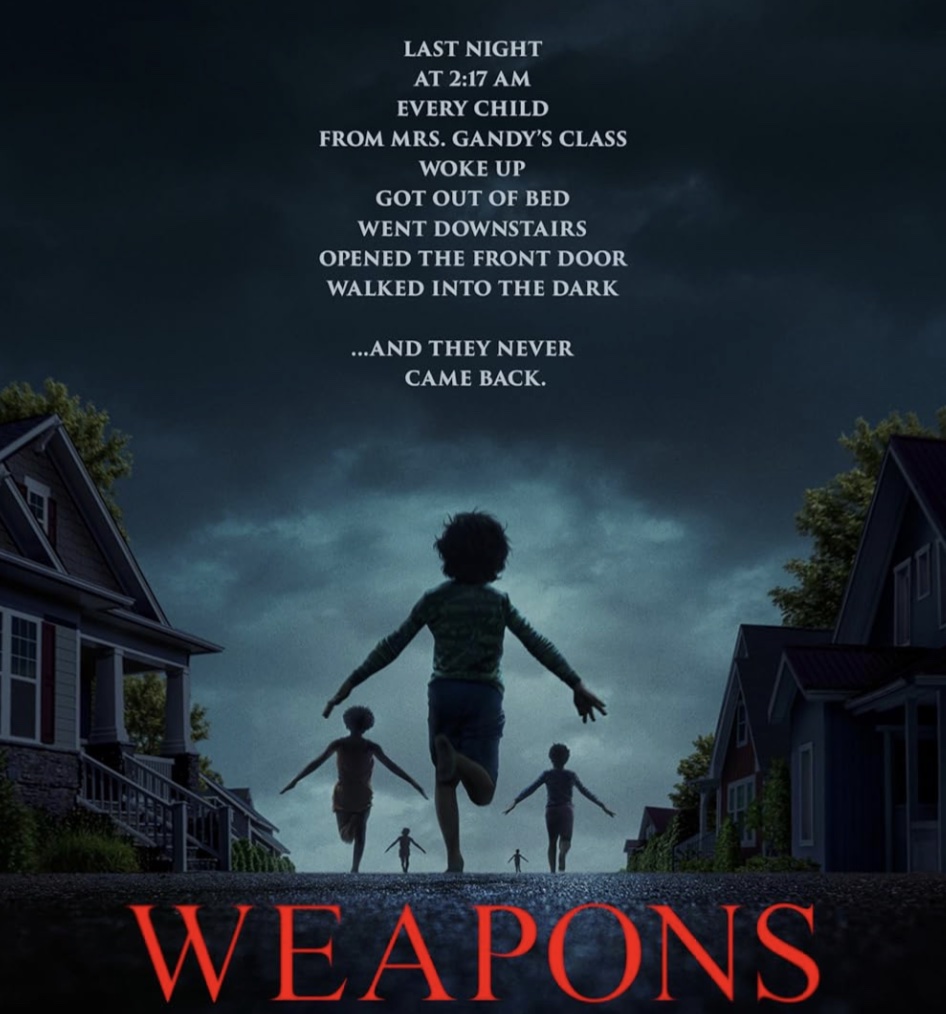
Zach Cregger’s, for all intents and purposes, second movie (it seems unlikely that there would be many people counting Miss March), Weapons, is already a sign of his vast progression as a writer-director in the time since the critically acclaimed Barbarian was released in 2022. And, in a similar fashion to Barbarian, Weapons showcases heavy themes of abuse, suppression and oppression. And what better framework for conveying such horrors than the disappearance of seventeen elementary school children? More unsettling still, the fact that all seventeen kids were in the same class taught by Justine Gandy (Julia Garner), with only one student, Alex Lilly (Cary Christopher), showing up for said class the morning of their disappearance, at 2:17 a.m. It was at this exact time that all seventeen kids ran out the door of their houses and into the night. Indeed, their unexplained fleeing (almost as though they were flying, arms outstretched—as shown in the eerie movie poster) into the darkness was captured on the Ring cams of many of their parents.
Archer Graff (Josh Brolin) is one of those parents. The father of Matthew Graff (Luke Speakman), who happens to be one of Alex’s primary bullies, Archer is the most vocally suspicious of Justine a.k.a. Ms. Gandy. He absolutely insists that she must have something to do with the children’s disappearance. He makes those feelings known during a meeting held at the school a month after the students’ unexplained “departure,” with Marcus Miller (Benedict Wong), the principal, opting to schedule the community gathering so that he can talk about grief with parents and residents the night before the school is meant to open again. And yet, when he says “grief,” Archer apparently hears that as “grievance,” airing his quite fervently as he all but accuses Justine in front of everyone of being a witch (that word harshly coming to roost on her car as well).
Certainly, a large bulk of Weapons is about a modern-day witch hunt, a community turning on each other when the going gets rough (à la Eddington). Justine is an effortless scapegoat, viewed as someone “dangerous” who must have been teaching the kids subversive things in order for them to abscond like that. Here, too, is one of the underlying themes of Weapons—the idea that teachers are constantly deemed as a threat by parents (particularly conservative ones). Somehow “seditious,” “infecting” the youth with “funny ideas” about life and how to live it.
More than that message, however, is the one that emphasizes how children are constantly taken advantage of by adults who seem, whether they’re aware of it or not, to get off on the inherent power/authority they have over children. After all, there’s a reason the trope about the innocent (this word so often being synonymous with “weak”) being the easiest to prey upon is so common. Along with the trope about education and law enforcement attracting some of the most abusive people. And yes, Cregger gets his digs in about cops as well, with Paul Morgan (Alden Ehrenreich) showing his true abusive colors more than a few times when it comes to exerting authority over the town’s resident junkie, James (Austin Abrams). Because, needless to say, even small, “idyllic” towns can have their “bad apples” and sinister, supernatural goings-on. Just look at Twin Peaks—to be sure, there’s plenty of Lynchian aspects to Weapons, far more than there are in Barbarian. Maybrook, a fictional suburban milieu in Pennsylvania (though the film itself was actually shot in Georgia), proves no exception to the rule. Complete with its seedy bars and general sense of “not all is as it seems here in Mayberry (or Mayfield, if you prefer)” vibes.
And, since each character is but a jigsaw piece in the larger puzzle of what happened to these children, Cregger opts to tell the tale from multiple perspectives, allowing the complete picture to unfold in the final act. But before the multi-perspective device begins, Weapons starts out with a child’s voiceover (delivered by Scarlett Sher), immediately indicating that the audience can’t trust the adults to give the real story (in this sense, channeling part of what Harper Lee wanted to achieve in telling To Kill a Mockingbird from Scout’s point of view). Instead, as the child narrator informs, the adults are too ashamed by their own inefficacy at figuring out what really happened that they feel compelled to cover the whole thing up. Bury the truth, bury the shame. In this way, Cregger also reinforces the notion that just because someone is adult, it doesn’t mean they have any clue about what’s really going on. That, of course, is pure myth.
In addition to Cregger’s now usual theme of suppression/oppression of the innocent, some audience members might also pick up on the theme of grief that drove the entire script/scriptwriting process. For it was around the time that Cregger started writing it that one of his best friends died without warning. This feeding into the concept of people just “disappearing into thin air” so suddenly. So unsettlingly. As Cregger put it, “The idea of these children leaving and this community left to grapple with how to feel about it—that phantom limb you get when you lose someone—it just felt very pressing.” Much the same way it feels pressing to say something, however “latently,” about the many insidious ways that children are abused and taken advantage of…often by those who are meant to be “closest” to them. Such a message coming at a time when children in war-torn countries are being picked off and/or starved at an unprecedented rate. For, when it comes to adults in power’s consideration of children, there can be no underestimating the levels of cruelty. Worse still, of apathy.
As for those searching for some kind of “Easter egg” significance in the time of 2:17 a.m., Cregger admitted, “I wish I had a great answer. I don’t. It just had to be some time.” But even his lack of a “real answer” lends further insight into one of Weapons’ strongest points: there is no rhyme or reason to cruelty, least of all when or where it happens. Sometimes, a person just does it because they can. Or maybe, if the tortured person is “lucky,” the torturer does it because they need to sustain their own “life force.”


