


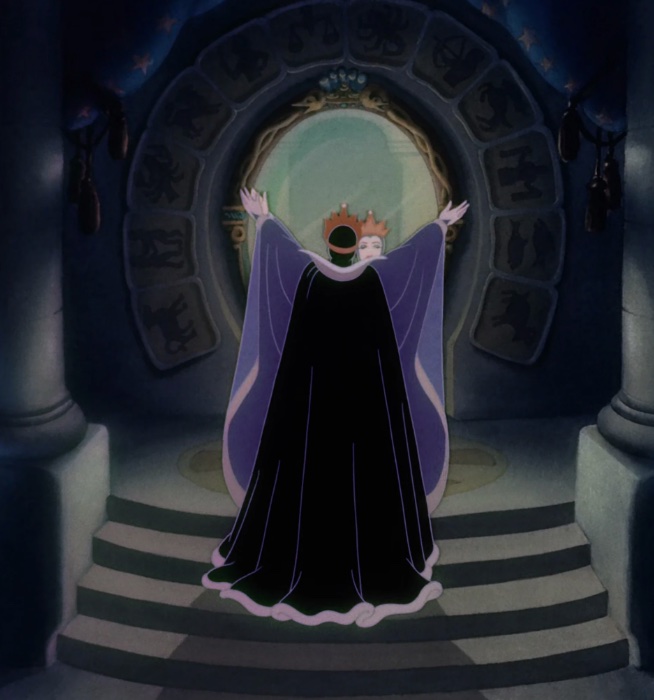
With the release of Laufey’s affecting single, “Snow White,” it’s worth looking back on some of the various other songs that women (the gender most easily rattled by the concept of beauty—and the impossible standards that society puts on it) have released about that same sense of insecurity that Laufey conveys so movingly.
“Vogue” by Madonna, 1990: While few would ever accuse Madonna of having low self-esteem, there’s no denying she’s suffered from her own insecurities about beauty. Particularly in her pre-fame days, when it took her dance mentor, Christopher Flynn, telling her she was beautiful to feel like—or even think—that she actually was. Indeed, Madonna told Time in 1985, “I knew that I was interesting, and of course I was voluptuous for my age, but I’d never had a sense of myself being beautiful until he told me.” And, because Flynn was gay, the complement held more weight, more genuineness to it, for he had no sexual agenda in telling her. But even at one of the heights of her fame, in 1990-1991, Madonna went on record in Truth or Dare when she said, “I know that I’m not the best singer and I know I’m not the best dancer, but I’m not interested in that. I’m interested in pushing people’s buttons, in being provocative, in being political.” That includes the “defiance” of not being conventionally “hot” and also challenging established notions of beauty with her ahead-of-its time inclusivity in music videos. “Vogue” was among such visual offerings, as Madonna chose to cast her Blond Ambition Tour dancers, Oliver Crumes, Luis Camacho, Jose Guitierez, Kevin Stea, Salim “Slam” Gauwloos, Gabriel Trupin and Carlton Wilborn, a rainbow of Black and Brown gay men that no other woman would have “dared” to showcase in the mainstream like that during said era. And yet, at the heart of why “Vogue” is a song about beauty (“Beauty’s where you find it”) through the lens of self-acceptance is due to one key lyric: “Soul is in the musical/That’s where I feel so beautiful.”
“Unpretty” by TLC, 1999: Nine years after a more “glamorous” approach to exploring the concept of beauty, TLC came out with their emotional “Unpretty,” the second single from FanMail (and a big about-face from the tone and theme of “No Scrubs”). The lyrics were written solely by T-Boz after she watched an episode of Ricki Lake during which the women who appeared on the show were critiqued on their physical flaws by their own husbands. Producer Dallas Austin eventually helped T-Boz turn that poem into a song that offers up such resonant lyrics as, “Never insecure until I met you, now I’m bein’ stupid/I used to be so cute to me, just a little bit skinny/Why do I look to all these things to keep you happy?/Maybe get rid of you and then I’ll get back to me.” Not only speaking to the ways in which a woman’s boyfriend (or husband) can make her feel like shit for the way she looks, “Unpretty” also addresses the ways in which society at large does the same. It’s the Paul Hunter-directed video that really drives this point home, with Chilli’s breast implants plotline in particular being a harrowing glimpse into the lengths that women will go to please their significant other, de facto the patriarchy.
“Beautiful” by Christina Aguilera, 2002: Among the most well-known songs about self-acceptance, Christina Aguilera’s ‘02 hit from her sophomore album, Stripped, remains a benchmark for other songs about beauty to this day (including Laufey’s “Snow White”). What’s more, its overarching motif of accepting oneself in the face of being deemed “other” by society is what has made it a go-to anthem in the LGBTQIA+ community, with Xtina being honored with a GLAAD award for the song and its accompanying Jonas Åkerlund-directed video, which positively presented gay and trans people (since it seems too much to ask for most mainstream media to do the same).
“Intuition” by Jewel, 2003: One of Jewel’s most brilliant songs—and also one of her most underrated singles—“Intuition” is an exploration of all the ways in which capitalism seeks to exploit people’s insecurities. Indeed, advertisers and businesses thrive on the masses being unsatisfied with how they look. It keeps the dollars coming, with everyone determined to somehow “amend” themselves until they achieve the “ideal” that is impossible to achieve. To playfully spotlight how that standard is constantly being altered for marketing purposes, Jewel sings, “They say Ms. J’s big butt is boss/Kate Moss can’t find a job/In a world of post-modern fad/What was good now is bad.” And then, to give her listeners some hope on how to navigate a world as treacherous as this, she advises, “It’s not hard to understand/Just follow this simple plan/Follow your heart/Your intuition/It will lead you in the right direction/Let go of your mind/Your intuition/It’s easy to find/Just follow your heart, baby.” Of course, sometimes that’s easier said than done.
“Ugly” by Sugababes, 2005: By 2005, the Sugababes were already in their second incarnation (Heidi Range, Mutya Buena and Keisha Buchanan), member-wise, and well-seasoned in reading negative comments about themselves both in print and online. Thus, the inspiration for “Ugly,” which also had help from Dallas Austin, like TLC’s “Unpretty.” So it wasn’t surprising that “Ugly” gained some critical comparisons to that song—as well as “Beautiful,” still fresh in the public’s consciousness. Even so, “Ugly” differentiates itself from both of those songs in that it ruminates on how the type of people who mock another person for their ugliness are often 1) insecure themselves and 2) ugly on the inside. So it is that the chorus, “People are all the same/And we only get judged by what we do/Personality reflects name/And if I’m ugly then so are you, so are you” served as one of the Sugababes’ greatest sick burns.
“Everything’s Just Wonderful” by Lily Allen, 2006: The fourth track on Allen’s Alright, Still, “Everything’s Just Wonderful” might not be immediately apparent as a song that contends with impossible beauty standards, however, there is one verse in particular that stands out with regard to this issue. And it arrives when Allen sardonically chirps, “I wanna be able to eat spaghetti Bolognese [said in that British way as ‘bowl-uhn-yaise’]/And not feel bad about it for days and days and days/In the magazines, they talk about weight loss/If I buy those jeans, I can look like Kate Moss/I know it’s not the life that I chose/But I guess that’s the way that things go.” And yes, Kate Moss always seems to be referenced when it comes to living up to impossible beauty standards.
“Young and Beautiful” by Lana Del Rey, 2013: After being shepherded out of the harrowing 2000s, a difficult time for women who were constantly being scrutinized, there seemed to be a glimmer of hope in terms of believing that a man could love a woman for something more lasting and meaningful than her looks. Hence, Lana Del Rey’s dreamy, baroque pop track (featured on The Great Gatsby Soundtrack), “Young and Beautiful.” During which she offers up the morose yet hopeful chorus, “Will you still love me when I’m no longer young and beautiful?/Will you still love me when I got nothing but my aching soul?/I know you will, I know you will, I know that you will.” Alas, that didn’t quite hold true for Kimye, at whose wedding Del Rey performed this song.
“Pretty Hurts” by Beyoncé, 2013 (released in 2014 as a single): That same year as the release of “Young and Beautiful,” Beyoncé had a very different view of beauty. One that emphasized the notion that little had changed since the pressures explored in TLC’s abovementioned 1999 track. As such, she chose to set the Melina Matsoukas-directed video amid the ultimate feminine battleground and cliché: a beauty pageant. This lending even more credence to Bey belting out, “Pretty hurts/We shine the light on whatever’s worst/Perfection is a disease of a nation/Pretty hurts/We shine the light on whatever’s worst/We try to fix something/But you can’t fix what you can’t see/It’s the soul that needs a surgery.” More specifically, the “soul” of society, which sets the benchmark for how people feel they ought to be perceived. As for Matsoukas’ vision for the video (all awash in female competitiveness and an obsession with being thin), she commented at the time, “…we definitely wanted to speak to as many women as we could and all the pain and struggle that we go through as women to maintain this impossible standard of beauty.”
“Jealousy, Jealousy” by Olivia Rodrigo, 2021: The dawn of the 2020s signaled a new era of pop stars, chief among them Olivia Rodrigo. And yet, more than pop, Rodrigo has often shown herself to be a bona fide “rocker” (this also made manifest in the types of guests she chooses to invite onstage—e.g., David Byrne, Weezer, et al.). A sound that shines through on the angsty, guitar-ridden “Jealousy, Jealousy” from her debut album, Sour. Like the theme on Sugababes’ “Ugly,” Rodrigo speaks from the perspective of how envy can make one’s perspective on beauty more than slightly skewed. But, in contrast to Sugababes’ day, Rodrigo’s generation has had to contend with the mind-fuck that comes with being chronically online, making it all the easier to compare one’s “lack.” So it is that Rodrigo confesses, “I kinda wanna throw my phone across the room/‘Cause all I see are girls too good to be true/With paper-white teeth and perfect bodies/Wish I didn’t care/I know their beauty’s not my lack/But it feels like that weight is on my back/And I can’t let it go.”
“Grapefruit” by Tove Lo, 2022: Nor can Tove Lo on “Grapefruit,” a song that speaks to the level of body dysmorphia that’s only been further intensified by the digital age. However, Tove Lo’s own battle with bulimia was brought on before the pervasiveness of social media, when she was told by a modeling agency (around the age of fifteen) that she needed to lose weight. So began a years-long battle with the disease. One that still clearly haunts her in lyrics like, “Sweet girl, you’re so disciplined/Now keep it down/I don’t like my measurements/Won’t make a sound/Diana, how she guards the clock/She’s in control/Now why is everyone in shock?/You let her go.” This Diana allusion obviously being to Diana Spencer a.k.a. Princess Diana, who famously struggled with her own bulimia issues over the decades she was married to Prince Charles.
“Lacy” by Olivia Rodrigo, 2023: Rodrigo wasn’t done talking about the pratfalls of comparison on her sophomore album, Guts. Enter “Lacy,” a song about a phantom girl meant to represent every impossible female ideal. And, like T-Boz with “Unpretty,” “Lacy,” too, originally started out as a poem. One that accuses, “Lacy, oh Lacy, it’s like you’re out to get me/You poison every little thing that I do/Lacy, oh Lacy, I just loathe you lately/And I despise my jealous eyes and how hard they fell for you/Yeah, I despise my rotten mind and how much it worships you.” It is through this fraught verse that Rodrigo illuminates the dichotomy of hating the woman who represents the feminine ideal and also wanting to be her.
“Pretty Isn’t Pretty” by Olivia Rodrigo, 2023: Yet another song on Guts that explores Rodrigo’s relationship to beauty, “Pretty Isn’t Pretty,” like “Lacy,” waxes on the torture of chasing an unattainable aesthetic. One that’s designed to never be achievable because, again, advertisers and businesses thrive on the money made from those constantly seeking to “improve” themselves with the products that will supposedly do just that. And so, Rodrigo rightly assesses, “‘Cause there’s always somethin’ missin’/There’s always somethin’ in the mirror that I think looks wrong/When pretty isn’t pretty enough, what do you do?/And everybody’s keepin’ it up, so you think it’s you/I could change up my body and change up my face/I could try every lipstick in every shade/But I’d always feel the same/‘Cause pretty isn’t pretty enough anyway.” In other words, you can never fully embody The Ideal.
“What Was I Made For?” by Billie Eilish, 2023: And, talking of The Ideal, it’s only too appropriate that a song made for the Barbie Soundtrack should speak to one’s insecurities. After all, Barbie is the ultimate symbol of what it has meant to be “the perfect woman.” Yet, as the movie shows, even Barbie (Margot Robbie) is filled with her own self-doubt once she leaves the safe confines of Barbie Land, thrust out into the Real World, where, as told through the lyrics of Eilish, she realizes, “I was an ideal/Looked so alive, turns out I’m not real/Just somethin’ you paid for/What was I made for?” As Barbie comes to terms with her own humanity (and cellulite), she begins to understand that being human has its perks, chief among them being agency (or so we’d like to believe). Ergo, Eilish’s chorus, “‘Cause I, I/I don’t know how to feel/But I wanna try/I don’t know how to feel/But someday I might/Someday I might.” And hopefully what she feels is not quite as shitty as other women do about their body and looks.
“Girl, so confusing” by Charli XCX, 2024: Among the few songs to really cut to the core of how competition between women is a primary part of what fuels the drive to be “the most beautiful,” “Girl, so confusing” is a revelation of candor. Made all the more so by the girl Charli is speaking to, Lorde, opting to appear on a remix of the song to “work it out on the remix.” Thus, showing other women that, more often than not, the girl one is jealous of is probably also jealous and insecure too. This made evident by Lorde freely admitting to Charli, “You’d always say, ‘Let’s go out’/But then I’d cancel last minute/I was so lost in my head/And scared to be in your pictures/‘Cause for the last couple years/I’ve been at war with my body/I tried to starve myself thinner/And then I gained all the weight back/I was trapped in the hatred/And your life seemed so awesome/I never thought for a second/My voice was in your head.” But oh, how it was. Presently showing up in a healthier way thanks to their improved friendship as a result of this collaboration.
“Broken Glass” by Lorde, 2025: As she was on the “Girl, so confusing” remix, Lorde is also extremely frank about her eating disorder (like Tove Lo, she suffered from bulimia) on Virgin’s ninth track, “Broken Glass.” Indeed, she remarked that it was one of the most difficult songs to record, as she went back and forth on the idea of 1) wanting to return to that dark time in her life and 2) sharing it so publicly. In the end, there’s no doubt she made the right choice in sharing it, for there are many women who still need to be reminded that they’re not alone in such battles and feelings of self-loathing. A sentiment acutely described in the chorus, “I wanna punch the mirror/To make her see that this won’t last/It might be months of bad luck/But what if it’s just broken glass?/I spent my summer getting lost in math/Making weight took all I had/Won’t outrun her if you don’t hit back/It’s just broken glass.”
“Snow White” by Laufey, 2025: And, talking of looking in the mirror to determine if you’re “the fairest of them all” yet, with “Snow White,” Laufey joins the ranks of women who have explored the triggering concept of what it means to be “beautiful” in this society that places a premium only on a woman’s appearance and youth. Ergo, a “Snow White” lyric that delivers an especial gut punch for its frankness: “I don’t think I’m pretty, it’s not up for debate/A woman’s best currency’s her body, not her brain/They try to tell me, tell me I’m wrong/But mirrors tell lies to me, my mind just plays along/The world is a sick place, at least for a girl/The people want beauty, skinny always wins/And I don’t have enough of it/I’ll never have enough of it.” In many regards, it echoes Rodrigo’s feelings on “Pretty Isn’t Pretty” when she asks, “When pretty isn’t pretty enough, what do you do?” The answer lies somewhere in the first track mentioned on this list, wherein Madonna—beacon of self-confidence extraordinaire—reminds that “soul is in the musical.” In which case, all of the women on this list ought to feel “so beautiful.”


[…] to be to gut-punch her listeners with the tonal shift on “Snow White,” an instant classic in the annals of songs about beauty (or, more specifically, the pressures and impossible expectations on women to “look hot”). […]