


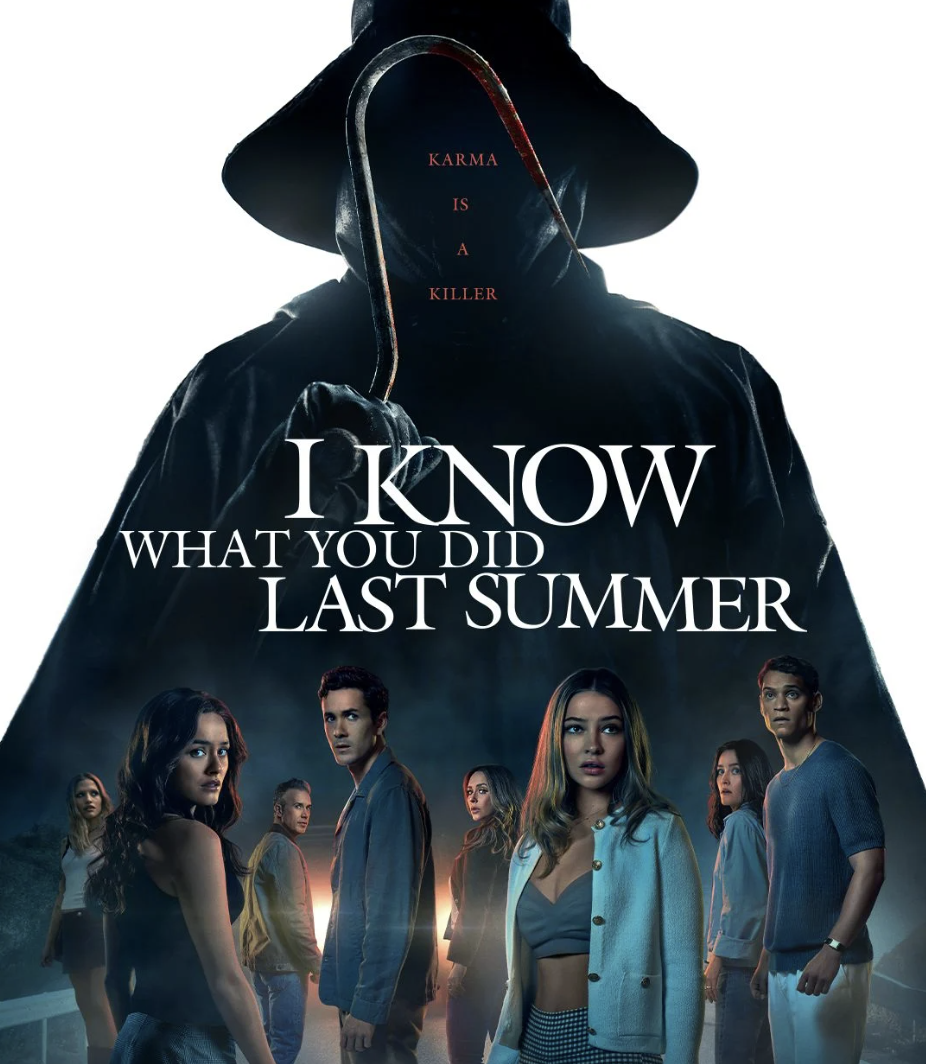
“Nostalgia’s overrated.” This is what Julie James (Jennifer Love Hewitt) retorts at one point to Ray Bronson (Freddie Prinze Jr.), a fellow OG of being stalked and nearly killed multiple times by The Fisherman of I Know What You Did Last Summer. Like many things about this “requel” edition of the movie, the comment is a meta reference to the past. And, more specifically, how it can’t be erased. Indeed, this is the first warning—“You can’t erase the past”—that the “new” Helen Shivers (Sarah Michelle Gellar) of the group, Danica Richards (Madelyn Cline), sees scrawled in blood over her fiancé, Wyatt (Joshua Orpin), a year after she and her friends bear witness to a terrible car accident. An accident that could have been avoided were it not for Danica’s then-fiancé, Teddy Spencer (Tyriq Withers), acting a drunk and high fool in the middle of the road. And while their crime isn’t as egregious as what Julie and co. did back in the day (call it a “generational divide” on the level of tolerance for fucked-up shit), the friend group of the present still could have prevented the driver from dying. This being part of the great moral quandary of the incident.
In any case, Teddy is, needless to say, the updated version of Barry Cox (Ryan Phillippe)—and yes, his name is mocked by Teddy when he sees it on the gravestone. Barry, boyfriend to Helen, and the drunk fool in the original scenario who acts so wild, crazy and generally distracting that Ray has no chance of seeing a pedestrian walking into the middle of the road as he swerves around the curve. The allusion to running someone over is made in I Know What Did You Last Summer (2025) when Teddy fake gasps as though something has just come into the car’s pathway. When Danica, the driver in this scenario, steps on the brakes, she finds that Teddy was just trolling her, much to her extreme annoyance. Though maybe it’s not as annoying as him making a “joke” to the effect of “and they say women can’t drive well,” then promising he’s “just kidding.” This form of misogyny is perhaps part of writer-director Jennifer Kaytin Robinson’s homage to the original, with Love Hewitt as Julie telling Ray and Barry in one of the first scenes (specifically, the Miss Croaker Pageant that Helen wins), “Guys, hi. I’m on sexist overload as it is. Kill the commentary.” It’s a sentiment that Love Hewitt has come to agree with more than she could have ever realized then.
As a matter of fact, in agreeing to return to the franchise, Love Hewitt had to make peace with a few things about the past herself. One that she doesn’t feel nostalgic about at all. Not the way Gen Z does when they look back on the late 90s/00s as something like #goals. But Love Hewitt doesn’t remember everything being so much better back then. Indeed, she recalls things being far worse. For it was a time when commenting on women’s bodies was not only “okay,” it was the norm. In the present, such commentary still rages on, but there’s more control over it from the women whose bodies are being dissected. And Love Hewitt’s is once again in the spotlight because she’s “dared” to not resemble her eighteen-year-old self for her reprised role.
So it was that, in a profile/interview by Rachel Handler for Vulture, Handler writes, “I ask what made her so anxious [about returning to the movie], and she answers matter-of-factly: ‘What people were going to say about how much older I would seem than when I was eighteen. That’s literally the only thing I was anxious about.’” Sadly, Love Hewitt wasn’t mistaken in her fear. But that doesn’t stop her from subtly trolling right back from her perch in front of the camera. Mainly, with a coffee mug that reads, “The Patriarchy’s Tears” on it. This sipped from as she counsels the latest obsession of The Fisherman’s, Ava Brucks (Chase Sui Wonders, who more people should recognize from The Studio), on how to deal—take this as the reference it is to her little appreciated 1998 single from I Still Know What You Did Last Summer, “How Do I Deal.”
Julie has more answers to this question than Love Hewitt on that song, telling Ava that the key to beating this killer is finding out who he is and why he’s been incentivized to kill them after the accident. Julie’s also chock full of advice for the students she teaches, informing them, “Trauma changes the brain in mysterious and complex ways.” This statement being all too applicable in terms of who the killer turns out to be.
But it’s also a statement that applies to Love Hewitt coming to terms with her own trauma, by even acknowledging it in the first place. As that revelation is described in the aforementioned Vulture article, “Hewitt says she recognized how much it had all messed with her head only a few years ago when she watched the documentary Framing Britney Spears, which covers, among other things, the misogynistic treatment the singer received from the media and the public. ‘When I started watching it, I was like, Oh, they talked to me like that. Oh,’ Hewitt says. ‘I started crying for her. And then I realized I was crying for me.’” Eerily/fittingly enough, the co-screenwriter for I Know What You Did Last Summer (2025) is Sam Lansky—none other than the ghostwriter for Spears’ highly successful memoir, The Woman in Me.
Like Robinson, Lansky is the type of millennial who would have not only been highly affected/well-formed by Spears’ oeuvre, but also by the Williamson canon, which includes more famously than IKWYDLS, Scream. The latter being a more prolific franchise perhaps because it isn’t quite as limiting, what with its plot that hinges on someone getting brutalized in a car accident, feeling the need to wear a fisherman’s getup and secure revenge by slashing those involved with a hook and for all of this to occur in a coastal North Carolina town. Namely, Southport. Which, surprisingly, is a real place in NC. As is Outer Banks, which is where the show of the same name starring Madelyn Cline a.k.a. Danica Richards takes place. And no, to one’s shock, Outer Banks wasn’t created by Williamson, a North Carolina boy himself who accordingly has a production company called Outerbanks Entertainment. The very production company responsible for another Williamson baby, Dawson’s Creek, filmed in nearby Wilmington (despite being set in the fictional Capeside, Massachusetts), and a show that also incorporated IKWYDLS into one of its first season episodes (“The Scare”). Not to mention a show that was a staple of the era of nostalgia that Love Hewitt is not overly fond of when she looks back on it with the wisdom of hindsight.
To that point, Handler synthesizes what it means to be skeeved out by nostalgia rather than charmed by it when she notes in her JLH interview, “Reading her old press clips, in which men and women alike refer glibly or grossly to her breasts, is like entering a cursed Y2K-hole where ‘MMMBop’ is playing on loop and Carson Daly won’t stop laughing at you.” Sounds like it could be a scene in its own separate thriller/horror movie, to be sure. But, for the purposes of IKWYDLS, 2025, the likes of 90s and 00s-esque music will have to suffice over “MMMBop.” This includes Chloe Slater’s “Tiny Screens,” a grunge-reminiscent track that plays over the first scene of the camera panning across the choppy waters of Southport (in an opening that’s almost identical to the original movie).
Then there’s Ravyn Lenae’s “Love Me Not,” a familiar hit that plays as Ava struggles to find something to wear to Danica and Teddy’s engagement party, where she knows her ex, Milo Griffin, will be. Played by Jonah Hauer-King, his similar look to Jack Alcott, who plays Harrison Morgan on Dexter: New Blood and Dexter: Resurrection, is further compounded by the semi-similar plotline of a podcaster named Tyler Trevino (played by, of all people, Gabbriette—adding to the camp factor) showing up into town (to the tune of Renée Rapp’s “Leave Me Alone”—because Charli XCX’s “360” would have been too meta, even for a movie like this) a year after the friend group, rounded out by Stevie Ward (Sarah Pidgeon), experiences more or less the same moral dilemma as Julie and co. did back in 1997.
Only, most people who live in Southport in the present aren’t aware of the Southport massacre, thanks to Teddy’s dad, Grant (Billy Campbell). A real estate mogul who has made it his mission to whitewash the past so as to secure the gentrification (or, as Tyler calls it, “gentri-slay-cation”) of the future, remaking the area into the “Hamptons of North Carolina.” So committed is he to the monetary value of this mission that he even has the internet “scrubbed” of headlines pertaining to the massacre. But that scrubbing is no match for Tyler, who’s on the case with Live Laugh Slaughter, which has a similar ring to it as the Merry Fucking Kill podcast that becomes a key aspect of Dexter: New Blood’s plot. And yes, true to the real-life nature of Gabbriette, Tyler gleefully sports a Helen Shivers shirt with the Croaker Queen’s face screen-printed on it. The Croaker Queen whose cameo during a dream sequence is also one of the highlights of the movie, in addition to being one of the highlights of its campiness.
However, camp and nostalgia aren’t the only elements IKWYDLS is keen on delivering this time around. There’s also a dash of politics, too (and not just in terms of spotlighting, almost Jaws-style, how business steamrolls over everything in a society that favors capitalism). This via the resonant line, delivered by Ava, “Fuck the Fourth of July.” Julie concurs. It is, in its undercutting way, a political comment on the state of the U.S. Because back in 1997, the thought of uttering, “Fuck the Fourth of July” would have been far more unthinkable. As it would have been that Ray could turn out to be so pathetic, such a toxic clinger to the past for all the wrong reasons.
But while Robinson and Lansky might be cautioning against the dangers of nostalgia (like Love Hewitt herself after actually enduring the harrowing era when IKWYDLS came out), as the credits roll, Addison Rae’s “Summer Forever” plays with a wink, providing yet another infusion of “modernity” into the film. And yet, Rae herself is the poster child for parading late 90s/early 00s nostalgia (just look at her album cover for Addison alone). So the dichotomy of the movie is there until the very end, on the one hand cautioning youths who romanticize a past they didn’t live through and, on the other, reveling in the fact that IP from the past is the only thing that people seem motivated enough to go to a movie theater for.


[…] You Did Last Summer (a part so synonymous with her filmography that of course she reprised it in the requel of the same name). Released in October of 1997, the popularity of the movie (which remained number one at the box […]