


There are often many things about music videos that don’t “jive” with the real world. And why should they? Because isn’t a “music video universe” at least partially about escapism? A retreat into the fantastical and over-stylized? Unless, of course, it’s a political statement video like, say, Pearl Jam’s “Jeremy” or Childish Gambino’s “This Is America.” Then again, Madonna’s 1986 hit, “Papa Don’t Preach,” isn’t exactly “escapist.” Indeed, it’s among the most political songs ever to top the Billboard charts. And, depending on who you ask, the political message behind the song is variable. To some, it’s an anthem for teenage pregnancy; to others, a pro-life call to arms (though that certainly isn’t on-brand with Madonna’s personal politics). This perhaps being all part of Madonna’s master plan to “provoke thought and take you on an emotional journey” (to quote part of her 1990 speech after stirring up controversy in Rome [read: Vatican City] with her Blond Ambition Tour). Which she certainly does from the outset of the James Foley (RIP)-directed video.
In the present, that sense of emotionalism retroactively comes from the fact that the images of “the New York of yore” act as a time capsule, showing viewers how much simpler and more carefree it appeared, at least on the surface. As for the “enchantment” element that characterizes the video, it all starts with the rapid-fire scenes of New York set to the pace of the Marcato Strings preset on the Emulator II synthesizer favored by Stephen Bray for this track. Foley’s cut to a scene of Madonna in jeans and a blue and white-striped shirt (a.k.a. a Breton shirt) with a leather jacket slung over her shoulder as she walks along the perimeter of Staten Island that features a view of the New York skyline (with the original World Trade Center shown in all its glory) is soon interspersed with two “other” Madonnas: Madonna the child in the home movies and Madonna as the storyteller rehashing this narrative to viewers. The latter is always set against an all-black backdrop and sports a different coif and outfit to make the distinction from the adult Madonna in this edgy fairy tale. A fairy tale in which the viewer is given that unsettling feeling of enchantment wearing off in one area of a girl’s life (in the relationship she has with her father) and strengthening in another (in the relationship she has with her boyfriend).
The bifurcation of her girl self and her woman self is made clear at the one-minute-and-three-second mark, the instant when Alex McArthur appears in the frame for the first time. Passing Madonna and her friends (played by M’s real-life chums Debi Mazar and Erika Bell) and eyeing her so intensely she has to do a double take in her famous “Italians Do It Better” tee. Indeed, this is a moment of attraction that’s also similarly re-created in another Foley project released the same year, At Close Range. Namely, during the opening scene as Madonna’s then husband, Sean Penn (as Brad), locks eyes with Mary Stuart Masterson (as Terry) while driving.
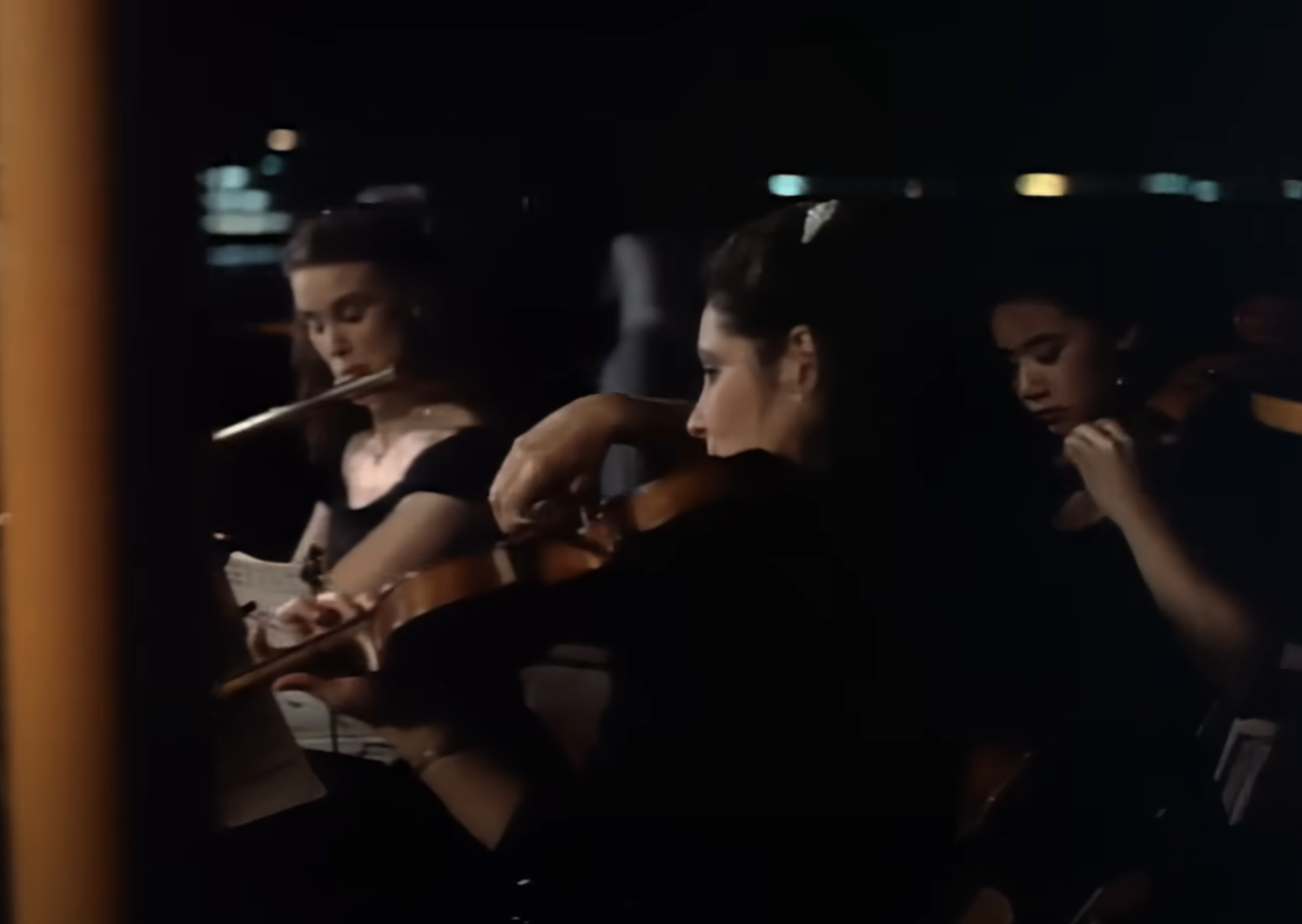
Once their eyes meet, Madonna’s a goner, so to speak. Hopelessly in love with and devoted to her blue-collar man, who she visits at the auto body shop where he works as a mechanic soon after that initial encounter. From that point forward, the relationship clearly escalates quite rapidly, for it’s not long before Madonna is defiantly walking away from her friends as the lyrics, “But my friends keep telling me to give it up/Saying I’m too young, I ought to live it up” play to this scene, indicating that she’s already told them about her pregnancy (even though it isn’t until later in the video that we see her looking at a pregnancy test while standing amid one of the many concrete ruins that were once so pervasive in NY in general and SI specifically). The one person she has yet to break the news to is Papa (played by Danny Aiello), who she clearly dreads telling in the scenes that follow, holding back from shattering his “little girl” image of her for good. So instead, she goes out on another date with her soon-to-be baby daddy, indulging in a romantic nighttime outing on the Staten Island Ferry. But perhaps Foley and Madonna thought to themselves, You know what would make this even more romantic and whimsical? A violinist, a cellist and a flautist subbing in for the synthesizer. This trio of women (and it is remarkable that they’re women instead of men, as would have been the norm) appearing in frame as Madonna and her boo impulsively run together on the outside deck after an elderly couple looks at them a little too wistfully. Perhaps feeling uncomfortable with all that’s being projected onto them in that moment, the duo starts laughing and then scampers off to a different part of the deck together so they can dance.
Enter the trio to soundtrack their impromptu moment of amplified romance. And this is where the abovementioned “not jiving with the real world” portion of the video sets in. Up until this moment, “Papa Don’t Preach” was entrenched in blue-collar realism, but this sudden insertion of “fancifulness” borders on the incongruous. And yet, perhaps it’s all in keeping with the “fairy tale” aspect of the narrative, even if it’s one that veers toward the tragic. Indeed, it would have been an outright tragedy if Madonna’s patriarch had refused to embrace his daughter (figuratively and literally) after hearing her news. And yes, the viewer is led to believe that this could very well be a strong possibility as Madonna endures the stern, silent treatment reaction of her father (no doubt inspired by the severity of Madonna’s real daddy, Silvio “Tony” Ciccone).
In truth, such a reaction would add up since, in a way, the presence of these three musical women—whose instruments don’t even technically appear in the song—just before Madonna finally confesses (always the Catholicism with her) enhances the idea that right when things are at the apex of “feeling magical” is, more often than not, a precursor to when a person is about to hit a nadir (or, as Bridget Jones once put it, “It is a truth universally acknowledged that when one part of your life starts going okay, another falls spectacularly to pieces”).
But no, since this is still, at heart, a fairy tale (even if set in Staten Island), things do turn out okay for Madonna. Mainly because she not only “chooses her choice” (as Charlotte York would say), but because she stands up to her patriarch (ergo, the patriarchy) for what she wants. And besides, it would be another seven years before Madonna opted to give a truly unhappy ending to one of her music videos: “Bad Girl.” A title that many felt could have just as easily applied to the woman depicted in “Papa Don’t Preach.” However, if being a “bad girl” means inexplicably conjuring up musical ensembles in places where they shouldn’t be to soundtrack a memorable moment of your life, well, then sign one up for being a bad girl.


[…] A Violinist, A Cellist and A Flautist Walk Onto a Ferry…In Madonna’s “Papa Don’t Preach” V… […]