


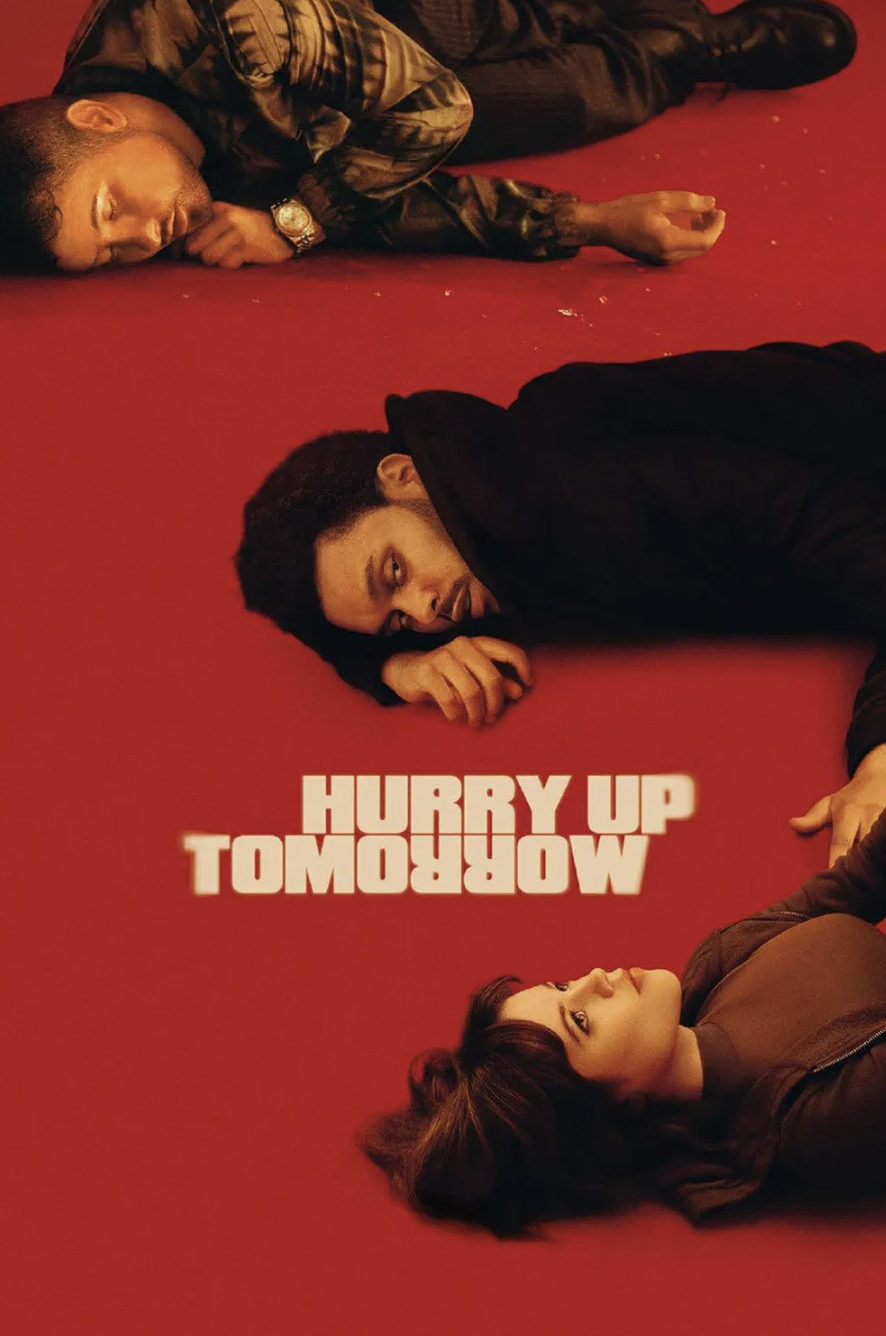
Of course, The Weeknd isn’t the first musician to come face to face with a botched film project a.k.a. critical and box office bomb. For, in the wake of Hurry Up Tomorrow, he’s now in good company with the likes of Madonna (Body of Evidence, Swept Away et. al), Britney Spears (Crossroads), Mariah Carey (Glitter), Prince (Under the Cherry Moon) and Cher (Chastity) when it comes to the film gods shitting—rather than smiling—upon them. The difference is, save for Mariah’s Glitter, the other music icons weren’t involved in movies that attempted to vaguely fictionalize their lives (Madonna, instead, going full documentary with Truth or Dare, which was actually one of her most well-received movies—others, not so much).
With Hurry Up Tomorrow, a movie that shares its name with The Weeknd’s sixth album, released earlier this year, further evidence is given that it’s ill-advised for musicians to attempt playing themselves in movies (unless it’s Charli XCX in The Moment, which will probably be far more watchable). Especially because, for the majority of this ego-driven lot, it’s difficult to engage in true self-parody seeing as how they all tend to take themselves much too seriously.
That certainly seems to be the case for The Weeknd, who also goes by Abel Tesfaye in the movie—yet another indication that he’s aiming to shed the “persona” of The Weeknd in the near future, a possibility he mentioned in an interview with Variety back in January (the same month that his record came out). Indeed, it seems that Hurry Up Tomorrow, both album and film, are all about “returning” to Abel, the person he was before The Weeknd arose as a coping mechanism. Except that the film isn’t “about” much of anything, save for a fan of his, Anima (Jenna Ortega, who went so far as to executive produce the movie), going “psycho” after spending a night with him in a lavish hotel room.
As for her name, it’s a bit heavy-handed on the metaphor front. For it means, in Jungian psychology, “the feminine part of a man’s personality.” Or, in philosophical terms, it means “the soul, especially the irrational part of the soul as distinguished from the rational mind.” Obviously, both definitions are what Anima, via her “unhinged” nature, represents. A foil for The Weeknd himself—who has always loved a good alter ego and/or id persona.
While, at first, The Weeknd is only too down to take her on a journey—otherwise known as: just another average night for him—after literally running into her when the concert is over, he quickly begins to regret being so open with Anima in his vulnerable, in-need-of-a-woman’s-touch state. A state compounded by the fact that he’s been having difficulty with his voice, the strain and stress of his life causing it to vanish when he least expects it while onstage (this inspired by the real-life event that happened to The Weeknd at his September ‘22 SoFi Stadium performance in support of the After Hours Til Dawn Tour—and yes, he even wears the same “illuminati cape,” of sorts, from that tour in the movie to really emphasize how close to “real life” it all is).
Directed by Trey Edward Shults, whose filmography is minimal but usually focused on the psychological horror/thriller genre, Tesfaye also co-wrote the script with him and Reza Fahim. Though it doesn’t seem scripted so much as “a general outline” was made and the only other two principals, Ortega and Barry Keoghan, were told to “just go with it.” As for Keoghan, he might have been compelled to take the role because he was allowed to keep his Irish accent while playing the part of The Weeknd’s “cheerleader” manager, Lee. So cheerleader-y, in fact, that he strokes The Weeknd’s ego real good every time he has a nervous breakdown (often), telling him he’s not an ordinary human, therefore not only can he go on, but he must go on—because his loyal devotees need him. Indeed, Lee assures him, he’s more like a god.
Here, it must be said that The Weeknd does seem to view himself as the modern answer to Michael Jackson. And while, vocally and musically, that might be true, it isn’t when it comes to album sales (though The Weeknd did recently break a Michael Jackson tour record). Even so, he bears a similar messiah complex. One that Anima more than slightly panders to as they lock eyes in the crowd during one of his shows—catering to the ultimate fan fantasy that their parasocial connection to the object of their obsession will one day reciprocate the same intense feelings. And perhaps The Weeknd wants his fans to hold onto that hope for the sake of selling more records. Though not, apparently, very many movie tickets.
In any case, isn’t really until this portion of the “movie” (though it’s really more of an impressionistic, half-realized attempt at a music video) that something resembling a plot point begins to form (however cursorily). Up until then, it was mostly The Weeknd amid nightmarish dream sequences and getting upset over his latest serious girlfriend abandoning him. A girl that, tellingly, we never see, for, when it comes to The Weeknd’s ego, it’s never about anybody except himself. That she could “dare” to leave him is what sends him into a tailspin more than the thought of losing the one he loves “so much.”
Anima appears right around this time to cushion the blow, becoming “disturbingly” attached the next morning, even though The Weeknd was acting just as needy the night before. However, once he gets what he wants out of her—an ego boost—he’s all ready to get back to his tour. Something that Anima won’t allow, knocking him out and tying him to the bedframe. For not only is she still attached to him, but she has a few messages to deliver. Ones that speak to his fucked-up psychology—including his tendency to use women for pop songs, sucking them dry until he gets an album or two out of them (though Taylor Swift is often guilty of the same “crime”).
So it is that Ortega is given her moment to really shine by torturing The Weeknd in a manner that’s highly unique to a musician: playing their songs for them and dissecting the lyrics while they squirm out of total uncomfortableness (though perhaps there’s a bit of pleasure-pain in The Weeknd’s case, for it’s clear he loves the sound of his own voice). To be sure, apart from getting to stab Barry Keoghan (likely as a favor to her new bestie, Sabrina Carpenter), this scene is the only reason Ortega could have possibly agreed to be part of this…endeavor. Her “deep dive” analysis of his music gives way to the type of scene one would expect of Patrick Bateman in American Psycho, with Anima giving him stats and personal reviews on songs like “Blinding Lights” and “Gasoline” (which Anima deems a “failure” by usual standards for The Weeknd, said dialogue implying this is how The Weeknd himself genuinely feels about its reception—that it was underwhelming considering how “good” it is).
Arguably, this is actually the best scene of the movie (though, to be fair, there isn’t much competition for that), because, for once, it seems that Hurry Up Tomorrow can bill itself as a satire. Though not during the rest of the roughly one hour and forty-five minutes of this roaming, incoherent “odyssey.” Complete with The Weeknd’s noticeably bad acting (worse than that is the thought he might not be acting at all) and an ominous voice that sounds like Frank in Donnie Darko occasionally chiming in to say things like, “Call me by the old familiar name” (i.e., Abel).
Which, again, goes back to The Weeknd wanting to shed the skin of that “character” and go back to being Abel Tesfaye. In the abovementioned Variety article, he also added of “The Weeknd,” “It’s a headspace I’ve gotta get into that I just don’t have any more desire for. I feel like it comes with so much… You have a persona, but then you have the competition of it all. It becomes this rat race: more accolades, more success, more shows, more albums, more awards and more number ones. It never ends until you end it.” And yet, with the overarching failure of the film version of Hurry Up Tomorrow, it seems that The Weeknd spoke too soon when he also said, “I think I’ve overcome every challenge as this persona, and that’s why I’m really excited about this film, because I love this challenge.”
A “challenge” not quite mastered. Which means, unfortunately for many, that he might try his hand again at another film project as The Weeknd. Or even a TV one—since he also failed at that with The Idol. Though, to be “fair,” he wasn’t playing The Weeknd (so he says) in that instance, but rather, Tedros. Incidentally, a character he cites as a contributing factor to the loss of his voice in 2022, explaining, “I just think it was the last straw, man. There was a lot of self-imposed pressure: flying to L.A. between concerts, getting into character, shooting and then flying back for the next show.” And all to make the only thing that has been as panned as Hurry Up Tomorrow now is.
While the critics are being far harsher on it than is perhaps warranted (indeed, it would be nice if they could funnel some of that contempt toward a film that deserves it almost just as much: The Shrouds), it does bring into question yet another “sound bite” The Weeknd offered in Variety: “When is the right time to leave, if not at your peak?” Hurry Up Tomorrow is not that. De facto, he’s got to keep going. So, silver linings…


