


Every time Rihanna has dropped a new single during the five years that have past in this decade, the fanfare surrounding it has always reached a crescendo. After all, Rihanna has mostly only been a featured artist on any singles released since her last album in 2016, Anti. Case in point, Future’s “Selfish,” DJ Khaled’s “Wild Thoughts,” N.E.R.D.’s “Lemon” and Kendrick Lamar’s “Loyalty”—all released in 2017.
With the remainder of the 2010s being a Rihanna desert, musically speaking, the level of excitement around PartyNextDoor’s single, “Believe It,” in 2020 was relatively high. That is, until hearing the sparse Rihanna contribution that mostly just repeated, “Hey, best make me believe it/Believe you won’t deceive me.” A phrase she repeats a total of three times throughout the song, calling it “enough” for a day’s work.
Failing to chart as significantly as previous songs with her as a feature on it, it was another two years before audiences heard from Rihanna again. This time, even more excitingly, as a solo artist. But, as would establish a new musical release theme for the 2020s, the single Rihanna offered up was part of a soundtrack. Namely, Black Panther: Wakanda Forever. Of the two songs she recorded for the album, “Lift Me Up” and “Born Again” (a title that Lisa, Doja Cat and RAYE would later adopt for a song of their own), it was the former that got tapped as a single. Reintroducing the world to her knack for balladry (as she showcased so well on singles like “Stay” and “Love on the Brain”), it seemed that Rihanna actually was committed to reminding her fans and casual listeners why she was so consistently deemed one of the greats of the twenty-first century. That she might, in fact, soon deliver on the long-held promise of R9, the as-of-yet untitled album that would, at this point, mark her first in a decade (a stark contrast compared to how she used to release albums once a year, with a few longer break exceptions in between).
And so, now, three years after the glimpse that “Lift Me Up” gave us into where Rihanna’s sonic headspace might be, she’s decided to release another single from a movie soundtrack. Granted, a movie that’s much more of a downgrade from Black Panther: Wakanda Forever—Smurfs. Not The Smurfs, mind you, just Smurfs. Obviously, Rihanna has an even more vested interest in doing a song for this movie because she also serves as the voice of Smurfette. And perhaps, like Britney Spears before her, a large part of her motivation in participating in such a project stems from having young children. Although she had already just given birth to her first child when “Lift Me Up” was released, it’s clear that having a second and, now, being pregnant with a third has influenced her musical choices even more overtly. Worse still, perhaps proven the old adage that one always loses their edge after having kids. Try as someone like Rihanna might to assure that she’ll always be “bad.” But no, it seems that Smurfs and its associated content is doomed to be a different kind of bad. As in, not bad ass, but just plain bad.
That much was already hinted at with the “new” music that Rihanna first allowed to be previewed in the Smurfs trailer: a cover of her singing Belinda Carlisle’s “Heaven Is a Place on Earth.” Not exactly much to get too excited about. Nor, unfortunately, is her first release of new material not only from the soundtrack, but in the three years that have gone by since Black Panther: Wakanda Forever. Called “Friend of Mine” (side note: you might be better off listening to Lily Allen’s “No Friend of Mine”), the song begins with a man’s voice making a “day-oh-eh-ah-eh” sort of noise before a lengthy musical break (courtesy of production by Pete Nappi, Jon Bellion, Tenroc, f a l l e n and Elkan—all of whom are, amazingly, also credited as songwriters of this extremely scant verse) creates an insane buildup (about fifty-two seconds’ worth) for hearing what Rihanna could possibly have to say after all this. As it turns out, not very much. For she manages to turn a simple verse repeated over and over again into a three-minute and twenty-five second song (already too long for a “TikTok attention span” anyway). Talk about phoning it in.
In any case, the “all chorus” verse is as follows: “Ooh, I think the word here is ‘déjà vu’/Just met you tonight, but you feel like a friend of mine/You feel like a friend of mine/You feel like a friend of mine/Feel like a friend of mine/You feel like a friend of mine/How can so familiar be so brand new?” While, sure, it’s oozing with good vibes and positivity, it’s a far cry from some of Rihanna’s more layered lyrical offerings (e.g., “Rehab” and “Russian Roulette”). At the same time, there have been plenty of instances in Rihanna’s discography where she’s shown her predilection for repetition, perhaps assuming it only adds to the “earworm factor.” For example, “Pon de Replay” “S&M,” “Cockiness (I Love It)” and “Work.” But even those had more to offer than the just the same verse over and over again. Begging the question of whether 1) Rihanna has lost her touch or 2) merely her enthusiasm for bothering when it comes to putting out new music (though she certainly hasn’t when it comes to putting out new products under the Fenty and Savage x Fenty brand).
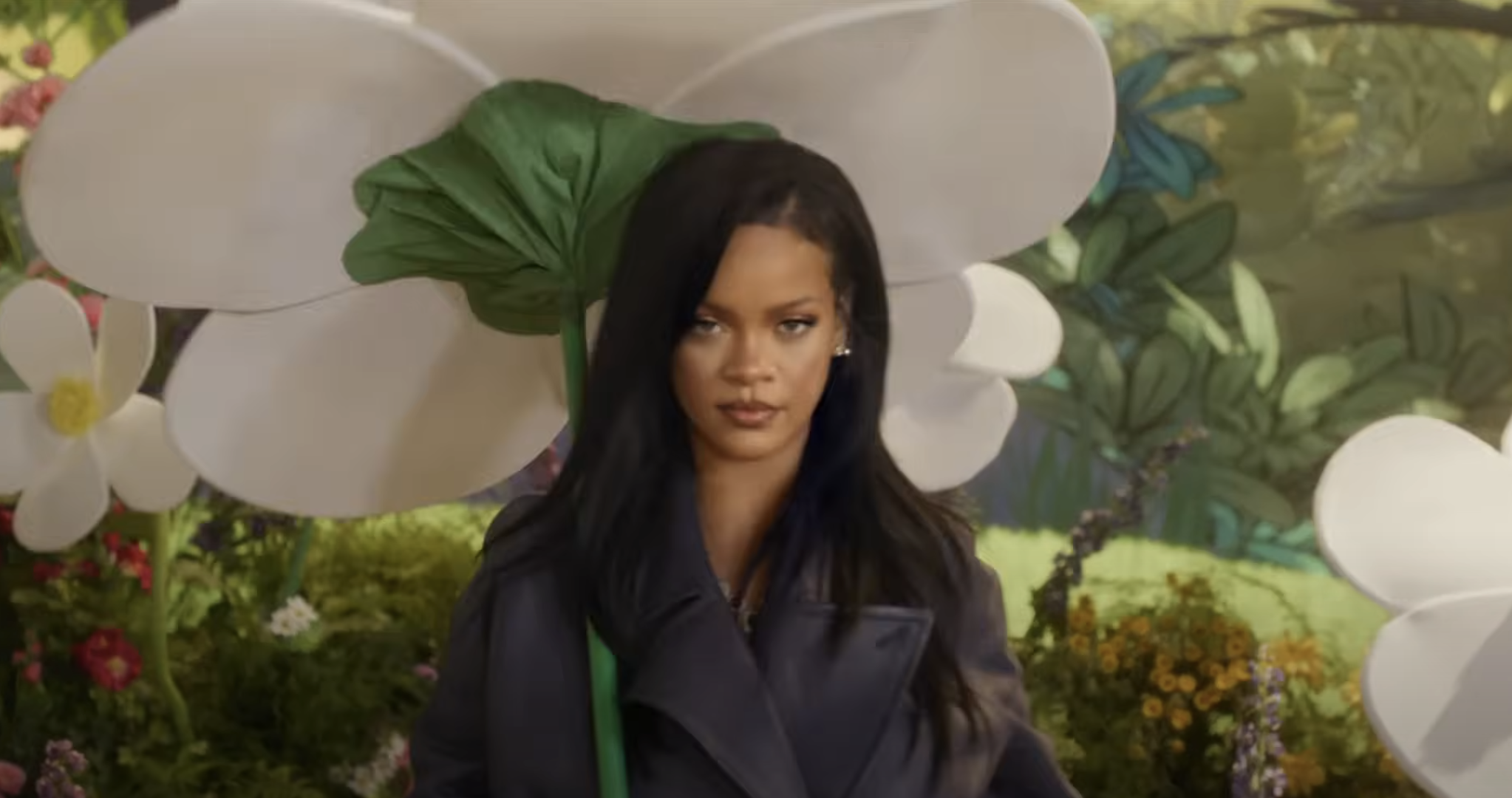
The latter statement can also be said for the accompanying video, co-directed by Chris Miller (who also directed Smurfs) and Andrew Hebert. In it, we’re given a quick snapshot of Rihanna in the mushroom-filled (Alice in Wonderland-esque) garden, of sorts, that will lead to the Smurf Forest. Carrying a flower-shaped umbrella (an almost undeniable nod to her hit song of the same name) as she walks toward the mushroom house that will provide her a peek inside the forest (it’s all very voyeuristic, so maybe there is still a hint of the deviant left inside Rihanna), it only takes about thirty seconds for Rihanna to vanish from the “narrative” in favor of showing her as Smurfette. A Smurfette who frolics among her brethren to the beat of this song. Which, yes, is mostly all beat. Not an unpleasant one, either. In fact, it harkens back to the vibe of “Don’t Stop the Music.” Or even her early singles, “Pon de Replay” and “SOS.” And yet, it lacks the sense of passion that was present on both of those songs.
At the end of the video, Smurfette blows a kiss that shoots out the same kind of cartoonish white flower (akin to a daisy) Rihanna was using as her umbrella at the beginning. That flower transitioning us back to Rihanna walking away from the mushroom house with the same kind of “tee-hee-hee” look on her face that Madonna had while running out of the hotel room in the “Justify My Love” video. The difference being, needless to say, that Madonna’s devious expression was actually warranted. Here, the only “transgressive” thing going on is Rihanna continuing to bend over so fully to corporate interpretations of “art.”


