


In a series called Mondo Appropriato, Culled Culture examines how “on the nose” something is in the pop cultural and/or political landscape.
As though to highlight, once again, that he’s Madonna’s most embarrassing ex (which is saying a lot), Sean Penn recently proved that reality anew with his comments on Woody Allen during an episode of The Louis Theroux Podcast. While Penn isn’t the first to come to the defense of Allen in the aftermath of his 1992 sexual abuse allegation (which flared up again when Dylan Farrow’s open letter was published in The New York Times in 2014, three years before 2017’s #MeToo movement), he’s certainly among the increasing few (even Scarlett Johansson eventually decided it was best to walk back her ardent defense of the writer-director). Especially to do so when most of the talk surrounding Allen has died down. Sure, the auteur is still “allowed” to make movies that are mostly distributed with the help of European financing (e.g., the atrocious Rifkin’s Festival and his latest, perhaps last movie, Coup de Chance). But, by and large, there’s an unspoken belief that, at eighty-nine, he’s at last “decided” to retreat from the limelight. Though the more accurate assessment is that he’s come to terms with being shunned by the bulk of the film industry. Save, of course, for Sean Penn.
Before Allen is discussed at the end of the episode, however, it is Madonna whose name comes to the fore right out the gate, with Theroux mentioning how Penn used to be married to her in the eighties. And that, at said time, Donald Trump was very much the “king” of New York. Not to mention Atlantic City, where Penn encountered him for the first time with Madonna on his arm at the 1988 Mike Tyson vs. Michael Spinks fight, held at the Atlantic City Convention Hall next to Trump Plaza. During a later portion of the podcast, Penn’s various “kerfuffles” with the paparazzi are mentioned, most of which occurred during his marriage to Madonna. Hence, the mention of one of Penn’s more serious legal accusations—attempted murder—after reports of him dangling a paparazzo by his feet from a hotel balcony in Macao surfaced while he and Madonna were filming Shanghai Surprise in early 1986 (with the film being released later that year).
Penn insisted to Theroux that he didn’t dangle the paparazzo by his feet and that his “greatest crime” was “the movie itself. It will damage you.” Theroux echoes, “It got terrible reviews.” Penn confirms, “It deserved worse.” Though, to be honest, it’s still more watchable than, say, Gigli. Continuing the line of Madonna questioning, Theroux asks, “Do you think you were slightly caught in the backwash of the obsession with Madonna as well? That’s part of it, right?”
Penn easily agrees, “Well, that’s most of what got the amount of attention that was happening. My life was much simpler before that. When we met, she had never gone on tour, you know, she was at the beginning of all of the whole thing and… She became a lightning rod of attention and I was there.” In a way, that might be Penn ignoring the fact that his own ego must have blinded him to how big Madonna already was (and the fact that her tour was announced three months after they met in January of ‘85, so he still had plenty of time to “back out”). Her superstardom was almost immediate after the First Annual MTV VMAs in September of ‘84. That Penn was already familiar with her work and the clout of MTV at the time speaks further to how he knew, on some level, that being in a relationship with Madonna automatically meant being in the spotlight.
But when asked, “How did you meet?” Penn continues to act as though he wasn’t very aware of Madonna’s influence on the culture already, responding, “A friend of mine was a PA on a music video she was doing four blocks away from where I was staying in town at that time. I was staying at a friend’s house, um, developing a movie and we would work on the script during the day and we’d have lunch… MTV was a big thing at that time, you’d put on MTV, so I was familiar with her from that. And then this friend of mine’s down the street making another video that she’s doing and says, ‘Oh come down, Madonna wants to meet you.’ Yeah. So we met there.” Penn seems to have a slightly altered version of the lore, which usually tells it as him arranging to meet her.
Still wanting to know more about their storied past, Theroux then brings up the famous Truth or Dare moment when Madonna openly tells her dancers during a game of Truth or Dare that Sean is the love of her life. Penn writes it off as “sweet,” adding, “She’s been a good friend for a lot of years. It didn’t take us long to realize that we’d mistaken a good first date for a wedding partner. And it didn’t take us long to recover after we’d got divorced. Maybe a year. And friendship, so.” But na, it took much longer than that, with the anger Madonna had over the relationship’s demise shining through on a song like 1992’s “Thief of Hearts” (speculated to be about Penn’s then new wife, Robin Wright). What’s more, Madonna always viewed the relationship with much more seriousness and affection than that, frequently gushing about him during and after the marriage—and even dedicating her album, True Blue, to him a.k.a. “the coolest guy in the universe.”
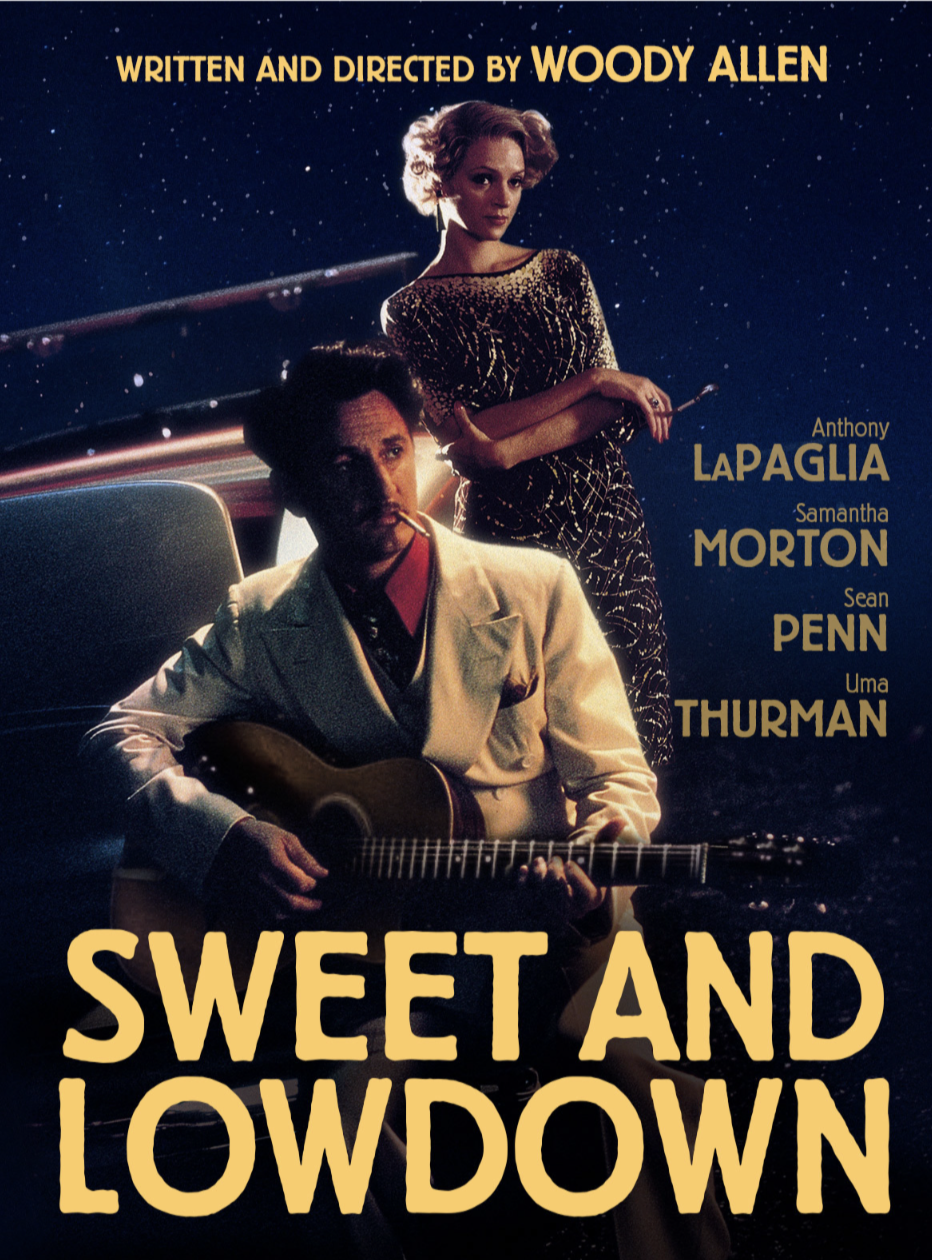
Alas, there’s nothing “cool” about the Penn of the past century. And perhaps that was already foretold by concluding the last one by starring in 1999’s Sweet and Lowdown, a film for which both he and Samantha Morton were nominated for Academy Awards. Funnily enough, Madonna had already beaten Penn to the punch on landing a role in an Allen movie. Albeit a very small part in 1992’s Shadows and Fog (the second to last movie that Farrow would star in with him). And yet, you don’t see Madonna coming to Allen’s defense (she reserves that kind of energy, instead, for another child molester: Michael Jackson).
As for Sweet and Lowdown, it was one of many movies that Allen made from his “old script lying around in a drawer” arsenal (with the original title being The Jazz Baby, and one that United Artists rejected when Allen first presented it to them circa 1970). It is this movie that comes up at the end of the podcast, when Theroux asks Penn, “Would you work with him again? Do you think he’s got a bad rap?” (The answer being “duh.”) Penn replies immediately, “I’d work with him in a heartbeat. If it was the right thing. Do I think he has a bad rap? Look, with these things [that phrasing already giving away his dismissal of women’s “claims” of abuse], I don’t know anyone well enough to say one hundred percent that this didn’t happen, that didn’t happen or something. You know, and God forbid you’re wrong and there’s a victim involved in something, right? But, boy, I find the stuff that I know about, and I haven’t, you know, read everything, the stories are mostly told by people that I wouldn’t trust with a dime. It just seems so heavily weighted…”
And yet, the “story,” as Penn calls it, is told by none other than the victim herself, Dylan, who eloquently wrote in 2014, “What’s your favorite Woody Allen movie? Before you answer, you should know: when I was seven years old, Woody Allen took me by the hand and led me into a dim, closet-like attic on the second floor of our house. He told me to lay on my stomach and play with my brother’s electric train set. Then he sexually assaulted me. He talked to me while he did it, whispering that I was a good girl, that this was our secret, promising that we’d go to Paris and I’d be a star in his movies. I remember staring at that toy train, focusing on it as it traveled in its circle around the attic. To this day, I find it difficult to look at toy trains.”
As for the frequent “excuse” Allen’s defenders like to use—that a vindictive Mia Farrow “coached” her daughter to say these things when she was seven, therefore brainwashing her into believing they were real—Dylan is sure to call this “failsafe” argument out in the same essay. So it is that she writes, “I didn’t know that he would accuse my mother of planting the abuse in my head and call her a liar for defending me. I didn’t know that I would be made to recount my story over and over again, to doctor after doctor, pushed to see if I’d admit I was lying as part of a legal battle I couldn’t possibly understand. At one point, my mother sat me down and told me that I wouldn’t be in trouble if I was lying—that I could take it all back. I couldn’t. It was all true. But sexual abuse claims against the powerful stall more easily. There were experts willing to attack my credibility. There were doctors willing to gaslight an abused child.”
Penn’s gruff yet earnest insistence that Allen couldn’t have done it only adds to that gaslighting, with the actor remarking, “I just think that whatever is the worst of people’s suspicions about him, you know, just check ‘em with the facts separate from the moment and the movement and all who benefited from that.” Here it must be asked, who, among the accusers that have continued to be skeptically questioned and made to feel shame for telling the truth, “benefited” from it? Still, Penn offers, “I see he’s not proven guilty, so I take him as innocent and I would work with him in a heartbeat.”
Allen mimicked similar sentiments toward Penn at the time of working with him, stating, in reference to his reputation for being “difficult,” “I had no problem with him whatsoever… He gave it his all and took direction and made contributions himself…a tremendous actor.” Oof. Birds of a white male feather (and yes, the word “tremendous” can now only be associated with Trump). Getting a final dig in about the whole thing, when Theroux refers to Ronan Farrow as “Ronan Farrow the journalist,” Penns says, “Well, you gave him that title, not me.” Theroux reminds, “I think he’s quite respected.” Penn condescendingly grunts, “Uh huh,” then adds an even more knife-digging explanation for why he doesn’t believe Dylan’s “story”: “I am not aware of any clinical psychologist or psychiatrist or anyone I’ve ever heard talk or spoken to around the subject of pedophilia that, in eighty years of life, there’s accusations of it happening only once. I’m unaware of that. And when people try to associate what were his, let’s say, much younger girlfriends, um, you know, right or wrong, that’s not the conversation here, but post-puberty, consensual stuff is, to me, a different conversation.”
And, once again, Penn shows himself to be a man undeniably of “a certain generation.” A generation that can’t even acknowledge that nothing is truly “consensual” between a man and a girl just because she’s gone through puberty. That such a thing as grooming is very real and very influential. And if he (and those like him) can believe grooming is real when it comes to Mia “coaching” Dylan, then it should cut both ways that Allen also groomed his younger girlfriends, most notably Christina Engelhardt and Soon-Yi Previn. In any case, Penn and Allen can start getting to work on that movie together which will invariably only be released in Europe.


