


The most challenging thing about adapting a novel to a film is when that novel is highly internal. Sigrid Nunez’s 2018 book, The Friend, is just that. And while some might say, “Isn’t every book ‘internal’?” the answer is, of course, no. Indeed, it’s arguable that the most “profitable” books are the ones that favor a plot-driven approach rather than a “stream of consciousness” one. Less introspection, more action. While The Friend has elements of both, its impact is reliant on Nunez’s internal reflections (translated to, as expected, voiceover in the movie) as the plot goes along. But the thing about a writer’s life is that it often isn’t very plot-driven at all (perhaps part of the reason that writers retreat into their writing: to make something actually happen). For the nameless narrator of The Friend, that plotlessness is thrown out the window when a Great Dane named Apollo is thrust into her life by her now deceased best friend.
Rebranded as “Iris” in the film version, Naomi Watts brings Nunez’s protagonist (an iteration of herself, it goes without saying) to life in a different sort of way than what one would have expected based on reading the book. In truth, it’s difficult not to picture someone who looks more like Nunez in the role. That is to say, a woman who isn’t white and is perhaps slightly older than Watts’ age. Even so, despite being a “New York movie,” there was apparently no avoiding the “Hollywoodization” of the material. Including the appearance of the main character. In truth, Watts playing this part makes the character feel sort of like a Carrie Bradshaw (of the …And Just Like That era) type. Except slightly more realistic in that her career as a writer is supplemented with teaching income, plus the benefit of a rent-controlled apartment she inherited from her father (side note: there is no mention of such a father in the book, the narrator “simply” has a rent-controlled apartment).
And yes, like Carrie, she’s part of a more elitist echelon of the writing community in New York—at least what’s left of it. To be sure, most of those still left are in the same age bracket as her mentor/former teacher/best friend, Walter (Bill Murray, who has worked with Naomi Watts previously in 2014’s St. Vincent, wherein their relationship was also of the friends-but-more variety). And now, even he’s not around anymore to 1) enjoy the last remaining benefits of being a “successful” writer thanks to having become one at a time when writing for pay was still viable and 2) reminisce about the days when “writers were writers” (you know, instead of constantly vying for “clout” in some ultra self-debasing manner).
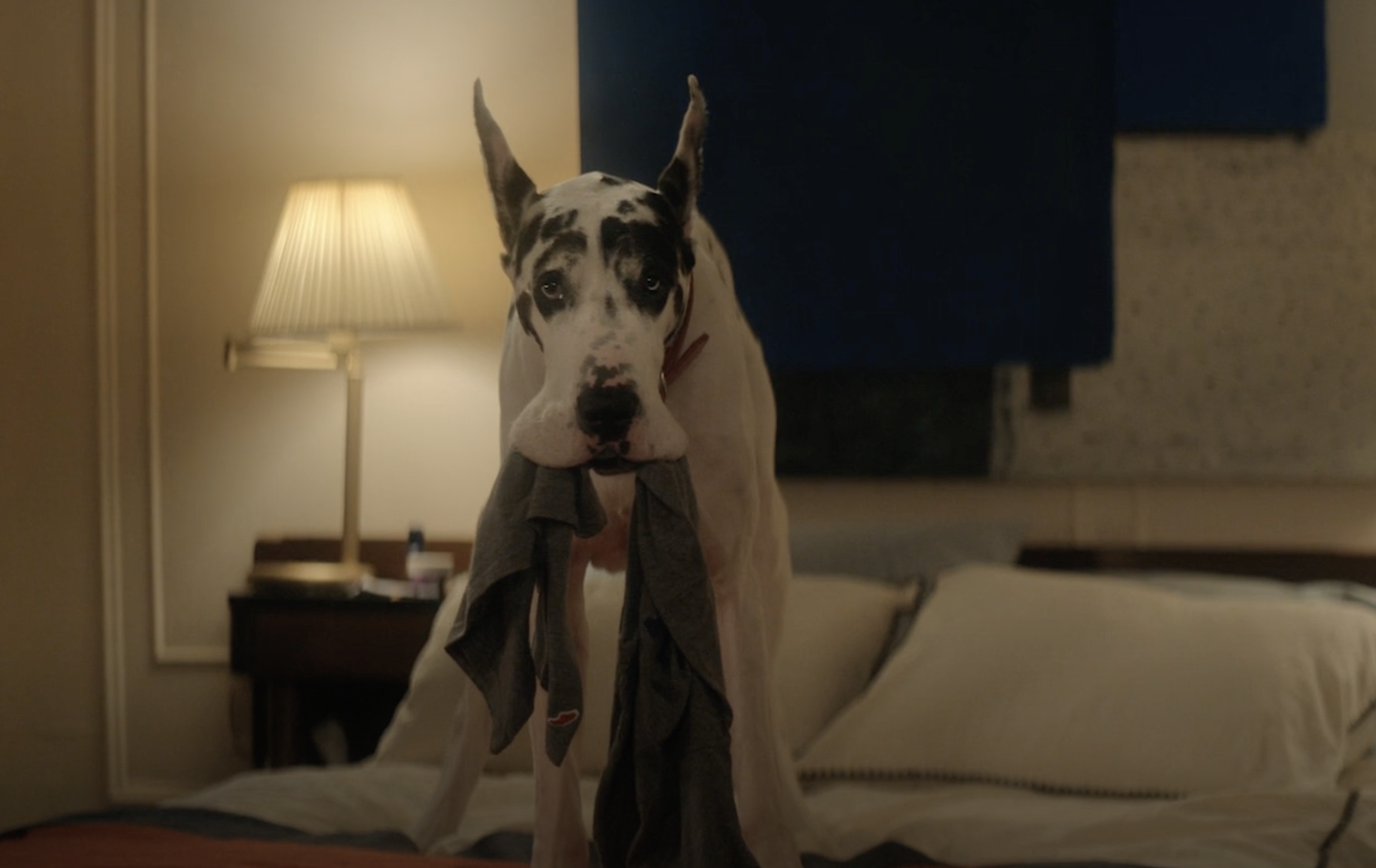
Having taken his own life, Walter (who was also nameless in the book) leaves behind not only a wife, two ex-wives and a daughter from an “out-of-wedlock” dalliance (this daughter storyline and character added into the movie version, in part to buttress a nonexistent-in-the-book plotline about Iris editing Walter’s manuscript of correspondence), but his beloved Apollo (played to perfection by a harlequin Great Dane named Bing). And, of course, Iris. Iris, who, despite knowing how important the dog was to Walter, doesn’t have any inkling that the responsibility for taking care of him might now fall to her. This because Wife Three—branded as Barbara (Noma Dumezweni) in the movie—is not a dog person. So not a dog person, in fact, that she’s put him in a kennel in the time since Walter’s death, citing an inability to deal with the dog’s grief. Least of all while dealing with her own.
So apparently, that means Iris ought to take him since she’s not struggling at all, right? Besides, Barbara adds, wanting to lay on the guilt as thickly as possible, “This is what Walter wanted. You were his contingency plan… You were his best friend.” A reality that isn’t easy for most of Walter’s wives to have dealt with, especially Wife Two, who, in the book was the most insanely jealous of all. In the movie, she gets a name as well: Tuesday (Constance Wu, somewhat wasting her talents in this role). But neither she nor Barbara gets as much screen time or holds as much weight with Iris as Wife One a.k.a. Elaine (Carla Gugino).
Both can commiserate with one another about losing Walter as a friend, even though that happened to Elaine long ago. In fact, during a “walk and talk” together, Elaine laments that she was jealous of Iris after her divorce from Walter. When Iris asks why, Elaine replies that she wished he could have found a way to be friends with her the way he did with Iris after they had a physical relationship. In the film, this sexual encounter is downplayed more via this particular conversation between Iris and Elaine, for in the book, the narrator makes it clear that some part of her always continued to pine for her mentor/best friend after that brief sexual foray. In more than just “some” sense, it’s part of why she remained single the rest of her life, watching her friend continue to get married and go through other women. Still, for whatever reason, she can’t seem to hold his lechery/“serial dating” against him. Even though it increasingly becomes a key source of not only their occasional contention, but his professional woes in the teaching arena. In short, the next generation of his female students won’t suffer through the demeanment of being called “dear” (this detail being excluded from the film version).
However, to get across Walter’s out-of-touch perception of what constitutes sexual harassment, co-directors and co-writers Scott McGehee and David Siegel take one of the quotes from the beginning of The Friend and reference it in the dialogue of the dinner scene at the start of the film. The quote in question being from Hans Christian Andersen’s “The Tinderbox.” Specifically, “You will see a large chest, standing in the middle of the floor, and upon it a dog seated, with a pair of eyes as large as teacups. But you need not be at all afraid of him.” In discussing his first encounter with Apollo, Walter alludes to Andersen’s tale, to which Iris reminds, “Walter, that story is a rape fantasy.” “It’s Danish social commentary.” She retorts, “So he can have sex with her while she’s sleeping.” Walter concedes that she might be right, and everyone continues to laugh good-naturedly in that “nothing’s wrong” sort of way that’s constantly present among hoity-toity New York dinner parties (or what’s left of them). But it’s plain to see there is “hurtness” to Walter’s general aura. As though he realizes he no longer quite fits into a world that’s so “sensitive” (the running theme among older white males, and part of why Bill Murray is an on-the-nose casting choice, himself accused of sexual misconduct in recent years). Hence, his suicide.
And as Iris and Apollo both reconcile with one another and processing their grief over Walter alone, together, the tenderness of their rapport is what begins to stand out more than anything in the film iteration of The Friend. Which rearranges and jumbles certain pieces of the book’s narrative for the presumed benefit of its altered medium. Take, for example, the way that Iris ends up getting a certificate from her therapist that vouches for Apollo as her emotional support animal.
In the book, the narrator goes to a therapist at the suggestion of a concerned friend (the same one who will give her and Apollo temporary access to a Long Island abode in the final pages). That friend becomes a composite of two characters in the movie: Walter’s daughter, Val (Sarah Pidgeon), and Iris’ next-door neighbor, Marjorie (Ann Dowd). Ultimately, neither of these friends suggest to Iris that she see a therapist. Instead, she does so of her own volition after commencing a road trip with Apollo, one that will end in her surrendering him to a Great Dane sanctuary in Michigan (this also not being at play in the book). Stopping off at a gas station, she notices how a man is able to walk into the convenience store with his dog without incident. Then she sees the sign that gives her the “lightbulb moment”: “No Dogs Except Service Dogs.” That’s when she turns her car around, heads back to New York and goes to her former therapist’s office to plead for the necessary certificate that could prevent Apollo from getting her evicted from her apartment. As it transpires, the therapist doesn’t need much convincing that Apollo is her support animal (though she tried to tell herself—and the therapist—that she’s his support human).
Try as she has for the entirety of The Friend to insist that Apollo is a burden, there’s no denying that he’s helped to heal her (and vice versa). In seeing the intensity of his grief (including nights spent whimpering in agony because he can’t understand where his master went), she knows that she is not the only suffering through the profoundness of this loss. This indescribable void in both of their lives now that Walter is gone. And it’s clear that he knew they would need each other, thus suggesting Iris be the one to claim him. Or perhaps it’s just easier to think that way rather than acknowledging that this Walter character is a patent narcissist who didn’t fundamentally care what befell either his best female friend or best canine friend. There is a moment in both the film and the book when Iris attempts to make peace with the narcissism at play in Walter’s suicide by writing an imagined scene of what she would tell him if he were still alive. In the movie, it’s a meta fantasy [still told as though Iris is the one who wrote it] that knows Walter killed himself; in the book, it’s a short story written by the narrator in a manner that suggests her best friend survived the suicide attempt.
As for the most important part of any story—the ending—in the book version of The Friend, the conclusion is more “ambiguous” about what happens to Apollo (“Does something bad happen to the dog?” as Nunez keeps repeating throughout the novel), but the film version wants to throw audiences a bone (the necessary dog pun here) by assuring that Apollo, to borrow a phrase from Interview With the Vampire, has “life in these old hands [or paws] still.” To that end, one additional line added into the script that every dog owner/enthusiast can relate to is this: “I want you to live as long as I do. Anything less is unfair.” But then, perhaps someone ought to remind New York liberals contained within the moneyed sect of the writing community that life is not fair.


