


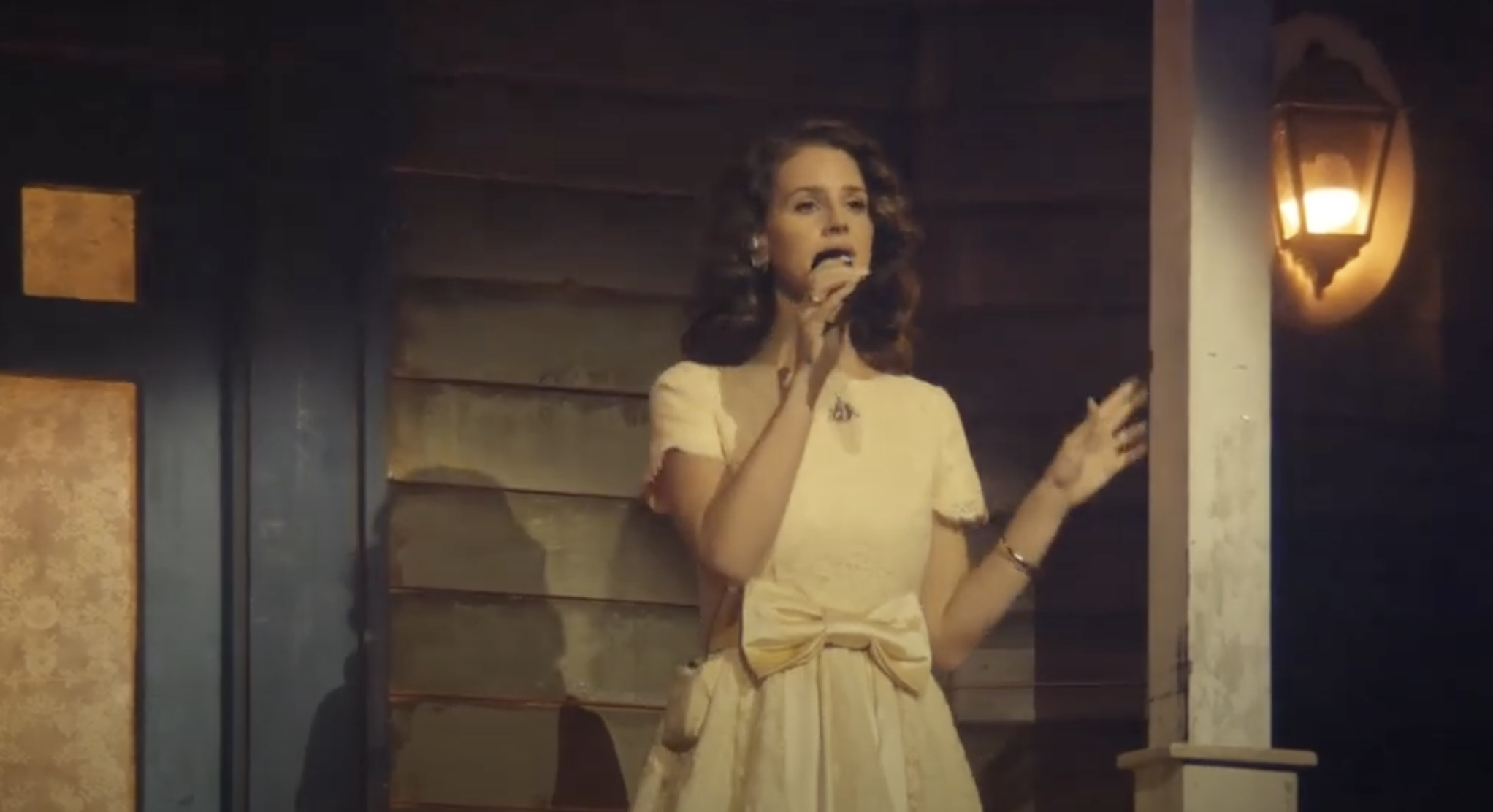
For those who thought Lana Del Rey was being too secretive about her married life with Jeremy Dufrene, she opted to give a very close glimpse into her post-bayou wedding existence during her headlining Stagecoach performance this year. And it all started with the set design, paired with the track she chose to open with. A song titled, what else, “Husband of Mine,” that served as one of a few she chose to debut in front of a live audience, giving them an additional taste of what’s to come on her “country” album. The long-teased one that’s now gone through two names, Lasso and The Right Person Will Stay. And yes, considering the sentiments presented on “Husband of Mine,” it’s something of a surprise that she would change the latter title, so convinced does she seem of being “Mrs. Dufrene” forever (“I love you forever, I love you forever,” etc.). And dresses accordingly for the role of “little missus” during this performance (and throughout the entirety of the show).
While the set design of her headlining performance at Coachella last year was all about The Great Gatsby-meets-Miss Havisham aesthetics, this one, instead, is very much reminiscent of what Taylor Swift did for Folklore and Evermore when she brought those albums to the stage at the 2021 Grammys. But rather than “cottagecore,” perhaps “bayoucore” is the better word. Indeed, the “cozy little house” with its front porch looks exactly like the type of place that Del Rey would settle down in (and likely has) with Dufrene. Though, unlike the house of this stage, she probably chooses to have curtains on her windows. But, for the purposes of the voyeuristic “glance” at the various iterations of Del Rey as wife in the bayou, different women are silhouetted (sans curtains, it should go without saying) doing different things before Del Rey herself emerges from the front door (to the uproarious approval of the crowd) looking like June Cleaver was her style inspiration.
Of course, Del Rey is no stranger to promoting styles and themes that are increasingly retro. With many insisting that, for the most part, it’s all ironic. But it doesn’t feel like that as she belts out in earnest, “You are like a combination of my/Favorite things, buddy/More Clint Eastwood than him without trying/You feel like you’re summer, babe/You got me singing on Clementine.” This being a nod to Del Rey mentioning her “daughter’s name” (still yet to be born, obviously—it’s like how Charlotte York had “Shayla” picked out as her unborn daughter’s name) on 2021’s “Dance Till We Die.”
And where other famous people might tread lightly with a normal in terms of being wary of their assets and money getting taken in the inevitable aftermath of a divorce, Del Rey decries “all this paper between us.” Paper being an allusion to both a prenuptial agreement and money itself coming between them. So it is that she demands of her true love, “Husband of mine/Don’t let them put all this paper between us,” further insisting, “What’s yours is mine/What’s mine is between you, me and Jesus.” As for bringing Jesus into it, the number of times and particular ways Del Rey keeps mentioning the Messiah (to some) in her music is getting decidedly cringe. Gone are the days of her “bad ass” approach to bringing him up on a song like “Diet Mountain Dew” (“Let’s take Jesus off the dashboard/Got enough on his mind”) or “Body Electric” (“Elvis is my daddy, Marilyn’s my mother, Jesus is my bestest friend”). Now we’ve got full-tilt Bible Belt Barbie energy emanating from Del Rey’s lyrics. Lyrics that infer an underlying fear of losing the love that’s made her feel so alive, admitting, “I’ve got nothing to lose except you and maybe my mind.”
“Husband of Mine” then transitions into her forthcoming album’s lead single, “Henry, Come On,” which is sure to dupe people every time into briefly thinking it’s Lady Gaga and Bradley Cooper’s “Shallow.” Delivering a rendition that is ultimately carried by her trio of backup singers (which 2020/2021-era Del Rey would have likely been sure to call out as Black to assure she’s not racist) toward the end, Del Rey decides that maybe she ought to make it more country than her first pair of songs proved to be for an event like Stagecoach. Hence, announcing to the crowd, “We’re gonna sing ‘Stand By Your Man’ ‘cause you can’t do this set without it.” Naturally, Del Rey has already covered it a few times during her 2023-2024 period of giving audiences a taste of her “country twang.” This rendition of it, however, is decidedly clipped. Even though Del Rey is sure to emphasize to the audience, “I really do love singing that song” (of course she does—she’s dressed like Mrs. Cleaver).
To further up the ante on her “country clout” for an event as genre-specific as Stagecoach, Del Rey then brings out George Birge and loosely joins in with him as he sings his 2024 hit, “Cowboy Songs.” When he concludes, Del Rey asks if they can sing a verse together, “acoustic-style,” since, as she tells the audience afterward, “I can’t hear shit, so I wanted to make sure you could.”
And then, as though to give them whiplash about her musical “orientation,” Del Rey leans into performing a fan favorite: 2012’s “Ride.” A song that, incidentally, she called out as being “kind of country” (along with “Video Games”) to MOJO back in 2021. Or at least “there’s something Americana about it for sure.” Just as there’s something “‘Ride’ video” about her dress and hair (the part where she’s “playing a singer” in a white dress and sporting wavy hair in the Anthony Mandler-directed short film). What’s more, it should go without saying that Del Rey brings out her usual vine-festooned swing for the performance, which is expectedly “country-fied,” musically speaking (though the dancers doing their “stripper moves” next to Del Rey as she swings isn’t quite so country). As is “Video Games,” the song that follows, allowing Del Rey to keep swinging/taking the pressure off any attempts at “choreo.” That Del Rey then moves to a porch swing in the middle of the performance also feels like an “homage” to her husband, for she told her brother before going over to Dufrene’s house for the first time, “If he has a swing on his porch, I’m in love.” And that’s how Dufrene landed one of music’s most “ungettable” women.
Continuing to roll out her more well-known songs for this portion of the show, Del Rey then leads into “Norman Fucking Rockwell.” But she doesn’t give the song its full-length due, instead opting to close out on the verse, “You make me blue,” so she can lay on her favorite word/color repeatedly in harmonization with one of her backup singers. This before the piano segues into “Arcadia,” an appropriate choice for the milieu, since the opening lyric is, “My body is a map of L.A.” (with Indio—the site of Stagecoach and Coachella—being a “stone’s throw” away). Devoting more time to “Arcadia” than “Norman Fucking Rockwell,” it’s the final line she delivers to the crowd that bears a particular bittersweetness in the current moment: “I’ll pray for ya/But you’ll need a miracle/America.” One that doesn’t seem likely to come. Alas, as is expected, Del Rey doesn’t take that “in” as an opportunity to say something “political” (read: truthful) afterward, opting to ignore the apropos moment in favor of summoning up the Secret Sisters to take Father John Misty’s place on the feature part of “Let the Light In” from Did You Know That There’s a Tunnel Under Ocean Blvd. It’s among the more lackluster moments of the show, but Del Rey seems intent to do it for the sole purpose of telling the audience afterward, “Can we get a shoutout for Alabama?” You mean one of the states that voted Trump in? No.
That doesn’t stop Del Rey from showing nothing but Southern love in the song that follows (with a brief instrumental interlude to the tune of Daniel Lanois’ “Agave”), another “premiere,” if you will. Titled “Quiet in the South,” Del Rey takes advantage of another part of the set backdrop by sitting in a country kitchen-looking room as a pianist plays along next to her while she laments, “Red wine on the table, dripping candle wax/Listening to angels from our old record scratch/Bet you’re down at Layla’s smoking at the bar/Hope nobody’s on the road when you get in your car.” Lyrically, it’s a bit like Del Rey’s version of Beyoncé’s “Jealous” (specifically, the verse where she sings, “I’m in my penthouse half-naked/I cooked this meal for you naked/So where the hell you at?/Just one shot left of this drink in this glass/Don’t make me break it”). A correlation further cemented when Del Rey unleashes the chorus, “Ooh, are you coming home tonight?/Should I turn off the light or burn down your house?/Ooh, are you coming home tonight?/It’s getting awfully quiet in the South.”
Of all the songs she’s unveiled thus far, “Quiet in the South” is the closest she comes to being “really” country. Complete with a scorned woman line that reiterates her love of porches (and their swings): “Feet up on the back porch, the wind’s blowing through/I’m staring at the propane, like, what’s a girl to do?” Burn it to the ground, obvi. Which is exactly what Del Rey “implies” when she has her backup dancers walk around the premises with cans of gasoline (this after they were playing with a dollhouse replica of the abode, for added sinister/“psycho girl” cachet), “hosing the place down,” as it were. So that it ignites thanks to the visual and sound effects provided (soundtracked by the famed instrumentals of Vertigo’s “Scène d’amour”—perhaps giving an indication of Del Rey’s “bifurcated” persona: the reluctant pop star and the family woman). Of course, Del Rey didn’t seem to get the message that L.A.-centric Californians might still have some PTSD from the fires that raged through such neighborhoods as Pacific Palisades and Pasadena back in January, marking the worst wildfires in L.A.’s storied wildfire history. Needless to say, that kind of “sensitivity read” wasn’t on Del Rey’s mind for this.
What is on her mind, at least for the next song, is domestic abuse. That’s the pointed motif of “Bluebird,” which serves as an interlude before Del Rey’s final act (giving her the opportunity for a costume change). So it is that she mimics the same “shtick” from last year at Coachella, when a hologram version of herself took the stage for “hope is a dangerous thing for a woman like me to have – but i have it.” Whereas that Hologram Lana was wearing a riff on the gown she donned during her illustrious 2012 performance on SNL, this one wears a red strapless dress with a flared skirt (and yet another bow at the waist). Not missing the chance to call out her new sartorial choice when she walks out wearing the same thing as her hologram, Del Rey commences “Summertime Sadness” a few lines ahead of what it actually starts with, announcing, “I got my red dress on tonight.”
To keep the crowd interested in her new material, Del Rey then pivots back to singing a track they’d never heard before: “57.5.” By now made famous thanks to Del Rey name-checking a kiss with Morgan Wallen (whether that’s true or just shade is left to the audience’s discretion). Even though she told the crowd she would only say that line once—which assumes that name isn’t in the recorded version of the song. Either way, it’s among her cheekiest lyrics yet (perhaps that’s why she had her dancers do their stripper moves again on a monkey bars-looking apparatus while singing it). And yes, she seems to be self-referencing (even if unintentionally) once again with the “like ooo” part. Which if it sounds familiar, it’s because it’s very similar to the “oh-oh-oh” she delivers on 2017’s “Heroin.” Unfortunately, like showing Angelenos a burning house, it doesn’t feel appropriate in a climate where RFK Jr. is suggesting a national autism registry for Del Rey to sing, “Round ‘em up, round ‘em up, they want the spotlight like/Ooh, ooh.” The part where she repeats, “Lasso, lasso” is, clearly, where the first iteration of the album title came in. But again, the image of “rounding people up” with a rope right now is an especially uncomforting one.
As for the chorus, she does a tongue-in-cheek flip of it by the end of the song, starting out with, “I got 57.5 million listeners on Spotify/Roger Miller, made him laugh/I guess some folks still like to cry/I ain’t got a man, but maybe one of them is a fan of mine/In that 57.5 million listeners on Spotify” and concluding with, “I got 57.5 million listeners on Spotify/Roger Miller, made him laugh/I guess some folks still like to cry/Now I got a man, he really wasn’t a fan of mine/And that 57.5 million listeners on Spotify.” This allusion to Mr. Dufrene being protective of his “missus” is as apparent as Del Rey’s insistence that part of her attraction to him is that he wasn’t a fan. As for the sudden appreciation/glut of new fans Del Rey has gotten in more recent years, she comments on it via the verse, “I hate everybody/Lately, feels like everybody’s loving me/Kinda feels like sugar/Sprinkled on the same wound thеy cut too deep.” In other words, it’s too little, too late for her. Besides, she’s made it evident that she could give a toss about the opinions of others (which, as she mentions in the song, is part of the secret to her success). If she did, she likely wouldn’t be tooling around as a 1950s housewife. Or “daring” to cover John Denver, closing out the set with “Take Me Home, Country Roads.”
Joined again onstage by the Secret Sisters and George Birge for this moment, Del Rey appears to be fully “at home” among the country crowd. Though she’s been ingratiating herself for years, starting with Nikki Lane. With her move to the South and marriage to a bayou boy, however, the cosplay has become, perhaps, real (thus, her overexcitement about getting to meet the women of The Secret Lives of Mormon Wives backstage).


