


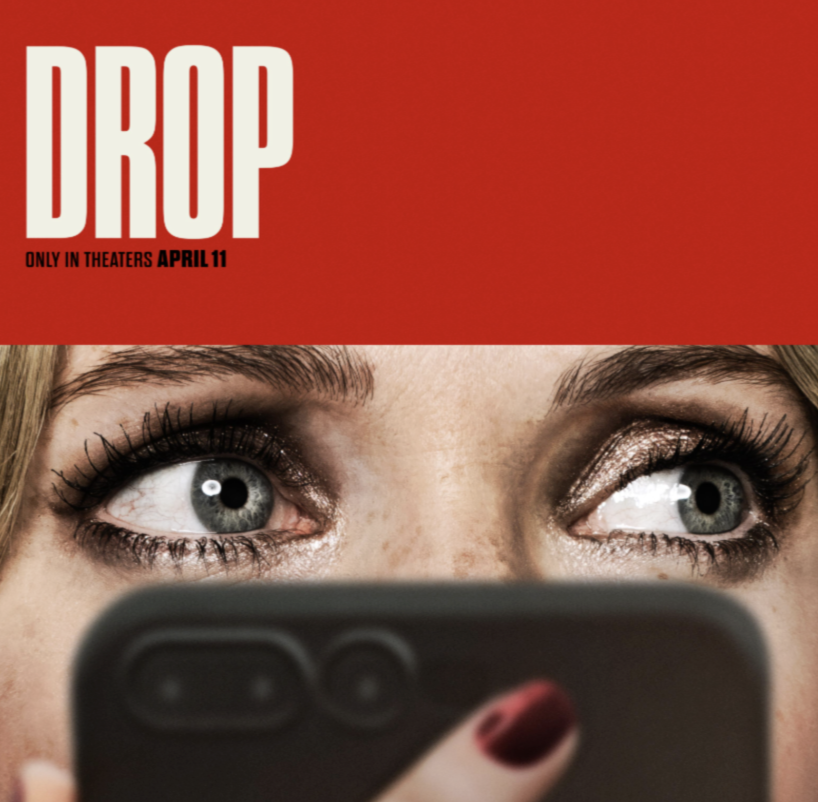
In 2005, it made sense to release a movie like Red Eye in theaters. After all, streaming hadn’t taken an unstoppable hold over audiences yet and Red Eye was “white knuckle” enough to warrant an outing on the big screen. But with Christopher Landon’s latest “horror” (though romance-thriller is more accurate) foray, Drop, it makes less sense to put a release like this in theaters. Not just because Meghann Fahy and Brandon Sklenar are hardly at the same star level that Rachel McAdams and Cillian Murphy were (even as early as ‘05), but because it just has that “feel.” This isn’t solely due to the contained location (a high-end restaurant called, smirkingly [one hopes], Palate, with a sweeping view of the Chicago skyline) and overall “smallness” of the movie, but rather, a certain “streaming vibe” that so many films emanate nowadays. And, unlike some of Landon’s previous movies (whether they were written, directed or both by him), Drop is his most “Netflix or Amazon Prime-ready” yet. Just as Red Eye could have been Wes Craven’s (or no, maybe that was Night Visions—which was “made for TV” back when that was considered the ultimate euphemism for “this is too shite for the theater”).
Even the title sequence alone radiates an immediate “made for a ‘high-end’ streaming service” quality. In fact, all those various objects shattering (a watch, an expensive bottle of wine, etc.) against a black screen as the opening credits to Drop roll conjure the association to the intro titles of Apple TV’s latest series hit, Your Friends & Neighbors. But no, Drop is less Apple and more Netflix, to be sure. With something as big-budget and action-y as such titles as The Gray Man, Back in Action and the much-panned The Electric State also finding their way onto this platform, there’s no reason Drop couldn’t (and shouldn’t) have as well. Especially since Landon already has an established relationship with the streamer via We Have a Ghost (which he wrote and directed) and Time Cut (which he produced). But clearly, someone called in a favor from Universal (likely Landon himself, whose Happy Death Day series was distributed through said company), and the movie was anointed for a theatrical release. Much to the undoubted delight of the script’s co-writers, Jillian Jacobs and Chris Roach (who previously co-wrote the little-loved Truth or Dare [a title forever assigned to Madonna’s 1991 documentary] and Fantasy Island together).
As for Landon’s attraction to directing the project, it seemed, to him, a form of movie god intervention. That is, in terms of leading him to a Wes Craven-esque project that he could further develop with the screenwriting duo that brought it to him. After all, he had just walked away from the chance to direct Scream VII after receiving multiple death threats against him and his family due to the firing of Melissa Barrera (which he had nothing to do with) over her comments about the Israel and Palestine. Once Barrera was fired, her co-star, Jenna Ortega, jumped ship in solidarity too. Landon might have stayed on to pick up the pieces were it not for the threats against his life and those of his loved ones (due to the fan assumption that Landon was responsible for the firing). Which happens to be a major aspect of Drop…and Red Eye. In both films, Violet Gates (Fahy) and Lisa Reisert (McAdams) are forced into doing something (namely, murder [or at least facilitating it]) they don’t want to by way of being threatened with the loss of a close loved one’s life. For Violet, that’s her son, Toby (Jacob Robinson)—not to mention her sister, Jenn (Violett Beane), who is babysitting—and for Violet, it’s her father, Joe (Brian Cox, very pre-Succession). And while, theoretically, recreating the setup for such tension with a single, confined location (though much more confined in Red Eye’s case) should help “do the trick” for “homage” purposes, Drop suffers from the same issue that so many post-mid-00s films do: the technology factor renders it impossible to make things that interesting. Even though the entire conceit of Drop plays up a desire to make audiences believe that technology hasn’t ruined storytelling in filmmaking. But of course it has.
This is why, throughout the dinner, Violet’s every move is observed thanks to planted recording devices and the cloning of her phone. And yes, Violet’s phone keeps receiving “drops” (a reference to the AirDrop feature of iPhones), a term that doesn’t really seem to have saturated the culture as much as “red eye,” but oh well. The sender of said drops is anonymous, naturally, and continues to bombard her with some “classic” memes (including the kombucha girl) captioned with some rather sinister warnings about how fucked up Violet’s night is going to get. A night intended to be romantic, as it’s her first date with an affable, good-natured photographer named Henry Campbell (Sklenar). Not just her first date with him, but her first date since getting out of a very violently abusive relationship. One that prompted her to become a therapist for other abused women. This undercurrent to the story provides yet another parallel to Red Eye in that Lisa also suffered abuse at the hands of a man. Not an ex, but a stranger in a parking lot who raped her at knifepoint. However, since Red Eye favors the thriller genre exclusively, viewers are never given the chance to see her “get back in the saddle” the way they are with Violet, who exists in a thriller-romance genre. There are other subtler nods and connections to Red Eye as well (apart from the latter being written by Carl Ellsworth, who later wrote the Landon-directed Disturbia). For instance, naming a high-end restaurant “Palate” is almost as tongue-in-cheek as naming an airline “Fresh Air.”
Landon’s careful homage to the movie also stemmed from his belief that, as he told IndieWire, “It’s something that I have always tried to do. I like to Trojan-horse heavy stuff into otherwise very entertaining movies. The Happy Death Day movies wrestled a lot with grief and loss, which is a top-of-mind subject for me and goes into a lot of my work. But nobody wants a mouthful of bad medicine—it goes down easier if you’re having a good time. And it still gets people to think and talk about this stuff. I grew up on a very steady diet of horror movies and pop culture, so that’s constantly what I’m reaching into, but I don’t want it to be empty calories. I like to have a conversation with the audience about meaningful things, just in a fun way.” Even so, Drop has mostly been written off as pure “empty calories,” deemed by Variety as, “a junk-food thriller” (adding the conciliatory line, “Fried to near-perfection”). Even so, other outlets have been more forgiving of the often “jumping the shark” premise. One that ultimately ties back into the tired trope about Chicago being the premier place for political corruption (an element of the plot that’s a major curveball [at a Cubs game] by the end). Perhaps that’s why they felt obliged to set the story there, along with the “Windy City” providing the kind of wind levels that could suck a person out of a shattered window.
Even through all the plot holes and “really?” moments, perhaps Drop does prove Landon’s other belief (as also told to IndieWire) that, “You can get away with anything in a movie if you endear your audience to your main character. You can put the audience through a lot of different kinds of tonal paces, and they’ll stay with you.” Especially if, speaking of sharks (and jumping them), the main character requests a piano version of “Baby Shark.” Regardless of being done in jest toward the lecherous piano player, Phil (Ed Weeks), as a means to get him off her back.
As it turns out, though, Phil will provide an opportunity for Violet to communicate her distress when he actually does play the song. Seeing it as a chance to tip him so she can write on a twenty-dollar bill that she’ll have the waiter, Matt (Jeffery Self), give to him, it mimics Lisa trying to write a “help me”-style message in a Dr. Phil book she offered to another passenger before boarding (perhaps Landon was so calculated about the homage that that’s how the piano player ended up with the name Phil—or maybe it really is mere coincidence).
In terms of trying to elevate tension in a way that makes the viewer more keenly aware of the stakes/Violet’s overall anxiety levels, there is an art to how the messages she’s receiving are displayed onscreen next to her for the audience to see. Of course, texts showing up onscreen near the character’s head is nothing new anymore. However, per IndieWire, “Landon also worked with cinematographer Marc Spicer to create specific lighting cues to place the audience in Violet’s head, and used the presentation of the texts themselves to convey her emotional state, using different fonts and placements to create an emotional effect.” One that comes off like some Jenny Holzer-style messages…without the depth.
What’s more, there is no amount of stylized-looking texts that can compensate for the fact that, like Henry, viewers are pretty much just staring at Violet staring at her phone with a pained expression for the majority of the film. Which opens up a bit more once Fahy’s character is able to leave the restaurant setting for the third-act denouement (like McAdams’ character being able to leave the plane setting in the third-act denouement of Red Eye). One that doesn’t drag out the tension quite as much as Red Eye, as Drop is more focused on wrapping everything up as neatly as possible into a bow. With Red Eye (which was well-reviewed enough in its time before developing an unexpected cult following), the bow isn’t quite so “Hollywood ending” tidy.
Even so, Landon maintains that not only is Drop on par with Red Eye, but that, after the drama and heartache surrounding his decision to walk away from Scream VII, “My best revenge was making something cool, and I feel like I did with Drop.” Well, as Joan Didion once said, “We tell ourselves stories in order to live.”


