


It is both entirely surprising and altogether expected that it’s only now, after all these decades, that another movie centered on the Bride of Frankenstein has been unleashed. Except that the first film “about” her, released in 1935, doesn’t feature her much at all, despite the title being Bride of Frankenstein. But no, the only time the eponymous character shows up is at the very end, when she’s finally “reinvigorated” by Henry Frankenstein (Colin Clive). And, much to Frankenstein’s (Boris Karloff) dismay/heartbreak, even she—the only other person of his “own kind”—is repulsed by him. Having no desire whatsoever to be his bride, let alone be touched by him at all. And yet, at the end of this movie, Maggie Gyllenhaal was left not so much with pity for “Frank,” but only thinking, “‘I wanna know more about what’s going on with her.’ You know, what’s going on in her mind, after having been dug up from the ground, uh, to marry someone who she doesn’t recognize and, in fact, who she’s never met.”
Indeed, this is what she said when asked by CBS Mornings’ Vladimir Duthiers what inspired her to write the story (or rather, “reimagine” it). And, luckily for her—vis-à-vis filling a narrative void—almost a century has passed since the last time anyone thought The Bride might deserve a movie devoted entirely to her story, her feelings, her monstrosity. And, talking of monstrosity, there’s a reason why The Bride’s tale likely went untouched for so long, and that boils down to the fact that the idea of seeing an “angry (and murderous) woman” doesn’t typically jive all that well with a studio’s bottom line (and, based on The Bride!’s box office receipts, still doesn’t). Oh sure, there have been plenty of exceptional cases when a rage-filled, murdering woman has drawn in a sizable audience (see: Kill Bill: Vol. 1 and Kill Bill: Vol. 2), but they’re few and far between. And something that not many major studios dare to take part in. Especially when that story is written and directed by a woman rather than a man.
To be sure, there’s a reason Quentin Tarantino is among the few writer-directors who can count himself as being “successful” with his box office returns on “rampaging” women. Because, in a man’s hands, there’s still this idea that a woman can be controlled within the narrative. Gyllenhaal takes that idea and upends it, allowing her anti-heroine to be as messy and untamed as possible. Because one of the key reasons she was also attracted to the story was because of how it shows that humans contain multitudes, a whole spectrum of qualities that, of course, extend to monster-like behavior. And yes, this remains a controversial reality when applied to women, who are so often expected to be just “one thing,” tick a single box on a proverbial list of confining women’s tropes (e.g., virgin or whore).
Upon being introduced to The Bride!’s lead, Ida (Jessie Buckley, serving up yet another tour de force), as she’s called for the first part of the film, it would seem she falls into the “whore” category, with Gyllenhaal setting the stage for her in 1936 Chicago, one of the heights of organized crime in that city. Ida’s part in that ecosystem is as an escort who accompanies various gentleman of a dubious nature to clubs and restaurants ultimately controlled by the major crime boss of the city, Lupino (Zlatko Burić—because, tellingly, no Italian wants to play stereotyping part like this). As for the use of “Ida” and “Lupino” as names for two separate characters, it most certainly feels like a nod to the actress-turned-director named none other than Ida Lupino. Because, yes, Gyllenhaal likely sees a kinship in such a person. Even if, thus far, The Bride! isn’t being met with its just praise or financial success as some of Ida Lupino’s directorial work achieved. Though that should also come as no surprise, considering that Ida/Penelope/The Bride is much too “grisly” a female character to be palatable to mainstream audiences. Especially since those in the average mainstream audience likely voted for a certain Orange Creature, who has made no secret about his views on women being that of disposable playthings designed solely for male pleasure and sadism (often one and the same).
At first, Frankenstein (Christian Bale, almost unrecognizable thanks to makeup and prosthetics design from Nadia Stacey) seems to be of the same mind. Assuming that when he seeks out Dr. “C.” (Cornelia) Euphronious (Annette Bening) and pleads with her—at first sexistly assuming it’s a man he’s going to be encountering—to “make” a woman for him, that said woman will be something of a docile “companion.” Or “helpmeet,” as The Bride calls it during one her many “rhyming spells.” Engaging in a style of talking that is inspired both by Barbara Stanwyck and artist Maggi Hambling, Ida’s manner of speech is influenced in part as a result of being possessed by the spirit of Mary Shelley, who gets her to start running her mouth about Lupino’s illegal and immoral activities while she’s out “entertaining” with a group of men and women at a table at one of Lupino’s joints.
It is before this scene that The Bride! commences with a storytelling conceit no doubt inspired by Bride of Frankenstein (which itself begins with Mary Shelley speaking to Lord Byron and Percy Shelley). What with Mary Shelley speaking directly to her audience from beyond the grave. And yes, like Elsa Lanchester before her, Jessie Buckley plays both Mary Shelley and The Bride. Incorporating Shelley into the story is what gives it an added texture that speaks to the ways in which women and their emotions, thoughts and feelings are constantly suppressed for the sake of functioning in society without drawing too much ire or “blowback” from the men who run it. Keeping their heads down, being polite and working “with” the system rather than “against” it.
But when Ida is simultaneously possessed by an enraged Shelley and then her body is dug up by Frank and Dr. Euphronious, the combination proves to make her volatile, unhinged and unfiltered. In short, the exact cocktail of characteristics that Patriarchy fears and loathes in a woman. Indeed, it’s hardly a coincidence that Lupino’s modus operandi is cutting out the tongues of women who try to “rat him out” or generally speak ill of his dirty dealings. For there’s nothing a powerful man loves more than to see a woman silenced. For example, the decades-long dark pall over Hollywood that was Harvey Weinstein. A man that Gyllenhaal herself was forced to orbit, photographed with him and her brother, Jake, at the 2015 premiere of Southpaw, a film distributed by none other than The Weinstein Company.
Reflecting on Weinstein’s reckoning back when it was still fresh in November of 2017, Gyllenhaal commented to The Hollywood Reporter, “I really feel that what’s been happening since Harvey Weinstein was instigated by feelings that came from having Trump elected.” That something being #MeToo, a phrase that gets pointedly repeated by The Bride herself during a particular scene wherein she reflects on all the rage she’s been keeping bottled up inside. Her own rage a representation of the collective crack in the veneer of women who could no longer accept, with a casual laughing off, such brutish behavior as having their bodies commented on, unwantedly touched or generally exploited by “string-pulling” men like Weinstein (or, in Ida’s case, the Weinstein-looking Lupino). That Gyllenhaal herself was starring in The Deuce (ironically, co-starring another already then known sexual abuser, James Franco) at the time of this reckoning was somewhat kismet. For Gyllenhaal herself plays a used and abused sex worker determined to free herself from the metaphorical shackles of men by entering the still germinal porn industry as a means to escape the mean streets of 1970s NYC. Little did she know…
In any event, with The Bride!, Gyllenhaal seems determined to remind her viewers that the abuse of women is as old as the oldest profession. Which is why, in that same abovementioned 2017 article from The Hollywood Reporter, The Deuce’s co-creator, David Simon, added, “With the show coming between Trump and Weinstein, I don’t think anyone can argue that society has in any serious way grappled with these issues. They’re present, and right now, not a lot of hard work is being done to make them go away.” Still isn’t, as a matter of fact, with the continued brushing aside of all the horrors contained within the Epstein files being the latest grotesque example of that. Horrors that echo some of the things Ida is made privy to as a grudging moll passed around from gangster to gangster as ordered.
When she finally finds her voice to bite back (sometimes literally) at the oppressors of the world, she also finds her match in controversy-courting as a dead woman. That is to say, Frankenstein. And this is where the influence of a Bonnie and Clyde (with a dash of Joker and Harley, to boot) dynamic begins to sustain itself throughout. A couple reference that makes plenty of sense considering Bonnie Parker and Clyde Barrow went on their own crime spree from 1932 to 1934, capturing the hearts and imaginations of Americans who saw this behavior as a symbol of their own repressed ids at a time when many a person would have loved to say “fuck you” to the banks that had done them all wrong during The Great Depression.
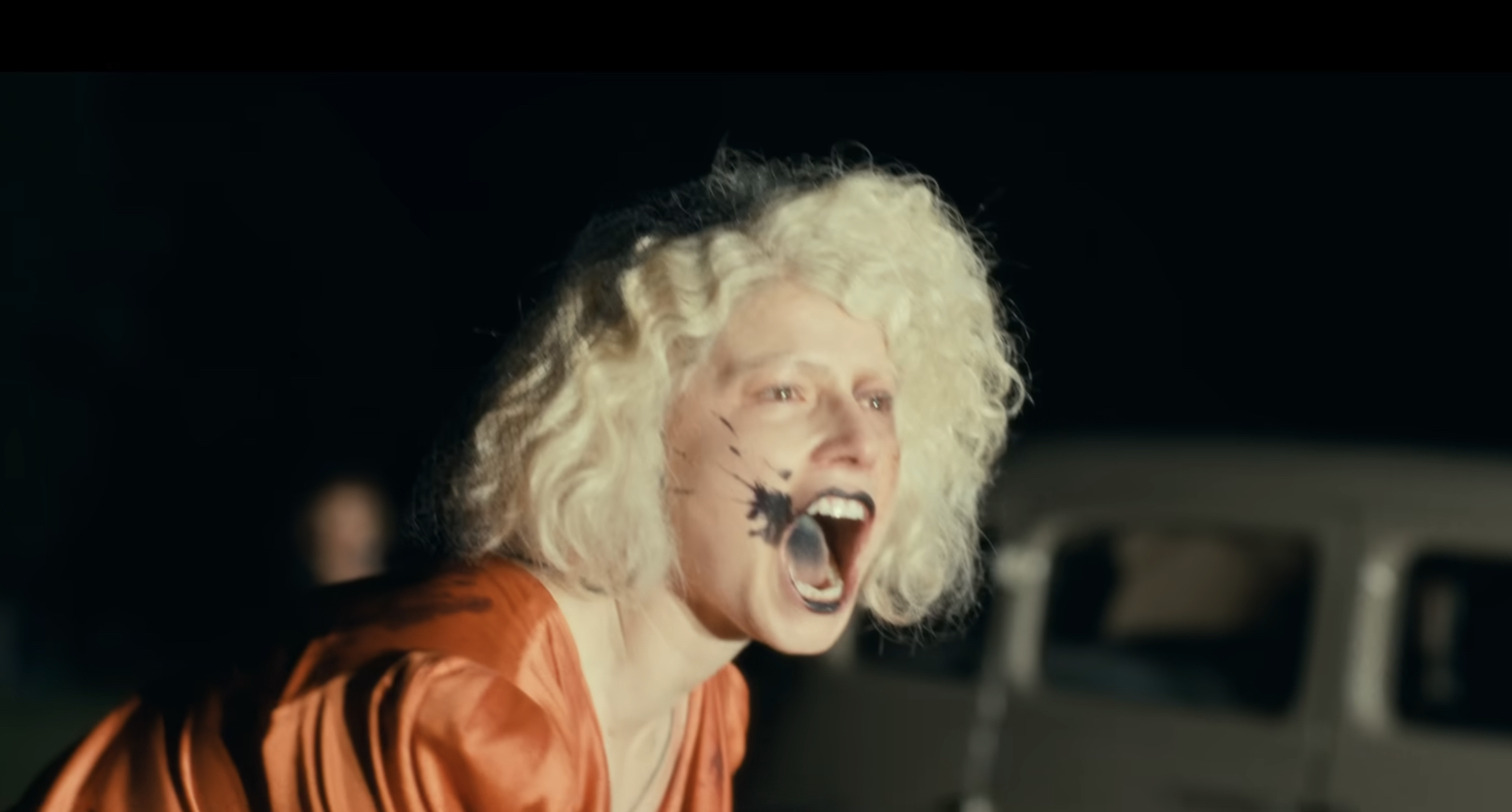
The Bride, with her black tar-stained mouth, is this kind of emblem for the women of America, themselves emulating her signature facial marking while declaring “Brain Attack!” as they, too, cause mayhem on the streets after hearing of her speech at some hoity-toity party where screen star Ronnie Reed (Jake Gyllenhaal, because Maggie wasn’t going to give her husband a role in the film and not her brother) is in attendance. The very star that Frank is obsessed with and that, as he tells Ronnie to his face, is someone he credits with keeping him alive all these years amidst his crippling loneliness. That Frankenstein has a parasocial relationship with a celebrity is also a very modern touch on Gyllenhaal’s part, along with being something of a meta quality considering that he himself is a “celebrity” to those who have watched his story unfold in all its many forms over the centuries since Shelley created him.
Another meta moment at this party is when Frankenstein dances to “Puttin’ on the Ritz,” an homage to a classic scene in Mel Brooks’ own 1974 adaptation of Shelley’s work, Young Frankenstein. In other words, Gyllenhaal knows her shit, and flexes that film enthusiast knowledge in various ways throughout The Bride! A story that, although set in the 1930s, is as “now” as it gets in terms of its subject and themes. And while some might argue that the decision to make The Bride actually end up falling in love with Frankenstein is nothing more than upholding the heteronormative “status quo,” the truth is that it would be more cliché, at this point in time, for The Bride to abhor Frankenstein. Because at the core of Gyllenhaal’s decision to make them fall in love is the idea that, if there ever is to be harmony in the world, men and women can’t hate each other as they currently seem to. Though, to be fair, it’s the former gender that appears hellbent on making themselves all but impossible to show love for.


+ There are no comments
Add yours