


In Mark Ronson’s memoir, Night People, the quote he uses for the introduction of the book is as follows: “The night is on your mind/Ayo, the sun’ll still shine/But now the night is on the mind.” Taken from A Tribe Called Quest’s 1993 track, “Midnight,” it’s a verse that also very much applies to Tame Impala’s latest single from Deadbeat (following “End of Summer” and “Loser”), “Dracula.” The evocative title of course referring to being a creature of the night (for vampires, as everyone knows, despise the day—after all, it literally kills them). And obviously one that abhors daylight. Or, at the very least, doesn’t get along half as well with it.
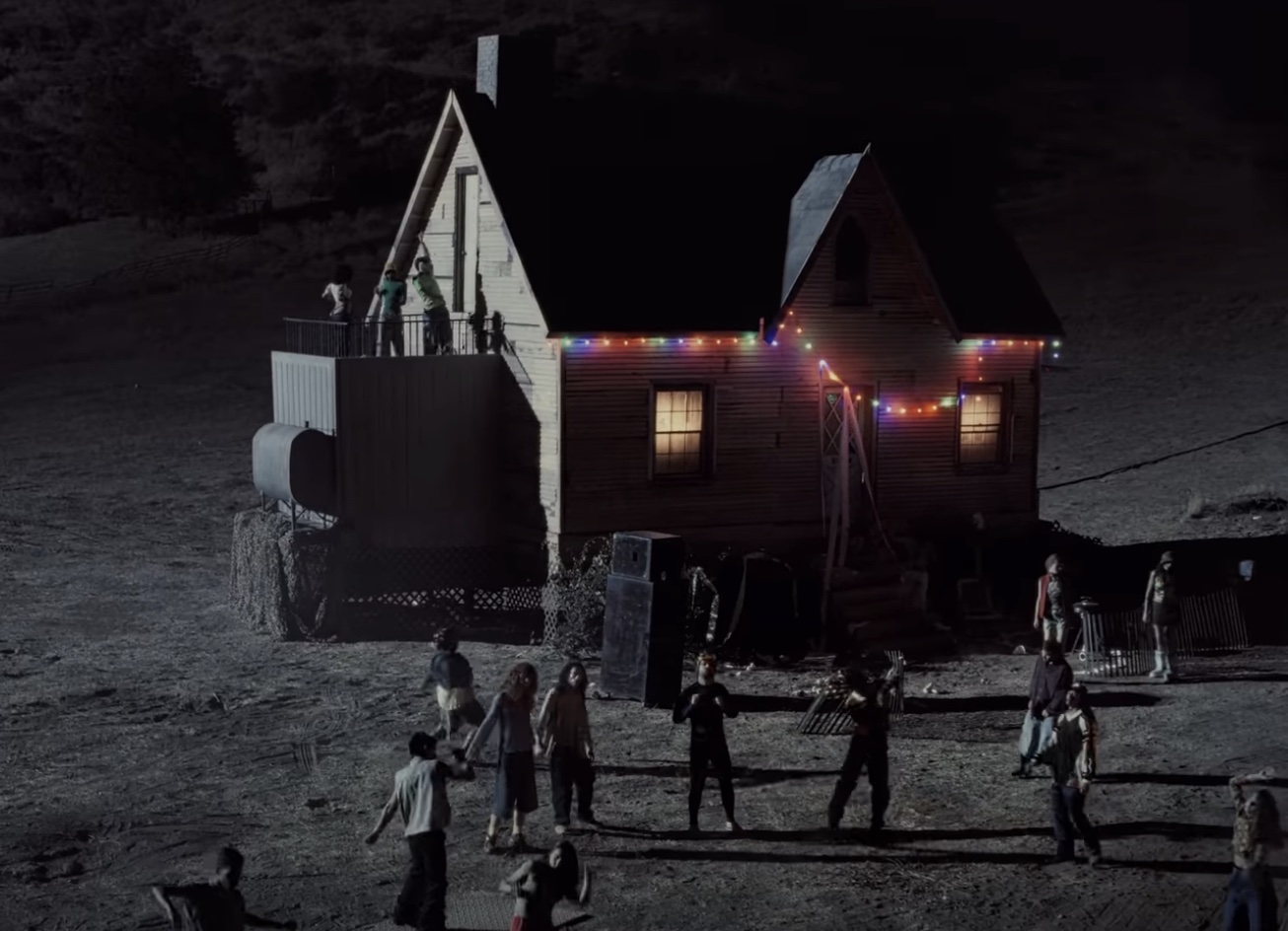
To convey that motif in the accompanying video for “Dracula,” directed by Julian Klincewicz, Tame Impala (a.k.a. Kevin Parker) sets the stage at a house party in the middle of nowhere (a setting he’s quite familiar with considering he grew up, for a time, in Western Australia’s Kalgoorlie). Except, rather than partying inside the house like semi-“civilized” people, these ghoulish creatures move about in an almost zombie-like (rather than vampire-like) fashion outside the abandoned/spooky-looking abode (given the added “deadbeat” touch of being outfitted with a string of colored Christmas lights on the exterior).
Before the viewer is given a chance to fully take in the non-splendor of the house, however, Tame Impala, in the opening scene, emerges as though out of thin air, cutting through the night like the very vampire the song is named after. This done as a trippy, almost incantation-like series of “oh-oh-oh-ohs” are let out before the expectedly infectious beat drops. A beat, as Tame Impala, described to Zane Lowe, that heavily evolved in that it “started in this really raw, minimal way and then just sort of like slowly expanded into this sort of like pop, you know…” Parker further added, as though to emphasize he’s but a vessel for “the muse,” “I just give the song what it wants. I feel like that one just…wanted to be like a Max Martin song.” And yes, it’s probably the most “Max Martin-y” that Tame Impala will ever get.
In any case, as he continues to walk through the deserted landscape, all at once, a semi-truck appears behind Tame Impala to follow him into the enclosure, as it were, and soon he’s strutting into the area like a rooster (especially with his “groovy” neck moves while walking). With the dominant pheromones to back up that comparison. The opening verse then heightens the establishment of the feeling that these are night people, with Tame Impala singing, “The morning light is turning blue, the feeling is bizarre/The night is almost over, I still don’t know where you are/The shadows, yeah, they keep me pretty like a movie star/Daylight makes me feel like Dracula.”
In other words, nighttime is the right time, particularly for continuing to fool people into thinking you’re attractive (further assisted by the intake of drugs and alcohol). Even though Dua Lipa’s “Illusion” (which Parker co-produced with Danny L Harle) rightly brings up the fact that most girls are well-aware they’re dancing with a, let’s say, false presentation at this time of night, as manifest in her lyrics, “I really like the way you’re movin’/Yeah, I just wanna dance with the illusion.” And daylight is the one major thing that can really shatter the illusion—break the spell. Or trance, if you will.
As he serves some very Kesha “the party don’t start till I walk in” vibes, the scene switches to black and white before being suffused with color again, with Klincewicz homing in on a pregnant woman as one of the many random-ass people who happen to be at this gathering. An image that solidifies the notion that not only does the nighttime always seem to bring an “eclectic mix” of people together, but also that once you are a night person, you never really let that go…no matter what your circumstances in life are. Married, pregnant, “old”—it don’t matter. Your commitment remains forever to the night.
With the video continuing to alternate between shots in color and black and white, Klincewicz lends an added sense that there is a line between “two worlds”—day and night—being tenuously toed. As for the desolate landscape, Parker cited Western Australia’s rave scene as one of the track’s inspirations (because, again, if anyone knows about that Western Australia life, it’s Parker). And this very much comes across in the isolated, remote tableau provided by the video. Along with the cult-like “circle dances” occasionally shown via overhead shots that convey a message about how “The Night” really is a religion for some people (see also: Charli XCX—side note: frequent Charli collaborator Imogene Strauss acted as the creative director for this video).
Throughout the strangeness-radiating “party,” Tame Impala appears to be in search of something—or someone—he has yet to find. An image that speaks to the romantic aspect of the song, which is that he’s looking for “his person,” his fellow creature of the night to depart with. Ergo, the lyrics, “In the end, I hope it’s you and me/In the darkness, I would never leave you.” That “in the end” part referring to the moment when the night really is over and you’re theoretically supposed to go “home” (or whatever ramshackle you’re currently squatting in) with someone. Unless, of course, you really are a vampire and truly only can be with someone else in the darkness (thus, Tame Impala warning, “You won’t ever see me in the light of day/It’s far too late/The time has come”—for him to enter his proverbial coffin bed).
As the sun starts to come up at this rave-y party, Tame Impala acts as the “cult leader” figure, leading them all away from this place (a pied piper of keeping the good times [literally] rolling) with the house rigged up on the back of the semi-truck like it’s no big deal. Clearly, they’re migrating elsewhere, maybe to a place where it’s still night (after all, “portal jumping” seems totally plausible within this video’s universe).
While the stumbling/dancing rag-tag crew follows behind Tame Impala and his truck, the lines, “Run from the sunlight, Dracula” repeat. And it’s an urging that could just as well possess the subtext, “Run from responsibility at all costs.” Stay a creature of the night—someone who can never be swayed or controlled by the “laws” of the day. A message that feels especially valid on an album called Deadbeat.


