


Perhaps if there’s any “persona” best suited for the times we live in, it’s a recluse who can only ever feel like her authentic (read: freaky) self inside her own home. And even then, probably just so long as there’s no smartphone or other such technology around secretly recording her every utterance, movement and maybe even thought. While Mitski is hardly the first musician to take on an “alter ego” for the purposes of threading together a narrative for a “concept album” (see/hear also: Marina and the Diamonds’ Electra Heart), she might just be the first to tap into one that feels so relevant to and reflective of the 2020s. A decade that, “incidentally,” began by forcing everyone to retreat into their homes (however humble they were) and, that’s right, become recluses. Though the term “self-quarantining” was supposed to sound so much more palatable.
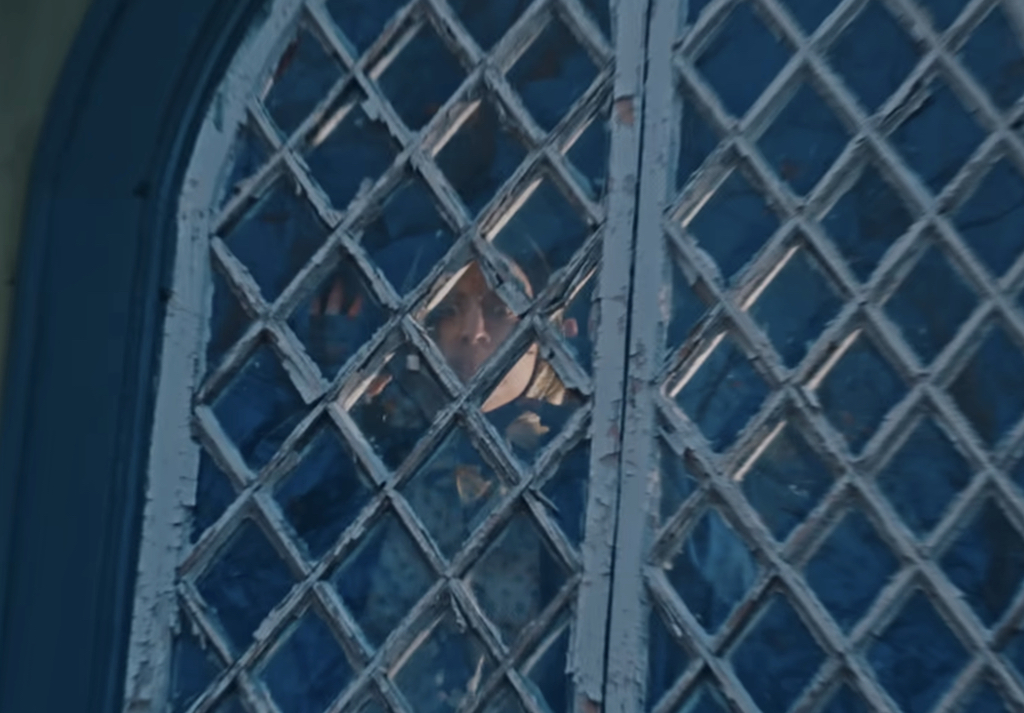
With almost a full six years passing since pretty much everyone in the world was forced to reckon with Covid-19 in some way, Mitski basically returns to the “self-quarantine”-core of the era, and throws more than a dash of Shirley Jackson’s We Have Always Lived in the Castle (with “just a pinch” of Grey Gardens) into the visual language of the Noel Paul-directed video (Paul also directed Mitski’s 2023 video for “Bug Like an Angel”). And though some might assume a song called “Where’s My Phone?” would eventually, in some way, include the kind of phone that the twenty-first century thus far has become synonymous with—an iPhone—Mitski keeps it strictly old school. As such, she does her best to exude the “aesthetic” of a gothic novel like We Have Always Lived in the Castle (which is supposed be set in the late 1950s/early 1960s as opposed to somewhere in the eighteenth and nineteenth century, when the gothic novel was initially birthed and gained popularity). Capturing the sense of anxiety and self-imposed oppression that goes with this kind of visual landscape.
In the first scene, the disorientation and feeling of foreboding that Mitski seeks to inflict upon the viewer is created as the POV shot that Paul wields is one that comes up through the depths of a well before cutting to Mistki carrying a pail toward it and then abruptly tripping and falling as she does so. This, of course, being an allusion to the title of her forthcoming eighth album, Nothing’s About to Happen to Me (with a cat illustration for its cover that also feels like a definite homage to the first edition cover of We Have Always Lived in the Castle). A title that feels as much like a sarcastic statement as it does an “I dare ya” to the universe to fuck with her. And, as most should know, the universe rarely passes up a chance to take on such a dare.
Despite her tripping snafu, Mitski is quick to pick herself up and get on with the business of collecting her water supply so that she can get the fuck back inside the house, ignoring the presence of a mailman standing outside her door trying to pass her some kind of clipboard to sign for a package…or just sign (begging the question of whether he’s a mailman, or some other type of “worker bee”). But to interact with him—let alone anyone—would be far too harrowing for Mitski the Recluse, who is quite literally given anxiety even by seeing her own reflection in the water she’s just “gathered.”
Within the first twenty seconds of the video, it’s also indicated that there’s an older matriarch in the house, and one who reaches for a wall-mounted “coffin phone,” as they were called in the nineteenth century. Soon, Mitski walks up the stairs to reveal another woman—a girl, really—in the house, clearly the “Merricat” of the narrative. And yet, it is the younger girl who appears to be the full-on recluse (with Mitski being the sister to go out and fetch her things) in this scenario, and one who is also naïve enough to fall for the boy outside who’s trying to court her. This being a clear nod to Charles from We Have Always Lived in the Castle. Except Charles was trying to court Merricat’s elder sister, Constance (and yes, he was also her cousin, adding to the gothicness of it all). In this sense, Mitski mixes and matches the characters for her own “repurposed” ends. Including taking on the protective, overly obsessed-with-her-sister vibe that was reserved for Merricat, but has now been transferred to the elder sister that Mitski is portraying—making her, in a way, half Merricat, half Constance.
In another instance, Mitski the Recluse is horrified when her younger sister gets the smallest of cuts on her finger, leading her urgently and frantically through the house, which suddenly feels like a hellish nightmare as random townspeople peer in and the milkman stands expectantly in the kitchen (on a related note, it’s his fault that Mitski’s sister got cut in the first place). The distorted, unsettling way in which these moments are shot and presented echo the style of Soundgarden’s signature video for 1994’s “Black Hole Sun.” Indeed, the sound that Mitski and her longtime producer, Patrick Hyland, create is one of a decided “alt rock-meets-grunge” flavor, particularly as “Where’s My Phone?” comes to a close, rounded out for the last roughly one minute and ten seconds by this unsettling cacophony of sounds as Mitski repeats, “Ba-ba-ba-ba-ba-ba” (the sort of “chant” that would be at home during a scene from Bizarro World Gilmore Girls).
As the visceral anger and tension (musically speaking) of the song ramps up, so, too, does the action onscreen, with Mitski literally going for the jugular of the lecher that tried to lure her sister away from the house. The only problem is, in the blind rage of trying to exterminate him (and ostensibly succeeding), all the townspeople that had infiltrated their house (in a scene that also mimics a key climax of We Have Always Lived in the Castle) have managed to take Mitski’s sister outside and toward the well. Leaving Mitski no time to stop them from shoving her right down it.
And so it is that two messages come to the fore: 1) jealousy can cause collateral damage in the form of death (a Shakespearean trope as well) and 2) maybe even when you’re home, living your life as a shut-in, you’re still not safe. For, though “Stay Home, Stay Safe” was the oft-touted mantra of 2020 and 2021, it doesn’t necessarily apply here. Regardless, Mitski is essentially bringing it back in 2026 to remind that, perhaps now more than ever, the fear of the outside world is entirely warranted. Only it has nothing to do with a virus…though another novel one could still come to roost yet again, considering that humanity never seems to learn from its mistakes. But at least Mitski has proven that it can still potentially learn from its literature.


