


While Madonna has always herself been one of the most glaring examples of a capitalist (and, perhaps even more tellingly, of the baby boomer generation that was conditioned to believe “bootstrap capitalism” is real), it was apparent that, by 1986, even she was feeling the strain and oppressiveness of neoliberalism. Better known in the U.S. at that time as Reaganomics. Indeed, if Madonna hadn’t managed to become rich and famous by 1984 (though she got her first taste of success in 1982 by releasing her self-titled debut), she might have found herself suffering the fate of so many blue-collar workers who struggled financially (and endlessly) under Reagan’s rich people-favoring government policies. Worse for her still, she would have kept trying to live in New York City during an era when it was steadfastly becoming a playground for Patrick Bateman types (see also: Donald Trump). In other words, increasingly unaffordable to artists like Madonna who came to the city looking for community, inspiration and cheap (or even free, if you squatted) rent. This allowing a person to focus on their art without falling entirely into a hamster wheel of worrying about where to get their next money fix to overpay for what should be the most basic of human rights (food, water, lodging).
Maybe there were moments in the mid-80s when Madonna did pause to think about how this could have been her fate if she hadn’t managed to do the impossible. In this regard, perhaps some part of Madonna possessed a keen awareness of just how much luck was a factor in her prosperity as hard work and determination. Because there’s something about True Blue’s “Where’s the Party” that speaks to the average working stiff’s plight—this constantly ready-to-burst-forth energy that is instead always suppressed by the crushing weight of responsibility (which means being forced to make money to pay bills and to give to various levels of government). At the same time, it’s a song that can apply to anyone who yearns for the simplicity and freedom of youth (which so often goes unappreciated in the time when it’s happening). This much conveyed when Madonna belts out, “Couldn’t wait to get older/Thought I’d have so much fun/Guess I’m one of the grown-ups/Now I have to get the job done.”
And grown-ups under neoliberalism had a lot to get done for their ever more low-paying jobs. Now operating under a system that no longer rewarded hard work with any kind of payoff. You know, like the kind of hard work and payoff that Madonna not only got to see for herself, but also for her father, Silvio “Tony” Ciccone, who was born to immigrant parents that wanted a better life for themselves and their children (you know, back when the U.S. was still vaguely adhering to the promise of the “American dream”). Tony wanted to continue that tradition with his own children, which is why, when Madonna dropped out of college, her father saw it as a huge affront to the type of life he had built and the legacy he wanted to leave behind. Of course, little did he know, Madonna would outdo every Ciccone’s legacy.
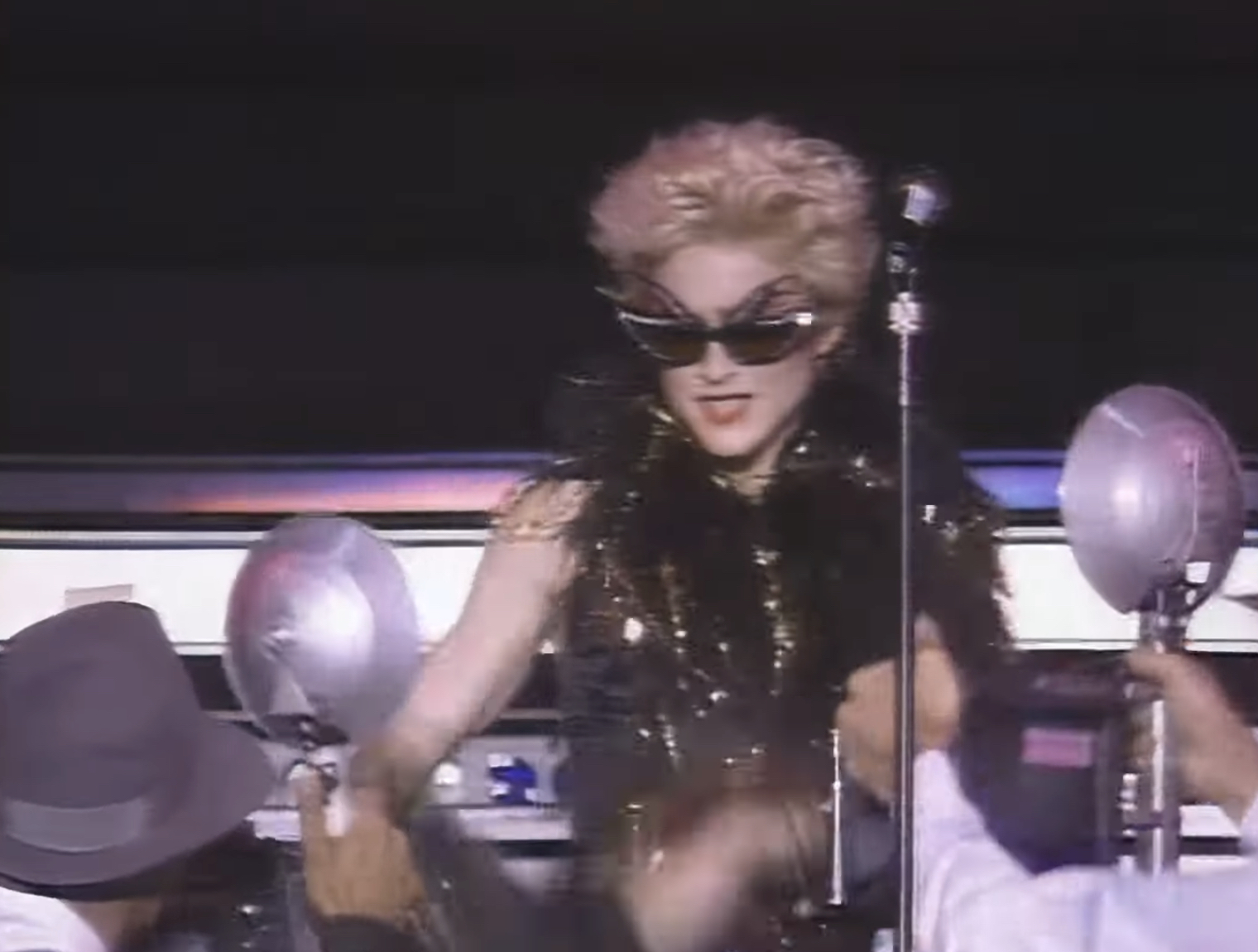
Speaking of Madonna’s fame level, for her first performance of “Where’s the Party” on tour (namely, 1987’s Who’s That Girl Tour), she positioned it around her woes of being stalked by the paparazzi. A reality that her then-husband, Sean Penn, abhorred far more than she did. Incorporating this aspect of her working life into the song, Madonna, wearing novelty sunglasses and a black boa, proceeds to run from the flashbulbs of the photographers (a.k.a. her backup dancers dressed in “old-timey” newspaperman attire) as she sings such lyrics as, “Where’s the party, I want to free my soul/Where’s the party, I want to lose control” (here, too, it can be argued that “Where’s the Party” was also a reaction to the seriousness that had taken over most nightclubs in the aftermath of AIDS). For, yes, even fame under neoliberalism meant that you had to always be “on,” “available.” The 1980s marked the start of this kind of 24/7 working culture. One in which, if you dared to turn “off” at any given moment, it could cost you your relevancy (ergo, your money-making potential). Madonna seemed to be absorbing that new reality and funneling it back through “Where’s the Party,” with lyrics that lamented, “Don’t want to grow old too fast/Don’t want to let the system get me down/I’ve got to find a way to make the good times last/And if you’ll show me how, I’m ready now!”
Alas, no one was able or willing to show anyone how, once neoliberalism had emerged from a proverbial Pandora’s box. The only thing to “show,” at that point, was “how to make more money.” And the answer to said question is, of course: be born rich. Something that, exceptionally enough, Madonna actually wasn’t. Oh sure, she led a mostly middle-class life in Michigan, but she wasn’t exactly born into a family that was rolling in it. This is part of why her rise to the top is a story that has captivated so many people for so long as a classic example of the “American dream” fulfilling its promise. That if you can put enough passion and elbow grease, so to speak, into a pursuit, your work must eventually pay off. But Madonna was part of one of the last generations where that might have been a possibility.
As the 80s got well underway, it seemed that it was becoming clear to someone even at Madonna’s level of newfound wealth that there had been a shift in the culture as a result of “the system’s” overhaul. Which Margaret Thatcher was complementing and reinforcing on the other side of the Atlantic. Together, Reagan and Thatcher approved policies that are still being felt by the working class (or what’s left of it) today. Madonna expressed the boot-on-face feeling that many workers were experiencing in the 80s for the first time. She just happened to do it in a much, let’s say, “pluckier” way, with such earnest urgings and declarations as, “Slow down, you move too fast/Gonna make the good times last/Gonna let my hair hang down/I’m ready now.” But what Madonna—and the working class at large—was “ready” for was never going to be given again. Reagan had sanctioned and bolstered the new era of capitalism that society is still currently trapped in (even if it’s now being rebranded as “technofeudalism”).
And, unfortunately, no amount of Madonna chanting, “We can make it all right, we can make you dance, we can make a party last all night” could change that. Because, as she had also accurately remarked just two years prior on “Material Girl” (from 1984’s Like A Virgin), “We are living in a material world.” Which means that only a very select few are able and “allowed” to party. To have the question itself—where’s the party—answered. Appropriately enough, it was also during the Who’s That Girl Tour that Madonna sang a rendition of “Papa Don’t Preach” during which images of the White House and Reagan were projected behind her (this marking her first overtly political statement during a world tour [which would soon after become her signature], along with the words, “SAFE SEX” displayed behind her during the same song). Thus, in addition to demanding to know where the party had gone in a post-Reagan world, Madonna was also telling this particular “patriarch” of the nation to quit preaching his bullshit Reaganomics. Tragically, it was already too late. Not that Reagan was really coherent enough to take in such fervent pleas to stop steadily destroying artists’ and the working classes’ quality of life.


