


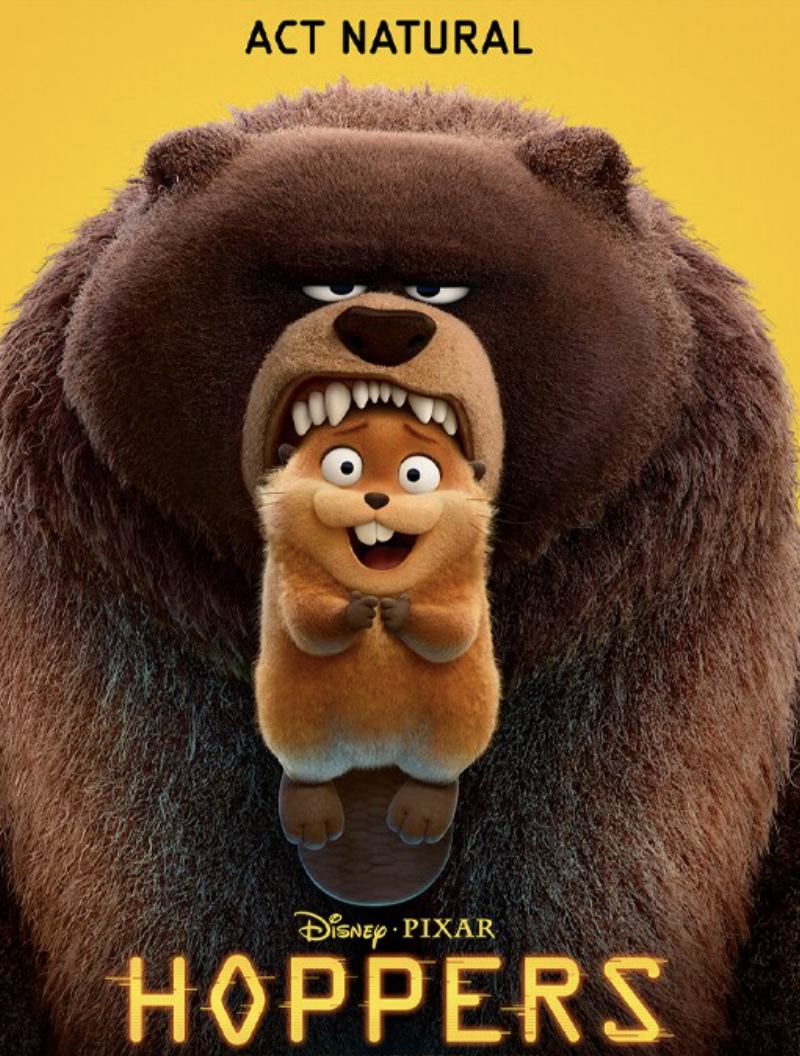
A movie like Hoppers arrives at an apropos moment in human history. One in which it’s been said that “human connection to nature has declined sixty percent since 1800.” A startling statistic when considering that Mother Nature was here long before humans and will be here long after they’ve destroyed themselves (even if, sometimes, it takes a little outside push for them to do it, Bugonia-style). However, it’s not a startling statistic at all when taking into account just how much human life has been pushed ever more inside. And yes, in no small part thanks to the many distractions of the internet. But it isn’t just that contributing to the decline in what University of Derby’s Professor Miles Richardson calls “nature connectedness.”
Indeed, Richardson, who conducted the study that yielded this “sixty percent decline” statistic, factors in three primary reasons for an increasing lack of human connection to nature: 1) urbanization, 2) parents failing to impart/pass down an appreciation and respect for nature and 3) a loss of wildlife in areas where construction and building drive ecosystems away (or just outright decimate them). It is the latter form of human selfishness that takes center stage in Hoppers, directed by a longtime storyboard artist for Pixar, Daniel Chong, and written by Jesse Andrews, best known for writing Me and Earl and the Dying Girl—until now. Because with Hoppers, Andrews has achieved one of his greatest writing accomplishments and, in so doing, potentially jumpstarted a new admiration and fervor for nature among younger generations that have been weaned primarily on a diet of “inside good, outside bad.”
With an animal-loving protagonist, Mabel Tanaka (Piper Curda), as the anchor of the movie, Hoppers begins on a familiar scene to anyone who has ever been subjected to the various cruelties of the public school system. One of them being to keep “class pets.” So it is that Chong homes in on a turtle inside of a tank just as he’s about to take a glorious bite out of a leaf after no doubt spending many minutes trying to reach it. It’s at that exact moment that a flurry of students bursts in, with one deciding to turn the turtle on his back just for the hell of it. Dreams dashed, hard work out the window. This simple moment speaks so acutely to the ways in which human behavior, cavalier and arbitrarily cruel as it can be, affects the animals and nature at the mercy of their often illogical whims.
The lone protector of this turtle—and of all classroom animals, as the viewer will soon see—is Mabel (whose moniker continues the Only Murders in the Building trend of only “odd ducks” being named that). For she’s the one who plucks him up and places him and some other stowaways into her backpack so that they might have some of their agency back. Of course, she’s cornered by several adult “authority figures” before making a giant leap for the exit and causing the fire sprinkler to go off in the process, wreaking general havoc. It’s clearly not the first time that Mabel has done so, with her mom dropping her off at Grandma Tanaka’s after she’s sent home and chastising her for once again causing a scene with her “attitude problem.” Even if what everyone is really telling Mabel with such comments as these is that she needs to care less. A kind of modern “wisdom” that has helped stoke the flames of a collective apathy, starting from a very young age now.
But because Grandma Tanaka still remembers what it’s like to be a human capable of emotions and passion, she comforts Mabel by telling her that she used to be angry all the time too, even going so far as to punch a girl in the face when she was twelve years old. But then, she found something that soothed her: nature. Because, as she tells Mabel, “It’s hard to be mad when you feel like you’re part of something big.” And in order to truly feel a part of something—the world at large—a connection with nature is key. For Grandma Tanaka, it’s one piece of nature in particular that calms her on a daily basis: the glade right next to her house. Where she invites Mabel to sit next to her on a rock overlooking the pond filled with an ecosystem that is rich and varied. It doesn’t take long for the insight her grandmother imparts to her about nature to take effect on Mabel, who becomes just as passionate about and appreciative of the glade.
As their bond solidifies, soon enough, Mabel is living with her grandmother full-time while her parents see fit to move to the other side of the country. Mabel, in stubborn Mabel fashion, refuses to leave Grandma Tanaka. Especially as she’s gotten older now in Mabel’s teenage years, and needs more help with day-to-day tasks. Needless to say, the viewer knows what’s coming because it’s the Pixar way to make its audience shed more than a few tears. And so, in the aftermath of Grandma Tanaka’s inevitable death, Mabel is the one tasked with the responsibility of saving the glade from total destruction by Jerry Generazzo (Jon Hamm), the mayor of Beaverton, determined to build a beltway over the habitat. Except that Mayor Jerry is miraculously claiming that there’s no longer any wildlife living in the glade to protect. That, quelle surprise, will turn out to be the result of a very nefarious plot.
Not like the far more well-intentioned one that Mabel’s college biology professor, Dr. Samantha “Sam” Fairfax (Kathy Najimy), has going on with her own plot—the one to transplant the human mind into a robotic animal that can then understand all the other animals (never mind the science behind such a rig). Hence, the movie’s title, which refers to a human mind hopping into an animal one—even if it’s a fake animal. And in this case a fake beaver (never mind the innuendo behind such an animal choice). Occupied by none other than an overly enthusiastic and hellbent Mabel, who needs to find a way to convince a real beaver to start working its magic on the glade again, having inexplicably disappeared, thereby leaving an empty abyss/gaping, waterless hole in the aftermath. And if the wildlife returns thanks to a beaver’s skillful damming ability, then the mayor can’t say, in good conscience, that the beltway ought to still be built.
Along the way, Mabel in her beaver form encounters and befriends many members of the animal kingdom, chief among them King George (Bobby Moynihan), the leader of the mammals who teaches Mabel some basic hacks for living as a beaver (e.g., swimming properly). This done because he’s trusting enough to assume that her parents just didn’t teach her these types of things for whatever reason. In this regard, too, Hoppers makes the subtle case for why it’s so important that parents are involved and engaged in teaching their children things. Because without that kind of guidance, it’s hardly assured that they’ll learn on their own. As the current state of nature disinterest has shown. A disinterest that is directly related to the escalating environmental catastrophes around the world. As Professor Richardson puts it, “Nature connectedness [or rather, a lack thereof] is now accepted as a key root cause of the environmental crisis. It’s vitally important for our own mental health as well. It unites people and nature’s well-being. There’s a need for transformational change if we’re going to change society’s relationship with nature.”
Throughout Hoppers, this is the kind of message being emphasized, with King George reminding Mabel that even though the humans kind of suck and are generally selfish, greedy knaves, “we’re all in this together.” This thing called an existence where resources are meant to be shared, not hoarded or destroyed for the sake of making fucking money. Which will mean nothing when it all comes crashing down (and it will, at the rate things are going).
While the irony is that it takes being indoors watching a movie for some people to understand the importance and majesty of nature—and how animals are just as sentient as people, with the right to be treated as such—at least it’s a small step in the right direction for rekindling a connectedness to nature for new generations. Though, of course, humanity is still a long way from making the necessary amendments that would truly create the kind of infrastructural change required to ensure humans interact with nature for a sustained and significant amount of time on a daily basis. But at least Hoppers is trying to inspire some of that much-needed change.


+ There are no comments
Add yours