


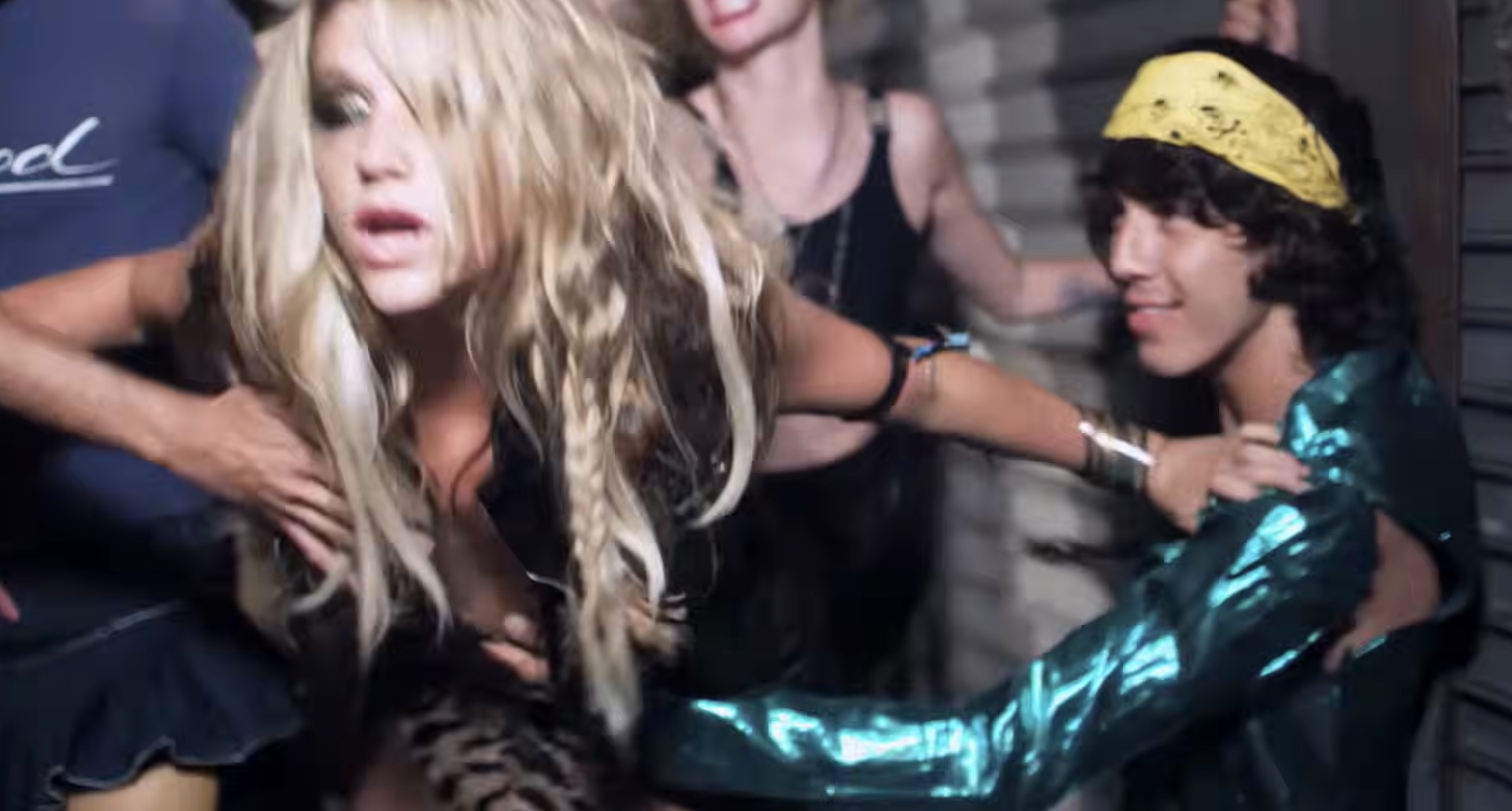
About four days before Kesha unleashed the “Backstabber” video from the proverbial vault, she began teasing some of its lyrics in captions underneath “sassy” photos of herself in her modern incarnation (in lieu of her “Animal/Cannibal era” one). Lyrics like, “Damn, Jeanie” and “Everybody knows it,” along with a flyer she created that read, “MISSING! Have you $een this car?” (Specifically, a gold Trans Am—a car brand that is also shown some love in the video for “Tik Tok.”) And yes, that dollar sign “S” was something Kesha laid claim to long before Slayyyter. What’s more, anyone who has followed Kesha’s work for long enough is well-aware that she’s the number one Trans Am enthusiast, even going so far as to co-write a song called “Gold Trans Am” for her 2012 album, Warrior.
And clearly, the worst thing a person—let alone a so-called friend—could do to Kesha is steal her prized Trans Am. Which is, believe it or not, something that actually happened (though not [necessarily] to a Trans Am), with Kesha informing Billboard in 2010, “A very close friend of mine stole my car one night.” This unexpected real-life “twist” serving as the driving (no pun intended) force behind the “Backstabber” video, originally filmed in 2009 and now, after years of never seeing the light of day, emerging at exactly the time when the masses are, more than ever, having a major bout of nostalgia for the recent past. Something Kesha (and, unfortunately, Lena Dunham) seems keen to assist with. For, in addition to becoming the premier example for what constitutes “recession pop,” she has also become something of a primary mascot for “indie sleaze.” A “genre” (a.k.a. aesthetic) that had no name when it was actually transpiring, only to secure this somewhat offensive one less than a decade afterward, when the 2010s were (and are) suddenly being romanticized (which, of course, is really saying something about how bad things are now).
The visuals for “Backstabber” certainly help with that romanticization. For while, to some, these images of Villaraigosa-era Los Angeles might look “garden variety,” they bear the kind of “grittiness” that simply isn’t seen in any major city anymore (not even most people’s “prized pig,” New York). With Kesha herself recalling, “We ran around Echo Park and Silver Lake together and just loved making art. It was so authentic to that moment in my life, before everything changed… We shot this in Downtown LA near the bar where I worked part-time. It was my first music video, and I just knew I needed it to work.” And it really does. Which is why it’s a bit of a shame that it wasn’t released “in the moment.” At the same time, it seemed that “Tik Tok” was destined to be Kesha’s lead (and signature) single. With a video that bears the same kind of “no frills” production that lends it that “authenticity” Kesha was referring to in “Backstabber.” Not to mention what “the kids” would deem to be a “vintage” flair. Complete with Kesha getting out of the driver’s seat of her Trans Am to use a pay phone while naively (apparently) trusting her “friend” to stay in the car while she makes her call.
But she can’t even get the conversation started after dropping the phone as she sees this Backstabber actually have the audacity to crawl into the driver’s seat and speed away into the night. Kesha reflexively runs after her beloved vehicle, even though she must know it’s an impossible race to win. Passing by the 730 bus stop as she tries to chase after the Backstabber, Kesha also provides another window into the past by reminding viewers of the part of L.A. transit history when the 730 replaced the 330 from 2008 to 2012 before reverting back to the latter. Her franticness turns to casual anger as she serves for the camera in front of Downtown staples like the Orpheum Theater. In fact, it’s outside of said venue that Kesha encounters a girl who can be described as Backstabber #2 as they engage in a kind of West Side Story-esque “dance-off”—their version of getting into a “physical” fight.
And that “violent” tussle leads to Kesha being pushed by Backstabber #2 against the gated façade of a pawn shop, its neon sign still illuminating the sidewalk where the “altercation” is happening. An altercation that starts to feel more sexual than violent as Kesha briefly walks away from the group, only to reengage in a literal dance with Backstabber #2 before kissing her right on the lips (in a moment that recalls Madonna and Britney at the VMAs and also the general 2000s-era obsession with straight girls kissing one another [see also: Olivia Wilde on The O.C. or hear also: Katy Perry’s “I Kissed a Girl”]).
In the next sequence, Kesha, now dressed and maquillage’d in the height of her 2009-2012 glory, opts for a “Thriller”-y tableau as she and her dancers—along with Backstabber #2—offer some rather impressive choreo (courtesy of practicing at Ryan Heffington’s house, then “up and coming” himself) for such a “lo-fi” video (though not so lo-fi as to be self-directed, with David Hache, Marc-Edouard Leon and Dori Oskowitz a.k.a. SKINNY at the helm of the camera). To boot, they even get a very “prescient” cameo in the form of Detox (well before her stint on Drag Race), as she scurries past them while Kesha sings, “Run your mouth more than anyone I’ve ever known/And everybody knows it, and everybody knows it.”
Detox then gets even more time to shine as she goes in on the first Backstabber that stole Kesha’s car, giving her a strangle after Kesha slaps her across the face. This done while said Backstabber is caught standing next to the stolen Trans Am. But, oddly, Kesha doesn’t seem all that eager to take the car back into her possession, instead becoming enamored of a quintessential indie sleaze guy who she walks off with into the proverbial sunset. Except it’s more like “into the moonlight” as it’s still quite late (or very early, depending on one’s perspective). In any case, maybe she’s not worried about losing it again since Detox thoroughly finishes the job of taking this Backstabber out.
As for Detox being a well-known Madonna fan, the connection to her here is that, while Kesha got misty-eyed in the crowd over the speech “Mother” gave during her acceptance of the 2016 Billboard Woman of the Year award, M actually said something that speaks to “Backstabber”: “To the doubters, the naysayers, to everyone who gave me hell… your resistance made me stronger, made me push harder, made me the fighter that I am today. Made me the woman that I am today. So thank you.”
Writing on her social accounts after the release of “Backstabber,” Kesha’s take on that sentiment turned out to be: “And thanks to those backstabbers : ) I appreciate the inspo.” As do fans of the song that at last get to see the accompanying visual that Kesha made solely because she felt so strongly about it being her lead single from Animal. “Backstabbed” in the end by the label who wanted “Tik Tok” to have that distinction. A move that, while undeniably beneficial to Kesha’s career, also set the tone for the early part of it in terms of her constantly being stifled and suppressed. Which is part of why Kesha’s decision to release “Backstabber” now, after becoming an independent artist with her own label, is so empowering. Another step on her path toward the redemption she’s been seeking when it comes to her early years in the music industry.


+ There are no comments
Add yours