


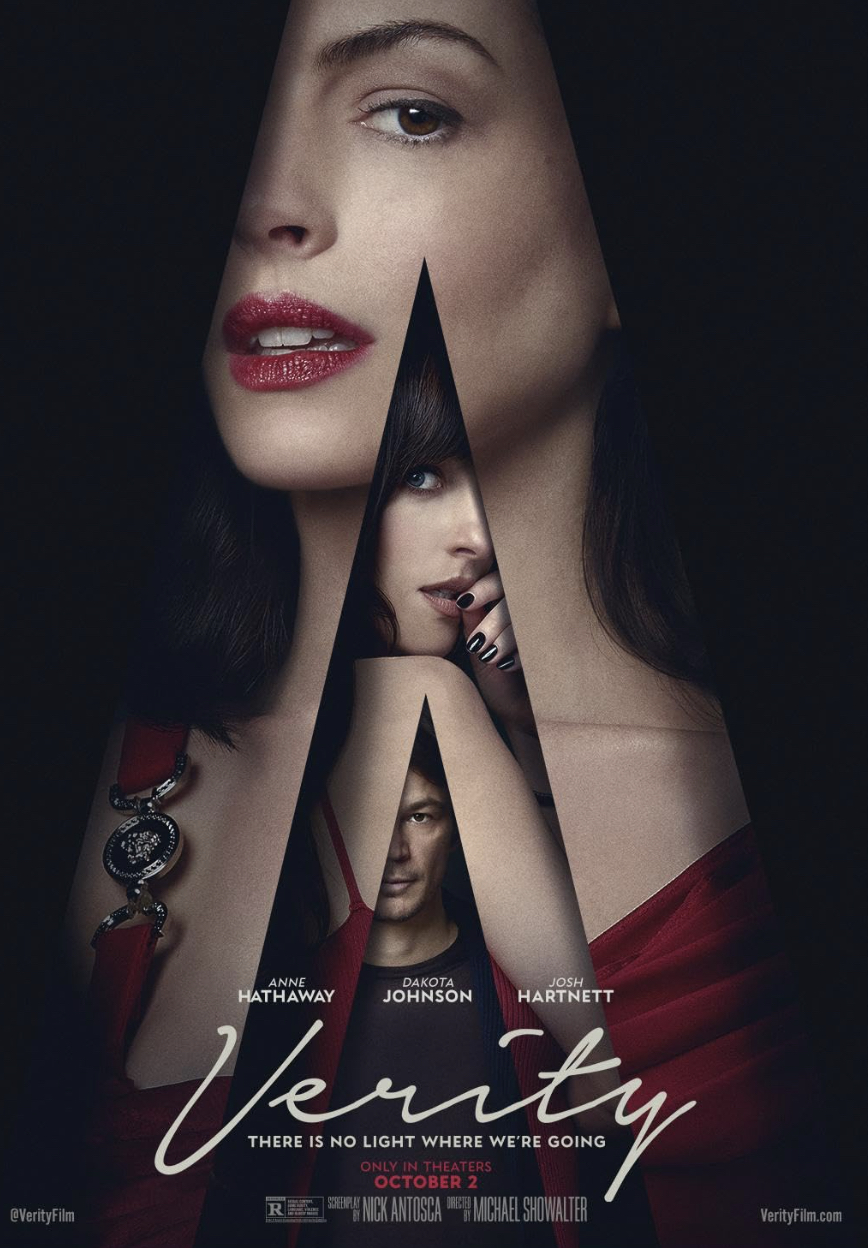
Perhaps it’s an indication from the very first moment that director Michael Showalter opts to open Verity with an exterior shot of Books Are Magic in Brooklyn that the movie is trying desperately to be something it cannot: “effortlessly” “in the know.” Not just about what it is to “be a struggling writer” (the likes of which would probably never get scheduled for a reading at Books Are Magic), but how to deliver some kind of “mind fuck” movie that only turns out to be a “what the fuck” movie. As in, what the fuck is this plot and how can it be so bad? For it’s not as if Showalter and screenwriter Nick Antosca, who adapted the script from Colleen Hoover’s book of the same name, are known for delivering such drivel. Though Showalter’s directorial filmography has often been less consistently good (the highlights being Hello, My Name Is Doris, The Big Sick and The Eyes of Tammy Faye) than his comedic work and screenwriting. Regardless, it still doesn’t explain the badness of Verity—unless, of course, one looks to the source material itself. And Hoover is nothing if not commonly deemed “the Taylor Swift of ‘literature’” for a reason. Both because of each “artist’s” major success and because they’ve both bastardized and dumbed down the respective arts they specialize in while being faux pretentious about it.
Yes, each “artist”—and especially Swift—is heralded as someone writing “honestly” and “unapologetically” about romance. In Hoover’s case, that often means a “twisty-turny” kind of romance, which overlaps with her additional success with writing psychological thrillers. In fact, she herself seems to be the inspiration behind the kind of books that Verity Crawford (Anne Hathaway, working for the second time with Showalter after The Idea of You) has made her fortune off of (complete with the cheesy cover art and font). The kind of fortune that can not only buy a luxury (albeit creepy), custom-built home in Vermont, but also buy any ghostwriter of Verity’s choosing. Not that she’s chosen Lowen Ashleigh (Dakota “Plain Jane” Johnson) for the task of writing her next novel. Mainly because she’s in an immobile, catatonic state after a car accident that’s been kept under wraps from the public so that fans of Crawford’s book series won’t freak the fuck out about not getting any more installments.
And, rather than fictionalizing the publishing house involved in keeping the secret, Verity wields Hachette, the same publisher that picked up Hoover’s book via Grand Central Publishing after she released it independently in 2018. Four years before the release of Freida McFadden’s The Housemaid, a book that not only got its own glossy Hollywood movie adaptation, but also provides, in its way, a similar plotline and twist, but does so with far greater, more satisfying effect, courtesy of McFadden’s deftness with the setup, plotting and pace. All of which lead to the payoff twist about an hour and thirteen minutes into the movie version, when it’s revealed that Andrew Winchester (Brandon Sklenar), the husband of Nina Winchester (Amanda Seyfried), is the real villain despite the latter being painted as such for most of the film.
To boot, like Lowen, Millie Calloway (Sydney Sweeney) is offered a job that requires her to move into her employer’s home, where she’ll see and hear things that she otherwise might not if she was just able to pop in and out during the hours of a “normal” assignment. But the strategicness of this kind of setup is what allows both McFadden and Hoover to toy with notions of truth and perspective, and how they can be manipulated depending on who’s telling the story and what known “facts” are meted out. Unfortunately, Verity, with its overarching theme of how “truth” is subjective, and no one can “really” know it, attempts to be highfalutin only to fail fantastically at presenting anything as “wow, so insightful” as it thinks it is. Instead, something like 2024’s Disclaimer, written and directed by Alfonso Cuarón, does a much better job of this form of presenting “truth distortion” or “manipulation,” and how it affects women specifically. And yes, at the center of that TV series is also a book that promises to tell the “truth” about someone (namely, Catherine Ravenscroft [Cate Blanchett]).
Verity’s unpublished manuscript (an autobiography), discovered accidentally by Lowen, is meant to tell the “truth” about herself. A truth so ghastly and unpleasant that Lowen is prompted to vomit. And since people are so frequently conditioned to believe that the truth can only ever be “ugly,” Lowen wouldn’t bother to question at all the nature of what she was reading. Especially after she asks Jeremy (Josh Hartnett) to corroborate certain details of what Verity has written (like how they met) to know for sure if she is telling the “objective” truth. With Jeremy confirming the “gist” of what Verity has written, Lowen is left to pity his situation all the more, which only helps further spur her attraction to him. As is also the case with Millie and Andrew in The Housemaid. Along with Lowen, like Millie, agreeing to go on a date with this married man because his wife is awful so why shouldn’t she? And why wouldn’t she also wear said wife’s clothes while doing it?
To that point, during the start of the date sequence between Millie and Andrew, Lana Del Rey’s “Cinnamon Girl” plays. When Lowen searches through Verity’s clothes (homing in on the red dress Verity wore the night she first met Jeremy), Kali Uchis’ “Sugar! Honey! Love!” plays, with both films indicating that they’re “aware” of what’s “happening” (a.k.a. modern) while also being fundamentally kowtowing in their old school deference to patriarchy. Which brings one back to the Taylor Swift connection in both movies, with “I Did Something Bad” playing in The Housemaid (or rather, during the credits). But Swift’s connection to Verity is far stronger not only in the sense that she’s been derisively compared to Hoover, but also because she’s effectively replaced Blake Lively with Dakota Johnson as her new “bestie.” And, as such, created a music video concept for “Patient Zero” that not only co-stars Johnson, but directly references one of the plot points in Verity.
As for Johnson, no stranger to starring in even shittier film adaptations of shitty books, she might have also been drawn to the familiar 50 Shades of Grey vibe occasionally exuded by Jeremy, who keeps fixating quite a few times on whether or not she’s eaten something—a very Christian Grey thing to do. And if that’s meant to be yet another “manifestation” of Jeremy’s need to control the things and people around him (despite his outward appearance of “mild-manneredness”), then it’s surely another tick in the column that clearly implicates him as the true villain of the story.
What’s more, opting to cast Josh Hartnett as Andrew feels less about his acting skills and more about offering a subtle callback to his “prime time” in the early 2000s, when mid-tier, and admittedly, kind of trite thrillers of this nature were more pervasive. On that note, any one the thrillers from said era (e.g., Don’t Say a Word, Enough, Unfaithful, The Skulls, What Lies Beneath, etc.)—with Hartnett himself starring in late 90s “thriller fare” like The Faculty (and later, in Wicker Park and The Black Dahlia)—is better than this absolute shite posing as “legitimate cinema” because of its cast and budget.


+ There are no comments
Add yours