


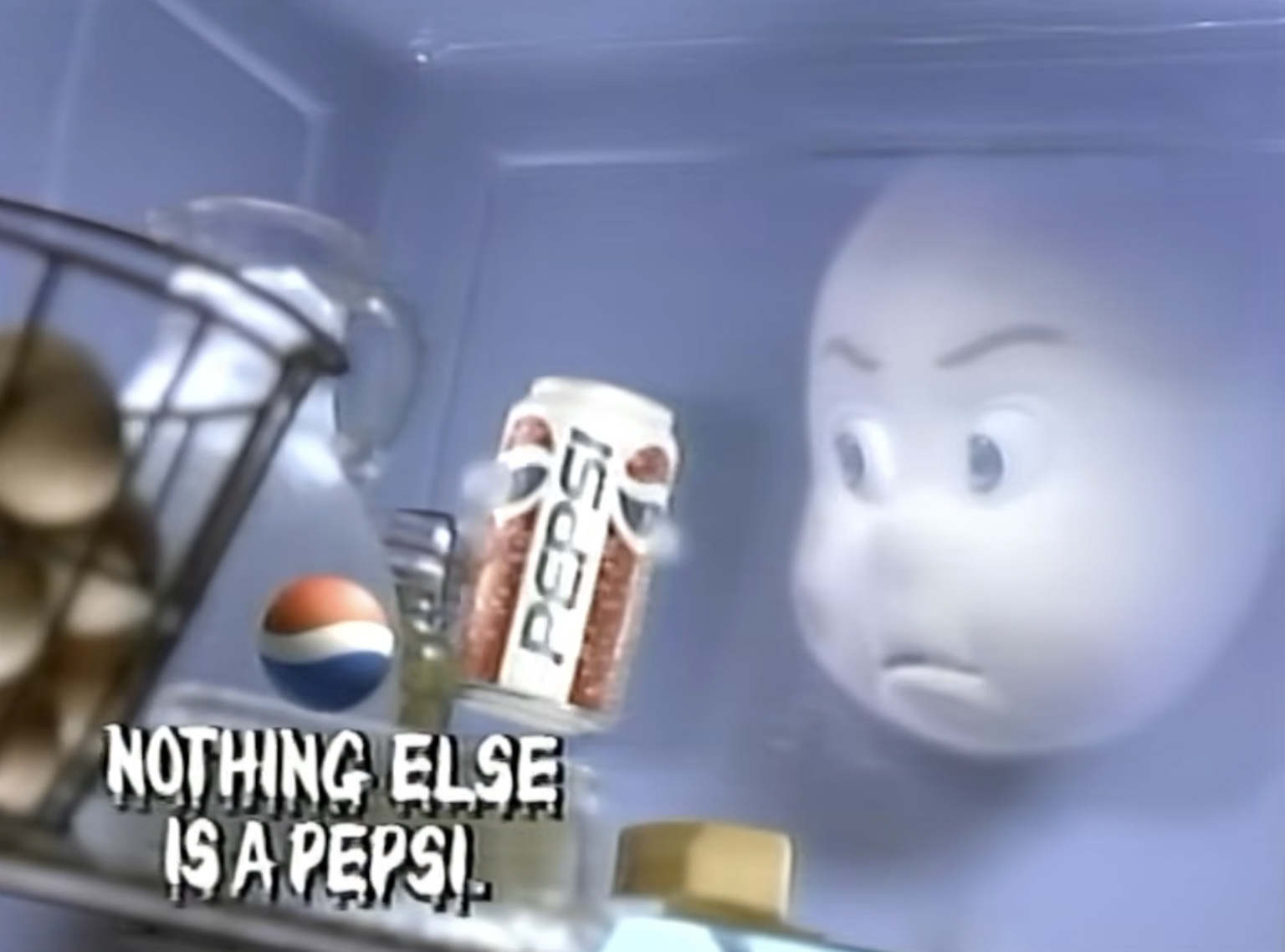
In the 90s, when capitalism was still yielding “bounty” to slightly more than just a few (as exemplified by the McCallister abode in Home Alone), product placement and/or “synergy” between brands and movies were far more common. Even when it was a movie that might presently be considered only “mid-tier” to the average studio. A movie like 1995’s Casper, which had no shortage of corporate partnerships. Among the leading ones being Pizza Hut and Pepsi (which is no coincidence in the sense that Pizza Hut has been “Team Pepsi” when it comes to the drinks they offer ever since being acquired by PepsiCo in 1977). It was the latter brand that opted to tie having a corporeal self to being “alive” in more ways than one. Mainly, in the way that allows you to truly feel “the joy of Pepsi”—by being able to move it out of a physical space so that you can drink it.
Something that, “tragically,” Casper cannot do. In fact, the limitations of his ghostly shell are the crux of the Steve Beck-directed Pepsi commercial. This made apparent after about twenty seconds of “touring” Whipstaff Manor from a perspective meant to make it feel as if the viewer himself is cautiously walking around inside the creepy, haunted mansion trying to figure out where the “bump in the night” sound is coming from. And yes, the sound of what turns out to be Casper repeatedly clanging an aluminum Pepsi can against the side of what looks like an old school porcelain enamel refrigerator (though it could just be made of metal) brings up many questions. Not least of which is: wouldn’t Casper, having already spent decades haunting the halls of Whipstaff, be well-aware that he couldn’t move something like a Pepsi can through the refrigerator? Or perhaps his desire for Pepsi was suddenly so strong and overwhelming that he forgot entirely about the limitations of physics. What’s more, couldn’t he just wait for Kat Harvey (Christina Ricci) to show up and remove the beverage for him? Unless, for whatever reason, this moment is meant to take place before she and her dad, James Harvey (Bill Pullman), move in.
As to why Casper would have such a strong desire for the drink, it could relate to both dying before the beverage truly (soda) “popped off” (with the brand not being officially incorporated until 1902) so now he’s extremely intrigued by it and to the fact that no one else had ever dared to set foot in Whipstaff Manor to stock the fridge with such “delightful modernities” (which, again, makes one presume that Kat and James are living there and could just hand Casper the drink when they get back). Of course, the “why” isn’t meant to be important or even considered in a commercial of this nature (or really any other). The point is that the having of a thing—in this case, a Pepsi—that can be bought and consumed is the closest any human, in capitalism’s all-seeing eyes, can get to being (and feeling) alive.
Considering that Casper, in this version of the story, died when he was just twelve years old of pneumonia, his enjoyment of having, of consuming was cut far too short (not least of which is because his father, J. T. McFadden, knew how to build toys and other objects with his own hands, mitigating Casper’s “need” to buy). Especially as far as “the corporations” are concerned—they could have gotten decades’ worth of more money out of Casper’s consumption capabilities had he not died so early. And now, as a ghost, his supernatural abilities aren’t even supernatural enough to allow him to enjoy the so-called perks of capitalism. Limiting as his “ectoplasm” can be, Casper clearly (no pun intended) couldn’t have foreseen just how stymying it could be until this kitchen “horror” befell him. Indeed, perhaps it’s even worse than the sting of not being able to use the last of his father’s formula to power the Lazarus machine to bring himself back to life because he instead sacrifices it so that James can live again and Kat doesn’t end up losing two parents (her mother, Amelia [Amy Brenneman], having passed away unexpectedly two years before she and her dad move into Whipstaff).
However, if he had been selfish enough—which is kind of what capitalism is all about (in terms of “being successful” at it)—to use the formula, he would have been able to grab that Pepsi and guzzle it. As a flesh-and-blood human. Alas, after rattling the can around for a bit, Casper is left only to say, “Ah man” rather ruefully—and even a bit angrily—when he remembers that physical objects can’t move through other physical objects like he’s able to. And that slight anger gives way to a noticeable sad face and hanging of his head as the commercial comes to an end and Casper is hit with the sobering revelation that not only can he not actually drink a Pepsi (if the film’s image of his uncles, Stretch, Fatso and Stinkie, stuffing food into their gullets only for it to go literally right through them is an indication), he can’t even “take one” either.
Then, as if to really underscore that point, the tagline for the commercial appears in a “spooky” font: “Nothing else is a Pepsi.” An obvious statement, to be sure. Just as nothing else is a Coke and nothing else is a lobotomy, etc. But the purpose, of course, is to emphasize the idea that “there can be no substitutions” for the so-called best. And what “the best” is really supposed to be, as reinforced by this commercial, is capitalism (something George W. Bush still had the gall to deem “the best system ever devised” in 2008, right as the banks were being bailed out by the government for the capitalism-based mess they caused). Because what fun is it to keep existing as a ghost if you can’t even enjoy the temporal things that you were conditioned to believe made life worth living? And now, evidently, doesn’t make the afterlife worth being dead.


+ There are no comments
Add yours