


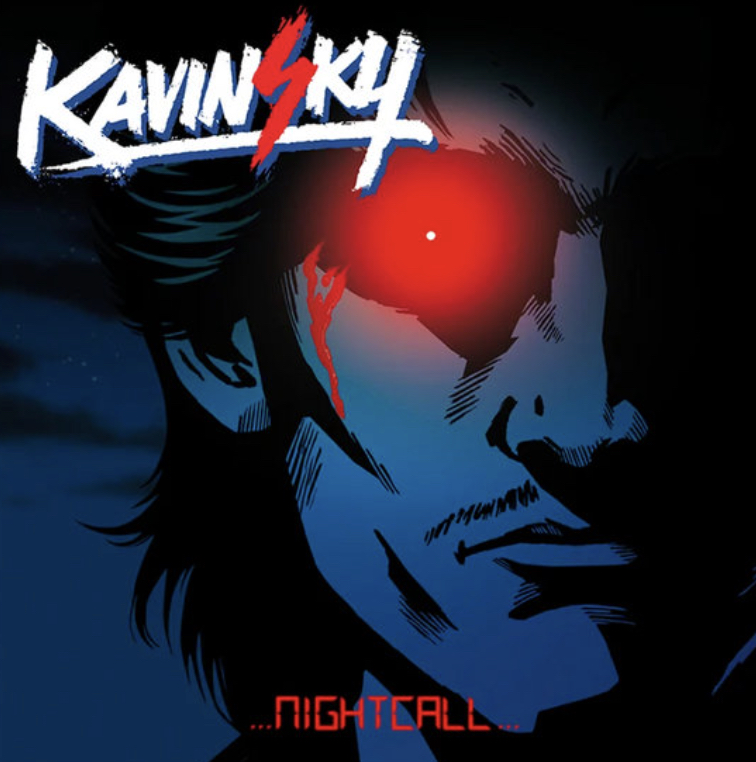
If there was ever a posterchild for a musician forever tied to one song, it’s Kavinsky. More to the point, a posterchild for providing a song that would be forever tied to a film’s soundtrack. And, no matter what he might have created after 2010’s “Nightcall,” it seemed it was Vincent Belorgey’s fate to be unable to top how iconic that single would become when paired with scenes of Ryan Gosling driving through Los Angeles in Nicolas Winding Refn’s Drive, released in 2011. One of the last years before the city would transition from its sodium vapor lights to the LED ones that changed the entire color palette at night. For while the sodium vapor lights lent the City of Angels an orange-yellow (or yellow-orange) haze, the bright white of the LEDs altered the entire aesthetic of L.A. in the dark over time as the replacements were systematically implemented. To be sure, that lighting distinction is part of what gives Drive such an instantaneously “nostalgic” look. Even soon after it was released.
And it was lucky that, for the purposes of capturing the neo-noir aura of the story (adapted for the screen by Hossein Amini and based on James Sallis’ 2005 book of the same name), Winding Refn was able to immortalize this look in a Hollywood movie for one of the last times. Of course, nothing about Drive exactly screams “Hollywood movie” at all. Starting with the fact that it begins with the tense sound of The Chromatics’ “Tick of the Clock,” one of the seminal songs that Johnny Jewel (in the band himself) chose for his contributions to the soundtrack. It’s “Tick of the Clock” that paves the way for “Nightcall” to come in after almost exactly ten minutes of the “on the edge of your seat” scene that reveals to the viewer just how valuable The Driver’s skills behind the wheel are. So valuable, in fact, that all three of his jobs—mechanic, stunt driver and getaway driver—rely heavily on him for this particular talent.
But it’s only from the moment the thumping bassline of “Nightcall” comes on at the same time as Refn cuts to the indelible Downtown L.A. skyline that the viewer can understand that, for The Driver, the act of driving is akin to the very sort of freedom and anonymity that an “old school” lone wolf like himself craves. And there is no more perfect match to convey this in the first scene than Kavinsky’s signature song.
What’s more, in the character of The Driver, Gosling embodied the nihilistic tone of Kavinsky’s stabbing synths and warped, vocoder-infused vocals—which are also shared with CSS’ Lovefoxxx, who lends the overall feel a slightly more romantic bent. Which coincides with The Driver’s own bubbling-to-the-surface romance with Irene (Carey Mulligan), the single mother that lives in the apartment just down the hall from him. Naturally, with The Driver being as repressed and “playing it close to the vest” as he is, the music is a key aspect of filling in the emotional gaps where The Driver himself can’t convey what he’s feeling. At least not with words. For, like “Nightcall,” The Driver is both brimming with emotion, yet somehow cold and impenetrable.
This contradiction speaks to something noted in an article for NPR (titled “Drive Lets the Songs Do the Feeling”) that was published the same month that Drive came out (in September). For it’s said that “the songs on the soundtrack were chosen to mimic and enhance both the isolation and the emotion of sitting behind the wheel of a car, closed off from the world passing by outside.” Just one of many aspects about this movie that makes it “so L.A.” And yet, prior to making this movie, Winding Refn didn’t spend much time at all in L.A. Nor had he ever heard “Nightcall.”
Instead, it was his editor, Matthew Newman, that turned him on to the track, with Winding Refn telling NPR, I always wanted an electronic score, but I’m not an expert—but [Matt] is, and he was very good at finding suggestions that I would then choose from. And one of them was [“Nightcall” by] Kavinsky, which I’d never heard of until he played it for me, which I really really liked. And that basically started that whole fascination with Europop, because I essentially wanted this whole Eurovision sound.” Johnny Jewel then helped him ensure that was the case, with additions from The Chromatics (“Tick of the Clock,” as mentioned) and Desire (“Under Your Spell”)—the latter being yet another band he was also a part of. It was then all rounded out by College featuring Electric Youth (“A Real Hero”), the former being part of Valerie Records rather than the Italians Do It Better label.
With “Nightcall” as the linchpin tying the entire sound together (even Cliff Martinez’s moodier compositions), it was no wonder that Refn chose it as the movie’s more overt opening track, booming out as The Driver gets to drive on his own personal time, and revealing him to be a very lonely soul indeed. This being further accentuated by Lovefoxxx’s lyrics, “There’s somethin’ inside you/It’s hard to explain/They’re talking about you, boy/But you’re still the same.”
As for how aligned The Driver is with the roving, fatalistic identity of “Nightcall,” in many respects, it was as if Kavinsky was somehow destined to be a part of Drive. After all, the “character” he created for the music that would inspire the Nightcall EP and his 2013 debut, OutRun, sounds as if he could have been modeled on The Driver himself. Except the part where Kavinsky came up with his character years before and his driver just so happens to become a zombie (hence, Kavinsky’s red “Terminator eye” on the album artwork and for certain live performances) after crashing his Ferrari Testarossa. On that note, there’s even a song on OutRun called “Testarossa Overdrive,” which precedes “Nightcall” on the album.
Before it appeared on OutRun, its EP format also offered a song called “Pacific Coast Highway,” during which the narrating voice could very well be talking about The Driver when he says things like, “For a moment it appears as if the driver and his car have disappeared into thin air.” Just as Kavinsky himself has done in the wake of his unexpected and untimely death, reportedly due to a stroke. With just two full-length albums under his belt (OutRun and Reborn), who knows what else Kavinsky might have been able to offer the world of music if he had been given more time. And yet, it feels almost certain that, no matter what age he might have died, “Nightcall” was destined (or doomed, depending on one’s perspective) to be the crux of his legacy. And, of course, that’s not a bad thing at all. It’s just that not everyone can always handle the pressures and limitations of being associated with one song in their catalogue.
As far as “one-hit wonder” tracks go (which is a completely reductive way to characterize it, but that’s how people will), however, it doesn’t get much better than “Nightcall,” arguably one of the best songs of the 2010s—a decade oversaturated with EDM and trap hip-hop. Which is part of why “Nightcall” was so special and stood out undeniably among the crowd. Much like The Driver himself (though in no small part thanks to that scorpion jacket).


