


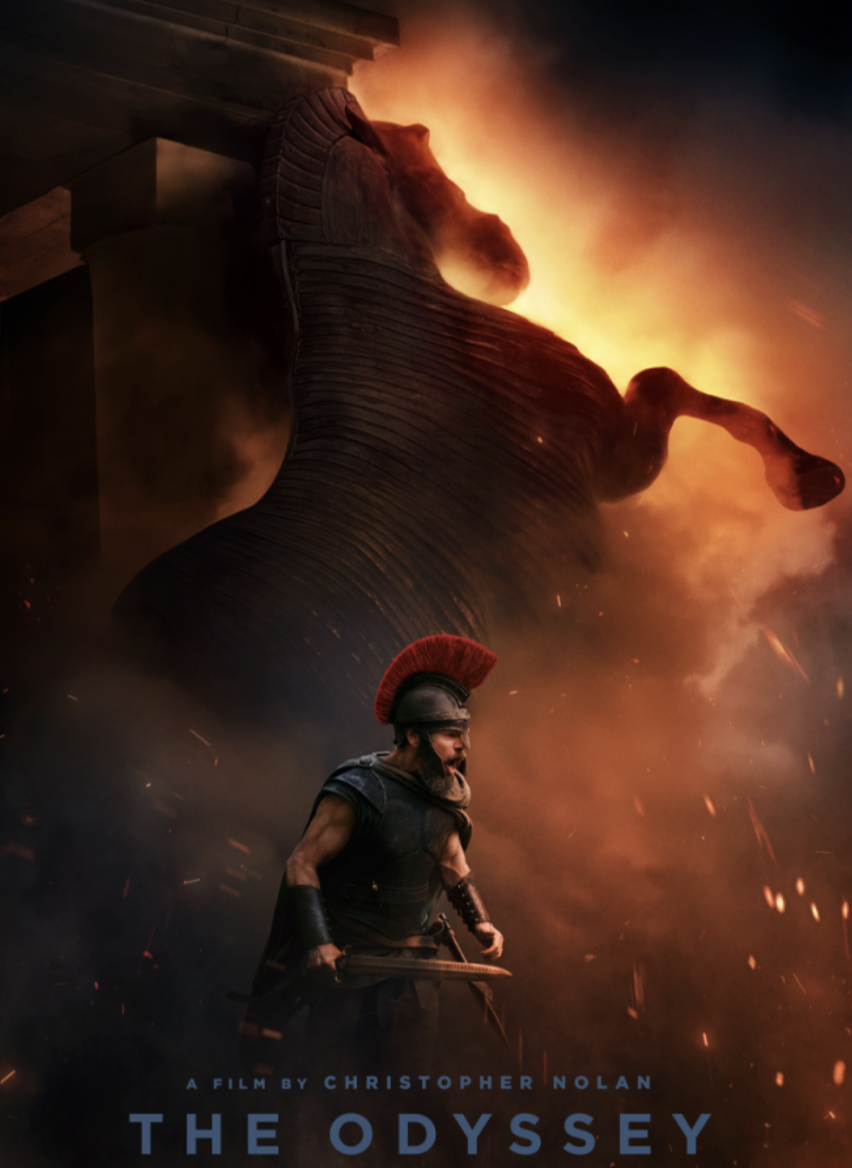
While some might have questioned why, of all the projects Christopher Nolan could have taken on after the success of Oppenheimer, he opted for The Odyssey, it makes sense when truly considering the nature and narratives of his previous work. In fact, Nolan himself remarked to Empire, “I remember seeing a school play of [The Odyssey] when I was five or six years old. The older kids were doing it. I remember the Sirens and him being strapped to the mast and things like that. I think it’s in all of us, really. And when you start to break down the text and adapt it, you find that all of these other films—and all the films I’ve worked on—you know, they’re all from The Odyssey.” Especially The Dark Knight Rises.
And certainly, many of them involve a man pining for his wife (see also: Memento [albeit in a retroactively macabre sort of way] and Inception). Even if the truth about The Odyssey is that Penelope (Anne Hathaway, now marking her third film collaboration with Nolan) is the one really pining. While Odysseus (Matt Damon) is the one out there gallivanting and ultimately dallying about coming home. This is something that Nolan’s version of The Odyssey definitely chooses to highlight, with Calypso (Charlize Theron) eventually telling him that she couldn’t have kept him on Ogygia with the assistance of the lotus flowers alone. Oh no, some part of him had to want to stay—or rather, not be ready to go home—to have been able to block out his past for so long. But Odysseus can’t fully reveal just why that is—to himself or anyone else—until the final act of the two-hour-and-fifty-two-minute movie (that’s right, it’s Nolan’s longest film to date…and a true challenge to those with a weak bladder).
That revelation turns out to be Odysseus’ unwanted admission that the men positioned as heroes are so often villains (or perhaps “mere mortals” is a less severe word choice). Particularly to those whose lives are touched and forever altered by such men directly. As Odysseus touched (read: decimated) the lives of the Trojans. Indeed, it was his brilliant idea to come up with the Trojan Horse, the tactic that led to the Greeks’ ability to infiltrate the city by being brought directly into it unbeknownst to the Trojans who naively assumed the horse really was some kind of gift from the gods. In this case, Athena (played here by Zendaya, whose presence is mostly spectral and silent—just how Nolan likes most of “his” women to be). And it is she who serves as Odysseus’ talisman both figurative and literal throughout the film, for Penelope instructs him to wear a pin she bestows so that she can always be sure it’s him that people are talking about when they give news of his whereabouts. This totem being such an indelible part of his “physical description” during the war and post-war years.
But it doesn’t seem that Athena is doing him much good, what with how many travails he goes up against on his long journey back home. And if she isn’t, maybe it’s only because Odysseus invoked some bad karma with his whole “opening up the gates of Troy to raping and pillaging” thing. Something that doesn’t often get discussed amid all the fanfare of painting him as a hero. But Nolan’s reimagining of the “heroic” character is not so heroic at all. Rather, it presents him as a man hopelessly riddled with faults and imperfections, even despite all of his intelligence and physical prowess.
Of course, that doesn’t mean that Nolan is immune to depicting Odysseus as an undeniable “benevolent soul.” This achieved through little details like how he deliberately plucks his bow loudly before trying to shoot an animal so that it can be alerted to his presence, thereby ensuring a “fair fight.” And, talking of animals, there’s Odysseus’ sweet relationship with his hunting dog, Argos, their story together playing out in the same heartbreaking way as it does in Homer’s epic. Which is to say, Argos waits all those years for Odysseus to come back so that he can properly bid his master goodbye. And when Odysseus returns to Ithaca disguised as a beggar, it is only Argos who recognizes him, wagging his tail in one last throe of excitement before at last allowing himself to die. For he has been able to carry out his final duty as a loyal dog.
Unfortunately, there isn’t much else in the way of loyalty for Odysseus to find upon his return, though, in the end, Penelope, despite outward appearances to Odysseus and certain others, is just as loyal as ever. But, as Homer’s story also goes, it takes some elaborate posturing on Odysseus’ part to put Penelope’s love to the test (as Madonna would insist upon, albeit only for women to do so with men). In the process of doing so, it seems she remains the only person he can still be completely honest with, confessing to her—still in the disguise of a beggar—that maybe Odysseus is no hero at all. Maybe he’s just a man who opened the floodgates to destruction, to a total lack of decorum and honor and, more to the point, setting a precedent for everyone to break “Zeus’ law.” A law that essentially touts what is know as the Golden Rule: “Do unto others as you would have them do unto you.” In other words, “Treat people the same way you would want to be treated.”
Such a law dictates that kindness must be extended to all strangers visiting Odysseus’ palace, no matter what their station in life. With the other caveat to this rule being that the risk of not treating people well could easily result in the revelation that it was actually a god disguised as a mortal, checking up on humans to make sure they’re acting right. Needless to say, in Odysseus’ time, it didn’t take much checking for the gods to notice that the mortals weren’t acting right at all (but then again, neither were the gods—thus, activating the hypocritical statement, “Do as I say, not as I do”). And for the first time, Odysseus himself cops to opening the Pandora’s box (to wield another Greek myth) on that front as a result of his actions during the war. Naturally, it could also be viewed as narcissistic on Odysseus’ part that he should take responsibility for all of the evils unleashed during this war. By the same token, if more men took personal responsibility for the ills they cause, the world might be a better place.
So while there is much to be discussed and dissected when it comes to Nolan’s adaptation of Homer’s epic—whether it’s the horror elements of the Cyclops confrontation, the horror elements of Circe’s (Samantha Morton) unforgettable scene during which she turns men into pigs in a decidedly body horror-oriented manner, Robert Pattinson’s A-plus portrayal of sleazoid suitor Antinous, John Leguizamo’s Oscar-worthy supporting role as Eumaeus or Anne Hathaway being cast as Tom Holland’s mother even though they’re fourteen years apart in real life—what the viewer leaves taking away most of all is that 1) Odysseus was the original imperfect hero and 2) civilizations fall, and rebuild. Time and time again. And the future generations inevitably forget about all the mistakes and levels of hubris that led to such falls in the first place, setting themselves up to endure the same fate. With or without the intervention of “the gods.”


