


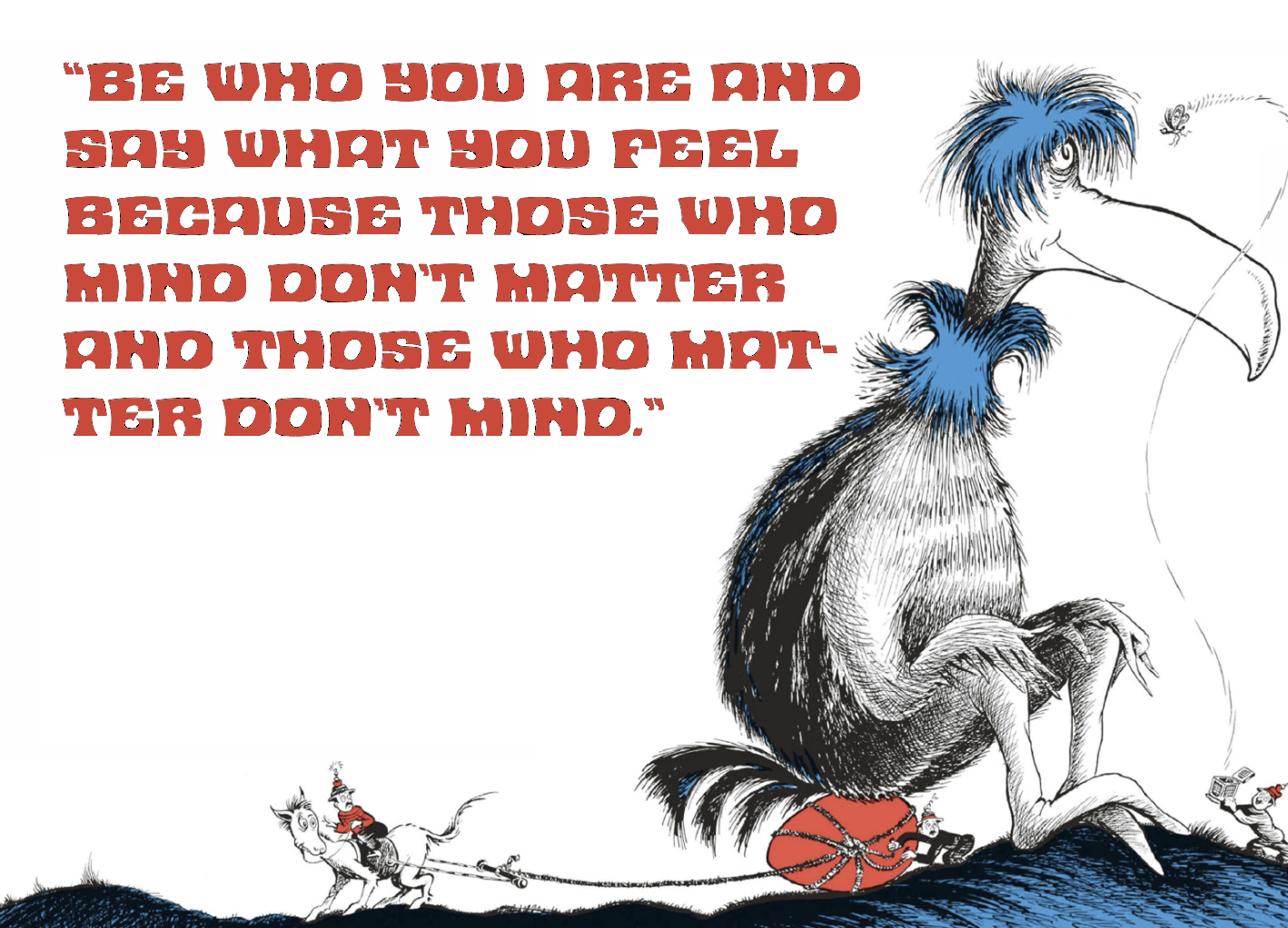
While Dr. Seuss is certainly known for many aphorisms, among his most (mis)quoted is: “Be who you are and say what you feel because those who mind don’t matter and those who matter don’t mind.” In theory, a lovely consolation to those who feel ostracized or generally “freakish.” Somehow not quite in step with the rest of society and/or the “average” person. In reality, it can easily turn into a justification for something diabolical. More to the point, for someone diabolical looking to find “like-minded” individuals to support their (often warped) worldview.
Take, for example, Eric Harris and Dylan Klebold. One person who “doesn’t mind,” after all, only tends to make sinister behavior seem normal, rational to the person desperately in search of a cohort. Someone, anyone who might feel the same. Or is at least “manipulatable” into feeling slightly similar. Or, at the bare minimum, won’t bat an eyelash at what 1950s types (here’s looking at you, Senator McCarthy) would brand as “antisocial behavior.”
Throughout history, there have been countless examples of people who just needed to find “that one” other person who “didn’t mind” their madness (therefore, “mattered”). There was Hitler and Mussolini, Bonnie and Clyde, Julius and Ethel Rosenberg, the Manson Family, the Bling Ring and so many in between. All people who were in need of another (or sometimes, multiple others) human to sanction their insanity by never calling it out as weird or abhorrent or even saying anything about it at all.
Granted, there have also been plenty of instances where the supposed Seuss aphorism has applied to friends or lovers in a positive sense. Like Jung and Freud (though some might argue that the “expansion” of psychology has actually made the world a more terrible place) or Marie and Pierre Curie. However, by and large, whenever this quote “works” on someone, it tends to be for evil. Only adding to the irony that it’s so often misattributed to Dr. Seuss, beacon of love and light, so to speak. In truth, the quote more credibly belongs to Bernard Baruch, a financier and political adviser to both Woodrow Wilson and Franklin D. Roosevelt. And, of course, a millionaire would say something like that, wouldn’t they? Especially back in the days when they had a greater sense of wit (not like the modern billionaires of the moment, Jeff Bezos, Mark Zuckerberg and formerly Elon Musk [now a trillionaire]).
Because, in all honesty, being grotesquely rich does require such thinking. To genuinely believe that the evil which money-making entails is immune to judgment or backlash. That anyone who “minds” simply “doesn’t matter.” And that much has been made apparent repeatedly over the centuries as rich people (primarily men) continue to steamroll anyone and anything that gets in their way. That doesn’t “agree.”
As for the nebulousness of where this saying truly originated, there’s also speculation that the antimetabole has been around since at least 1938 (which would have been a prime of Baruch’s career, despite already being sixty-eight years old at that time). According to Quote Investigator, “The phrase was used comically [in a London-based journal] to discount the criticisms directed at housing designs.” Then, in the 1940s, “the expression was used in two popular anecdotes [written in magazines] about seating arrangements at parties.” So popular, it seemed, that it seeped into the culture enough to need “attribution” to someone.
That someone, in 1946, became Baruch, who was credited with saying it in a more “official” capacity to gossip columnist Igor Cassini. For, as Quote Investigator also dredged up, “Igor Cassini was acknowledged for telling the story and for participating in the dialogue,” then quoting from an article in which it is stated, “B. Baruch, who entertains so many notables, was recently asked by Igor Cassini how he managed the seating arrangements at his soirees. ‘I suppose it’s really very difficult to put the guests in their correct places,’ commented Mr. C. ‘Not at all,’ stated the elder statesman. ‘Those who matter, don’t mind. Those who mind—don’t matter!’”
Thus, this aphorism is fundamentally embedded within the culture of the rich (for even if Baruch didn’t say it/come up with it to begin with, the quote’s previous application to housing design and seating arrangements is part and parcel of the trappings of “affluence”). Which is possibly the foremost reason why broke-ass “nutters” ought not heed it as advice to help sanction their own folly.
Then again, perhaps the rich have only “asked for it” by disseminating the expression into the larger culture. Ergo, yielding outlaw couples, mass shooters, serial killers, etc.—people who are so disaffected with the inequitability of things (yet not seeming to realize that’s what truly ails them) that their version of “acting out” with others who “don’t mind” is almost like a form of cosmic “recompense” for the existence of this phrase, helmed by the upper crust and those catering to them. Which evidently includes Dr. Seuss…depending on who you ask.


